
Can Bad Decision-Making Be Avoided?
Leaders have never had more information to make decisions with. Yet bosses are rarely trained in decision-making.


March 25, 2026
It’s safe to say that corporate success has always hinged on the decision-making of executives. Leadership is a constant fire hose of choices: which strategy to pursue, how to navigate risky markets, how to handle a delicate HR situation, what to say in a speech, what not to say in a speech. It’s also safe to say that most people in corporate America struggle to make good decisions—but won’t admit it.
Despite billions spent training leaders, 85 percent of mid- to senior- level professionals have never received training in decision-making, and 45 percent still do not have a structured way to make decisions (yes, you’re supposed to have a framework), according to a new report from the Global Association of Applied Behavioural Scientists. “Decision-making is one of the least systematically taught skills in corporate life,” says Usha Haley, a distinguished professor at Wichita State University, and she says this is a critical failing as AI complicates decisions with constant information overload.
Despite this, 91 percent of professionals consider themselves to be above-average decision-makers, which further compounds the problem: People who think they’re good at something don’t seek training. Typical mid- to senior- level employees make hundreds of decisions every week, and believe that they’re generally making good choices—which is classic outcome bias, i.e. judging by the results rather than decision quality. In reality, experts say, employees’ complete lack of decision-making training prevents them from accurately assessing their own skills. Addressing this is “one of the challenges of performance management,” says organizational strategist Maria Amato, senior client partner at Korn Ferry. When rated against other employees, “most people are going to feel unfairly rated, almost definitionally.”
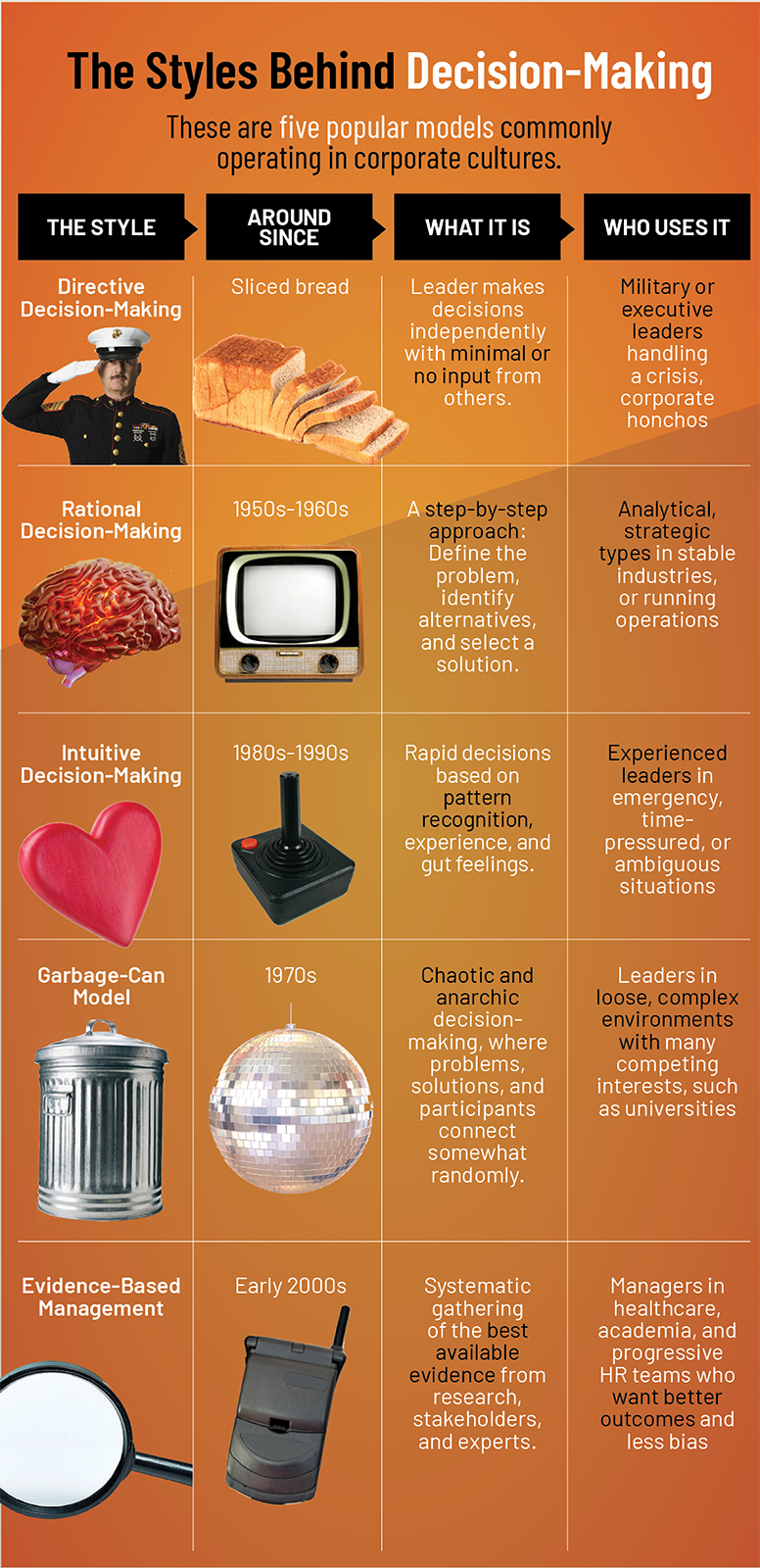
So what are workplace decision-makers doing wrong? A lot. Few use structured frameworks for analysis, and instead most rely on heuristics that oversimplify the situation, allowing them to fall prey to a suite of biases, such as making choices that align with their initial impressions, continuing strategies with high sunk costs, and maintaining the status quo. Most are fundamentally approaching decision-making as a task of deciding what to do, rather than a process of deciding how to achieve something. “Organizations confuse having answers with making decisions,” says Joe Lalley, a workshop facilitator in design thinking, a problem-solving methodology. Companies reward speed and certainty, rather than the exploration, perspectives, and cognitive diversity that fuel smart decisions. Good decisions often involve curiosity and listening to frontline employees, Lalley says, but “too often, hierarchy and expertise get in the way.”
In the world of AI, companies will need to train decision-makers to be ready to implement contingency decisions, which will be readily suggested by the technology. “Plan B is just as important as the initial decision,” says Nicholas Grigoriou, a lecturer in marketing at Monash University. Yet all too often, especially during corporate crises, firms fail to test or put in place their “what to do if X happens” action plans. And let’s not get started on group decision-making, which despite being rarely taught, makes up the majority of corporate decisions. (Individual decision-making receives the lion’s share of academic research and theorizing.)
Experts advise that strong decision-makers gather frameworks for likely scenarios. For example, one popular approach, taught by the Markkula Center for Applied Ethics at Santa Clara University, walks decision-makers through 10 steps, including identifying the ethical issues at hand (e.g., “Could this decision be damaging to someone or some group, or unevenly beneficial?”), gathering the facts, evaluating alternatives, testing and implementing the leading choice, and reflecting on the outcome. Notably, post-decision steps, which usually fall by the wayside in corporate settings, are part of the process. The framework is not an algorithm: Rather than automatically selecting the best choice, it allows the decision-maker to do so, working from a strong base of information. And yes, make the excellent decision to get some training ASAP.
Photo credits: DNY59/Getty Images; Rubberball, Dev Images, Ruslanas Baranauskas Photo Library, Peter Dazeley, Liudmila Chernetska, Hallopino, Charlie Drevstam, Kutaytanir, Mohamad Faizal Bin Ramli, Eduleite/Getty Images
