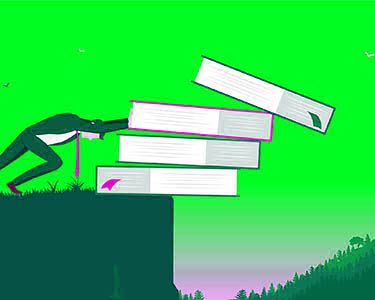
How AI Could Produce ‘Cruel Optimism’

AI could be a fantastic tool, but best-selling author Dan Goleman worries that business leaders are expecting it to solve problems that only humans can fix.
Daniel Goleman is author of the international best-seller Emotional Intelligence and Optimal: How to Sustain Personal and Organizational Excellence Every Day. He is a regular contributor to Korn Ferry.
There’s a phrase introduced in Johann Hari’s book Stolen Focus, a wide-ranging exploration of why attention is deteriorating in modern life and what can be done to reclaim it. The phrase is “cruel optimism,” a term coined by cultural theorist Lauren Berlant. It describes a painful dynamic in which we attach ourselves to something that promises a better life, only to find that the attachment itself blocks our flourishing.
Cruel optimism often happens when we take a massive structural or systemic problem and try to solve it with a shiny, simple, individual solution. The intervention sounds hopeful and actionable, positioning the problem as within our control. Two great examples are the diet industry and an obsession with productivity hacks. Instead of looking at our deteriorating food systems or an insidious culture of burnout and overwork, we put the onus on the individual to eat better and manage their time more efficiently. In doing so, we turn away from the deeper causes of systemic issues. And then, when the solution fails, people blame themselves for not having enough willpower.
AI is increasingly positioned as the answer to everything. Overwork? Automatation? Loneliness? AI companions. Skill gaps? AI copilots. Leadership strain? Decision-support tools.
The message is clear: Use AI well and your problems will shrink.
There is, of course, some truth here: AI can increase efficiency, surface insight, and carry on a conversation for endless hours. But a new form of cruel optimism may be taking hold when organizations face structural issues such as toxic workloads, low trust, unclear strategy, and misaligned incentives, and respond by layering AI tools on top. The organization is trying to apply a technological solution to what is fundamentally a human-systems problem.
Cruel optimism works because the fantasy feels possible. AI is real, impressive, and produces fluent output that can feel like rapid progress. But most organizational struggles are not problems with tools. They are meaning problems, trust problems, culture problems, and leadership-capability problems. While AI can be part of a solution, it is not the solution in itself.
When AI is framed as the fix for deeper fractures, two things can happen: The structural problem remains and individuals begin blaming themselves for not leveraging the tools well enough.
If employees feel overwhelmed, they are told to automate better. If teams are not innovating, they are urged to prompt better. What disappears from the conversation is whether the workload is realistic, whether expectations are coherent, or whether the culture allows for experimentation without punishment. Instead of the system taking responsibility for change, cruel optimism shifts responsibility downward. It puts the burden on individuals to manage the situation and make it better.
This is not an argument against AI. It is an argument against a subtle failure of attention.
The leadership concept of Triple Focus describes three critical domains of attention: inner focus, other focus, and outer focus. Inner focus strengthens self-awareness and self-management. Other focus builds empathy and relational intelligence. Outer focus expands systems thinking and contextual awareness.
Cruel optimism takes hold when outer focus collapses. Leaders concentrate on individual behavior and tool adoption while ignoring the broader systems shaping outcomes. They optimize prompts but neglect culture—and accelerate output while overlooking trust. Without systemic awareness, technology becomes a distraction from structural redesign.
The opposite of cruel optimism is not rejecting technology but rather restoring balanced attention. Mature leaders can distinguish between a tool gap and a human gap. They can look beneath surface symptoms, see the roots of a widespread issue, and invest accordingly.
The alternative is not cynicism but sober hope. It is the willingness to acknowledge that some problems require redesign, not acceleration, and that no technology, however advanced, can substitute for trust, clarity, and the human connection on which leadership ultimately depends.
Co-written by Elizabeth Solomon
Click here to learn more about Daniel Goleman's Building Blocks of Emotional Intelligence.