


It was going to give those in the most time-intensive jobs, from investment banking to law and medicine, a break from a crushing workload. Office workers were going to get more time for creative duties, now that artificial intelligence was here and removing routine and repetitive tasks. And for leaders of firms, the shift was finally going to justify the millions of dollars they’d invested in this once-in-a-generation technology.
But look at official productivity numbers, or talk to anyone in these fields, and you probably won’t observe much change in working hours. Indeed, we’re a few years into the AI onslaught, and things aren’t substantially different for most professionals. Sure, the technology has cut the time—by as much as half—workers spend scouring documents and drafting memos. Yet work hours in 2026 look very much like they did in 2019. “I have yet to talk to anyone who has cited AI as reducing their hours,” says Karena Man, senior client partner in the Technology and Digital practice at Korn Ferry.
If it feels like you’ve seen this movie before, it’s because you have. Call it the Return of the Productivity Paradox. Back in 1987, economist Robert Solow aptly noted that the computer age was evident everywhere except in productivity statistics. At the time, the prevailing assumption was that computers would improve productivity. In practice, this did not happen for over a decade, and in the interim, as professionals became more efficient, their bosses’ expectations soared, with the result that aggregate hours were unchanged. Productivity improvements from computers did eventually appear, but not until the late 1990s.
Today, just as they were back then, efficiency gains are unevenly distributed. AI is strongest where the workload is dominated by research, summarization, drafting, reviewing, and documentation, says AI-organization-design expert Ryoji Morii, founder of Insynergy Inc. “I would expect the biggest AI-driven reductions in hours to show up first in law, and then in documentation-heavy areas of medicine,” he says. In other fields, AI might compress parts of the workflow, but long hours will remain, because they’re fueled by other pressures, such as real-time deals or client responsiveness.
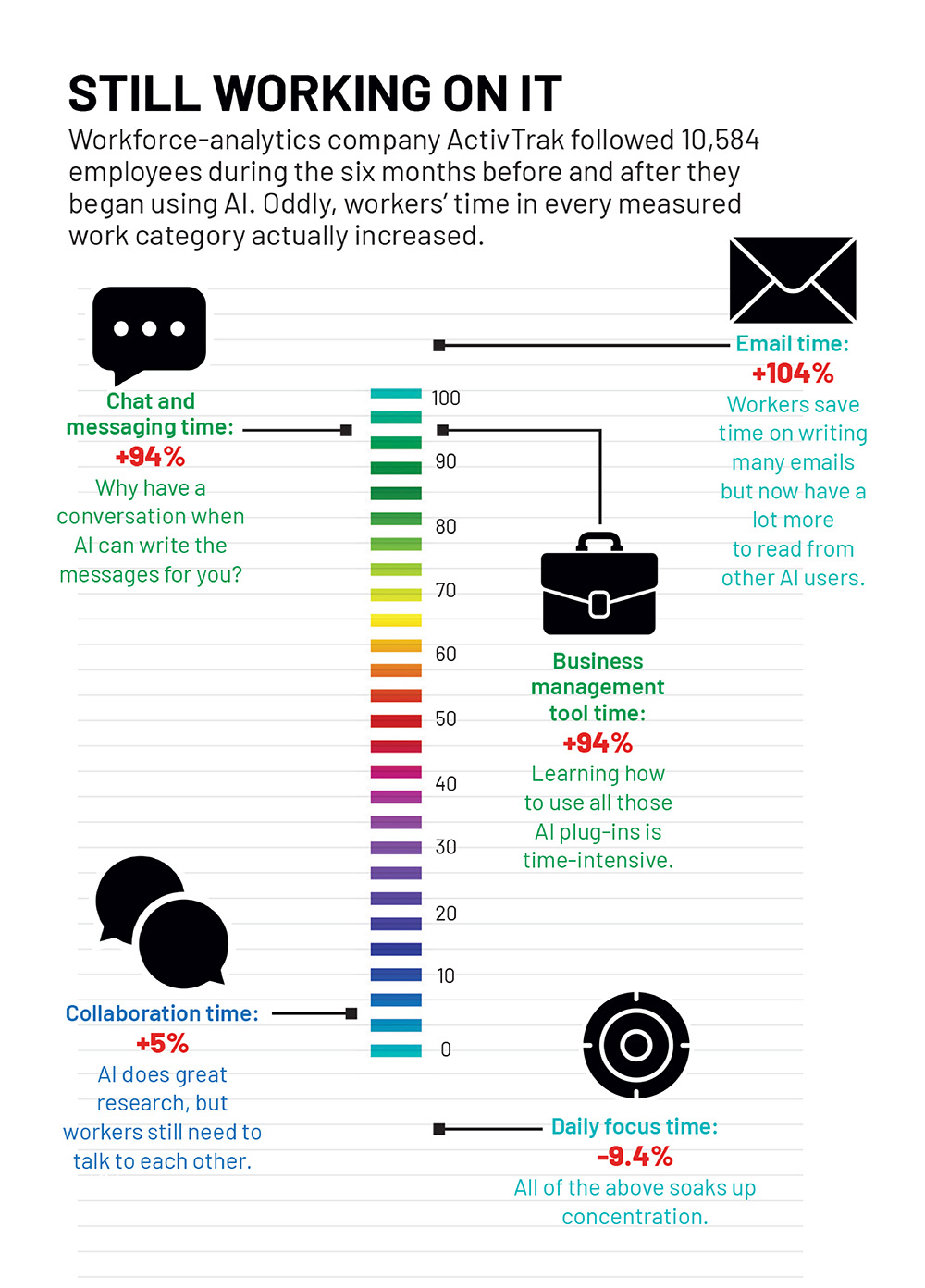
To be sure, overall productivity figures are up slightly, by 2.8 percent, according to the Bureau of Labor Statistics—but not as a consequence of AI. A study by workforce-analytics firm ActivTrak following 10,584 workers in the six months before and after AI adoption found that work time increased across every measured category, such as email and collaboration. Meanwhile, average focus time decreased by 9 percent.
The overall hours of corporate roles, it turns out, do not suddenly shrink. With or without AI, a 44-hour-a-week job is still a 44-hour-a-week job. “Capturing time savings requires redesigning jobs,” says Bryan Ackermann, head of AI strategy and transformation at Korn Ferry. “We’re finding that that’s not happening organically.” Historically speaking, firms have rarely been incentivized to lower the weekly hours of salaried staff. For instance, this same pattern emerged in the 1980s and 1990s: Companies that bought computers and continued operations as usual did not see gains. The firms that did see gains rebuilt their workflows around what computers made possible, then restructured their organizations and retrained workers.
At this juncture, experts say, leaders shouldn’t expect workers to have a ton of free time to explore more projects. Instead, they should focus on helping employees improve their use of the technology. Patience will be critical here until AI can branch out into other duties. In the meantime, for professionals whose work is not document-driven—i.e., most employees—the long hours will continue. “An investment banker still needs to sell you their idea in person, on a road show,” says Guillermo Triana, founder of HR outsourcer PEO-Marketplace.com. “And you cannot outsource a knee replacement to ChatGPT.”
