

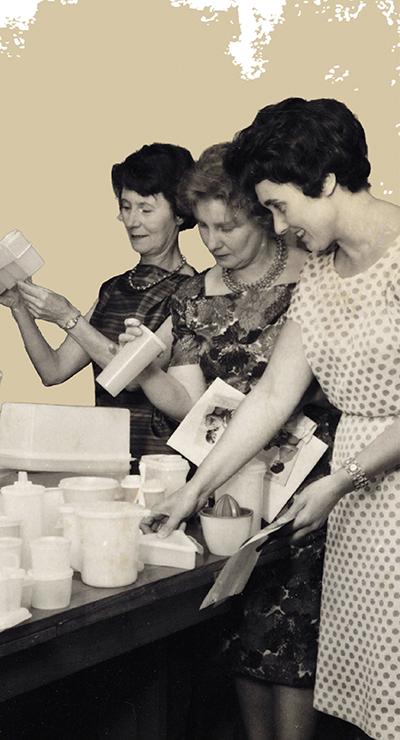
It was a staple of American suburbia in the 1950s and 60s: small parties of housewives selling plastic food-storage containers that could “burp” out the air to seal in freshness. It was often a fun afternoon affair. But behind all these events were women who were becoming entrepreneurs, and behind them, an iconic company that would ultimately end up in bankruptcy court.
The story behind Tupperware is the stuff of business legend. In the years just after World War II, Earl Tupper, an inventor who envisioned himself a modern-day Leonardo da Vinci, molded some polyethylene plastic beads from DuPont into the first of his Tupperware bowls. He founded Tupperware Plastics, and began selling his new products in department stores, including a showroom on New York’s Fifth Avenue.
But sales were disappointing, so he shifted gears and embraced a new model: home merchandise parties for housewives and their friends, where they could touch and feel products at home before buying them.
Brownie Wise, a single mother with no business background, had started hosting Tupperware parties in her Dearborn, Michigan, home and her business was booming. When Tupper heard about her sales prowess, he hired her in 1951 to become head of sales for his nascent company, and Wise wasted no time building a marketing empire. The key to the concept was training and deploying a small army of amateur saleswomen across the country to host parties and recruit more women to sell the products.
As the postwar economy in America boomed, Tupperware soared. Women, who were largely excluded from the workforce, could earn a steady income without becoming teachers, nurses, or secretaries. For its part, Tupperware saw its sales grow steadily, earning $1.37 billion in revenues in 1996 and peaking at $2.67 billion in 2013. But trouble was on the horizon.
As the new millennium approached, women both at home and abroad were holding full-time jobs and working the same hours as men. They had children to raise, and they had no time to hold or attend Tupperware parties. The company, according to Angel Martinez, a longtime former Tupperware board member and former CEO of several footwear companies, didn’t see the erosion of its sales model coming. It turns out that “the model was hard to sustain,” Martinez said.
Meanwhile, competitors such as Rubbermaid and Glad, selling via Amazon and in retail stores, had grabbed chunks of the market selling lower-priced, lower-quality alternatives. Adding to Tupperware’s woes was a growing perception among consumers that all plastic containers were hazardous. Then the pandemic seemed to seal the brand’s fate.
As sales plummeted and Tupperware’s debt soared past $700 million, the company filed for bankruptcy and was sold in 2024 to a group of lenders. The group, Party Products LLC, couldn’t be reached for comment, but has said in press accounts that it plans to revive the brand. But the party of a past generation seems to be long over, which Martinez saw as a warning sign: “You have to keep up with how consumers want to buy your product.”
