
The Ugly Phase: Can You Survive It?
Some 37 million workers will likely need to shift careers soon because of AI, and experts say it may be the hardest thing they ever go through.


May 28, 2026
Shari Solomon Cedar didn’t think she’d ever leave her career in media production, which had led her to the upper echelons of reality television. “It was not just a job, but part of my being,” she says. She worked from sunrise until her head hit the pillow as the executive producer of shows like The Real Housewives of Atlanta. But then came marriage and family life, and her perspective shifted.
THE PROBLEM In record numbers, workers are being forced to give up lengthy careers to start over.
WHY IT MATTERS Firms will be far short of the skill sets they need if people don’t transition.
THE SOLUTION Explain the difficulties to employees and help guide them as they change fields.
Maybe she could find creativity in something other than media. So when her husband floated the idea of giving up their corporate jobs to build a family business, she didn’t say no. She told her friends, “I’m moving to South Florida to start a commercial cleaning business.”
This news did not land well. Friends asked if she had really thought through her plans, and “my parents had a heart attack.” Cedar and her husband purchased a tiny cleaning service, banking on his familiarity from growing up in the industry. The company expanded through acquisitions and client growth, and today AK Building Services is one of the largest privately owned companies in Florida.
“I have to trust in myself, in my path, and in my excitement—and let my ego go.”
As with most career-shift success stories, the details of the transition tend to get papered over. Shari didn’t, in fact, jump right from TV to cleaning; she moved to Florida, where she continued working in television for years until she burned out, while her husband bootstrapped the business. Her decision to work with him was neither automatic nor intuitive. (When she told him that she’d show up if he gave her an office, he said, “I’m not wasting money.”) She calls her career transition a “long and complicated story.” When she did finally make the leap, “it was humbling. I had to earn credibility by being quiet and listening and earning the respect of colleagues.” She’s now CEO.
We’ve all read tales of career transitions. Roughly 30 percent of US workers change jobs every year—some 50 million people. Whether it’s a leap from one company to another, or one career to another, the difficulty of those years of transition—and it is years, not months—is often swept under the rug. With all the trainings, new knowledge, old cliques, confusing acronyms, plus the grinding overlap of jobs and studying... very late nights or very early mornings inevitably ensue.
Apparently, psychologists don’t have an official term for this period, but they do describe it as extremely challenging. “A midlife career shift is a big identity reset,” says Cathleen Swody, an industrial/organizational psychologist and managing partner at Foster Talent Consulting. When someone becomes a novice again, the signals that once reinforced competence, status, and belonging disappear, creating a loss of validation and dip in confidence. “There are feelings of disorientation and unsteadiness, even when the career change is positive,” she says. Laypeople have their own apt name for it: the ugly phase. And most experts agree that people are going through this phase a lot more often, and that it’s getting uglier. Artificial intelligence has landed with an enormous thud, right smack in the middle of the workplace. Thousands are getting laid off, plunging them into a new ugly phase if they manage to find work. Those who are not let go are being forced to retrain quickly and complete a professional makeover at lightning speed.
The Key Stages of Workplace Development
Every career has a shape—a series of phases that, when viewed from afar, follow a surprisingly universal arc. Our experts have assembled a field guide to those phases, from the humbling first job to the retirement question few have figured out.

The Warm-Up: Ages 16-22
This is the job you will describe at cocktail parties for the rest of your life—and also the reason that you will never, ever set foot in that fast-food or clothing chain again. This gig has nothing to do with where you are going, but builds key skills like showing up and not matching your patrons scoop for scoop. Roughly a third of teenagers hold a job, according to the Bureau of Labor Statistics, down from over half in the 1980s.

The Relationship Ups and Downs: Ages 23-34
You have the energy, the ambition, and none of the context. These are the years of learning how to work and play with others, even if this is not obvious to you at the time; you falsely believe that your work is the focus. A few slips and slides ensue: Workers between the ages of 25 and 34 hold an average of 4.5 jobs, according to the BLS.

The Climb: Ages 35-40
The path has narrowed, the stakes have risen, and now you speak up when you spot a meeting about a meeting on the schedule. It’s slowly dawning on you that the ladder you’ve been climbing might not lead to personal happiness.

The Reckoning: Ages 41-46
Here it is. The corner office is either coming into view or… it’s not. Either way, you’re coming to terms with it. In psychology-speak, you’re either turning toward growth and development, or stagnating in a job and life you mastered during the previous Trump administration. For some, this means a new career route and the humbling experience of becoming a beginner again.

The Second Round: Ages 47-59
You matter. Your comfort in your chair and shoes matters. You’re done pretending that it’s OK if you only got four hours of sleep last night. You’re able to tolerate woefully boring colleagues and undesirable work tasks because you no longer tie them to your identity or self- esteem. In this phase, whether you’re logging hours to support a family or taking it easy, your eye is on the ball.

The Debate: Ages 60-75
Should you retire? And if so, when? And what is “retirement” in a country where half of people 55 and older don’t have any retirement savings? You’re in good company: 38 percent of people over 65 work at least part-time, according to BLS data.
A recent survey by AI Resume Builder found that nearly six in 10 firms now require employees to use AI, and one in 10 will fire them if they don’t. In all, a study by the Brookings Institution estimates that 37 million workers in the US alone are “highly exposed” to AI shifts. In other words, they are holding jobs that are unlikely to survive the AI wave. Whether they know it or not, this legion will be stepping right into the ugly phase, and in numbers that are without precedent in labor history. Indeed, people enjoying roles in finance, graphic design, software engineering, and a host of others—people who worked hard to build their careers—will have to scour the job market to find more secure roles and rebuild again. The question is obvious: How will they handle it? Is it possible to not just survive, but thrive?
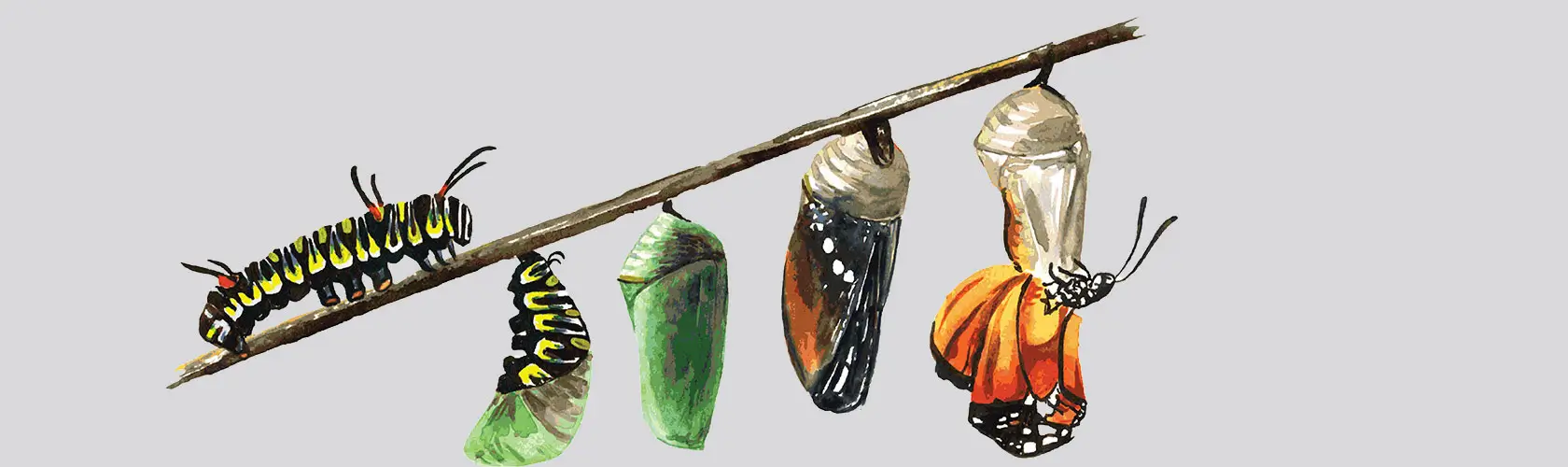

Career leaps do not have a long history. At the turn of the 20th century, the average life expectancy was 47 years, leaving most professionals feeling lucky that they got one career in. People typically entered a trade or profession in their youth, and died in it. When US life expectancy reached 68 in 1950, thanks to vaccines, sanitation, and modern medicine, the two added decades brought on the possibility of reinvention.
Yet for nearly the entirety of the century, reinvention was neither expected nor encouraged. Instead, the postwar period produced a golden era of corporate employment in which workers stayed with the same firm for their entire career—“from cradle to grave,” as the saying went. An entry-level job at a big corporation was seen as a ticket to the middle class, thanks to widespread policies of promotion from within. As financial historian Richard Sylla of New York University’s Stern School of Business has noted, companies were able to be generous with employees because international competition was limited: Following World War II, many economies and companies were rebuilding. Firms showered appreciation on employees, and jumping ship was not just uncommon in most fields, but also seen as a red flag.
Under economic pressure from abroad, along with inflation, the cradle-to-grave ethos began to crack in the 1970s and 1980s. Corporate downsizing brought an end to the promise of lifetime employment. With that shift, employees began to forge their own paths. By the aughts, career transitions were both a norm and (often) a choice, rather than a necessity. The average American worker now changes jobs 12 times during their career, spending an average of 3.9 years at each one, according to figures from the Bureau of Labor Statistics. A term like “gig economy” is part of the work world’s fabric.
Even with all the shifting, though, a career still has some important junctures. Forks in the road. “No turning back” times. According to figures from Indeed, the biggest career shifts happen at around age 39, a moment at which workers are clear-eyed about their professional prospects and can see the finish line—and decide whether they want to cross it in their current industry or another one. And they likely have enough money in the bank to support such a transition. (Fifty-eight percent of workers are willing to accept a large pay cut in pursuit of a new career path, according to the same report.) Online and hybrid graduate-studies options expanded substantially during the pandemic, and have been sustained, which has allowed workers who couldn’t previously consider a major shift—such as working parents or people with corporate hours that curtail their availability for in-person classes—to consider big leaps.


About the ugly phase: The challenges come in many flavors and dimensions, but tend to involve three themes: learning a new workplace on the fly, juggling multiple jobs and/or trainings, and a loss of identity. Nearly all job shifters find themselves in a completely new workplace. “The bigger the brand or marquee quality of the company, the more difficult the transition,” says David Vied, global sector leader for medical devices and diagnostics at Korn Ferry. Perhaps the employee has been a customer of the company, or has seen decades of their commercials, so they come to the interview with a preconceived notion of the business and culture. Yet the public image of a company is often very different than its internal reality. For example, a company prized for engineering and technology innovation may espouse a check-the-box, by-the-rules internal culture; a company famed for its creative marketing might, internally, be all about salesmanship; a start-up known for moving fast might also require its employees to repair their own printers. As a rule of thumb, the preconceived notion is “never the reality once they join,” says Vied. This is partially why roughly a third of job shifts fail.
“It was humbling. I had to earn credibility by earning the respect of colleagues.”
Big leaps also involve new identities, which is the main reason people tend to stumble. “The transition has been hard,” says Lisa Tong, former executive director of global finance and strategy and transformation at Estée Lauder, where she worked for 11 years. These days Tong is in Toronto, studying to become a doctor of traditional Chinese medicine, which she chose after spending her entire adult life following the parentally and societally approved track of an engineering degree and corporate career. The achievements that she thought defined her no longer do, so she struggles at social gatherings with the simple “so what do you do?” questions from neighbors. “It’s been a complete ego breakdown,” she says.
To make it work, she’s navigated financial tradeoffs, including a simpler lifestyle of careful spending and no more fancy vacations. She has dipped into her retirement fund, using the logic that she’s investing in herself and can make more money later—because, critically, people who love their jobs don’t want to retire at 65. For someone who aggressively climbed the corporate ladder, these challenges are more psychological than logistical. “I have to trust in myself, in my path, and in my excitement—and let my ego go,” she says.
And then there’s the mountain of new information that needs to be absorbed. Typically, most transitions into new fields take around three years. From 2021 to 2024, Olga Valadon worked three days per week as a chief of staff at Deloitte, while spending the other two days boning up on how to launch her leadership-development company. She needed to learn not just entrepreneurship, but also how to deliver the services of the business she was building. To that point, she’d spent a quarter century in roles where someone else handled IT systems and payroll. “That was a totally new mindset,” she says. “At the beginning, it’s easy to focus on what’s been lost, rather than the opportunities ahead.” The danger, for her, was the temptation to give up quickly and return to full-time work. She held on.
“People used to call this a midlife crisis, but it feels like a midlife solution.”
A common second career is financial planning, which favors people with the life experience to understand both the financial markets and career trajectories (clients often want a planner who “gets” their life). The Certified Financial Planner certification requires a progression of a half dozen courses over 18 months or more, an exam, and thousands of hours of on-the-job experience. For Aaron Bosch, a father of three in St. Louis, it took two years (while he continued coaching his kids’ sports teams), followed by a test-preparation course that required four to five hours of daily study over a short period. He often found himself reading textbooks in parking lots, both before and after games, while his kids played baseball. As with most new careers, speeding through it was not an option, he says: “I like to learn things right away, and I had to realize that there’s no replacement for experience.”
Yet despite the sacrifices they’ve made—the late nights and dry textbooks—those making major shifts are quick to affirm their pride in what they’ve done. “It’s really hard to have my kids tugging on my arm,” says Nathaniel Allenby, 42, who returned to school to become a psychotherapist while managing the live-entertainment company he founded, Cirque Quirk, which provides pre-produced shows to clients like SeaWorld. “People used to call this a midlife crisis, but it feels like a midlife solution.”
Career hoppers who make it to the other side of no-man’s land tend to offer similar advice. Whatever the industry, the emotional geography of taking a leap is surprisingly universal. Nearly all the career hoppers describe a moment of near-surrender, followed by the resolve to stick with it. Signs of success might not appear for months or years, and it’s not always clear where things are headed. “It’s no longer a career ladder,” says Cedar, the former TV producer. “It’s chapters.” Some of those chapters get very messy.
And within each chapter, it’s critical to surround oneself with people who know more. Cedar keeps what she calls a personal board of directors: Her running partner is a successful female CEO, and her mentor is legendary in the cleaning business. She bounces things off them regularly. The goal is not cheerleading, but rather enlisting the perspective of people who have survived the ugly phase—people who can distinguish between a setback, a dead end, and someone who needs a nap.
The ugly phase, it turns out, is the road itself, not a detour. Yes, there’s more sleep on the other side. But the ability to tolerate that disorienting in-between is, in fact, the most valuable professional skill of our age of AI and globalization. One arrives on the other side with a career worth having; not despite the no-man’s-land, but because of it. “It’s fascinating to me that I could make such a hard turn in my career and be happier,” says Cedar.
Image credits: May Lim/Getty Images, Daria Ustiugova/Getty Images, Daria Ustiugova/Getty Images, Enaga/Getty Images
