Workforce 2026 Survey: Crucial Insights for Industrial Leaders
Industrial workers reveal their thoughts in Korn Ferry’s global survey, showing a disconnect between leaders and workers that’s stalling growth. Here’s the fix.

The next phase of growth in the manufacturing and industrial sector won't be won by technology alone. You need a workforce ready to adapt and innovate.
Is the workforce ready? That’s what Korn Ferry’s Workforce Survey 2026 aimed to find out.
The results are promising. It found industrial and manufacturing talent want to:
- Experiment with new technologies
- Build skills for the future
- Improve how work gets done
Yet our survey also shows that many workers don't feel they're being given the support to do so. That points to a gap between leadership priorities and employee experience.
“Industrial and manufacturing organizations are understandably focused on solving today’s challenges,” says Dave Rossi, president of Korn Ferry’s Global Industrial Market. “But the issue we’re seeing now is that they’re underinvesting in tomorrow’s growth.”
Here's what these findings mean for your business and how to respond.


Workers Want More Freedom to Experiment
Many of the biggest gains in industrial manufacturing come from frontline workers finding safer, faster ways to do the job.
Fostering a culture of experimentation enables just that. It allows people to solve problems and streamline daily processes.
But many industrial workers feel they’re not getting the support they need to make that happen. Fewer than half say they’re encouraged to try new ideas and technologies.

That’s a missed opportunity. When workers feel they don’t have permission to experiment with new systems, they may simply revert to familiar processes—limiting what the technology could achieve.
Rossi says organizations that treat employees as partners in transformation are more likely to accelerate technology adoption.
“When leaders create an environment that encourages workers to solve complex problems, they foster a greater sense of ownership over change,” says Rossi.
“That way, people feel that the change is being done with them and not to them.”

Technology Adoption Is Outpacing Skills Development
Half of industrial workers don’t think they're getting the training they need to develop their AI and automation skills. And many aren’t confident their current skills will remain relevant over the next three years.

As technology takes on more routine tasks, industrial and manufacturing employees need development that strengthens the human capabilities machines can't match.
“One manufacturer I worked with found its most experienced operators could detect equipment problems simply by the sound and smell of the plant—critical judgment no AI system could replicate,” says Rossi.
People also need to feel confident they have the skills to succeed in what's next.
“Leaders must help their people understand how the work they do now will change in the longer term,” says Rossi.


Efficiency Drives Are Stifling Innovation
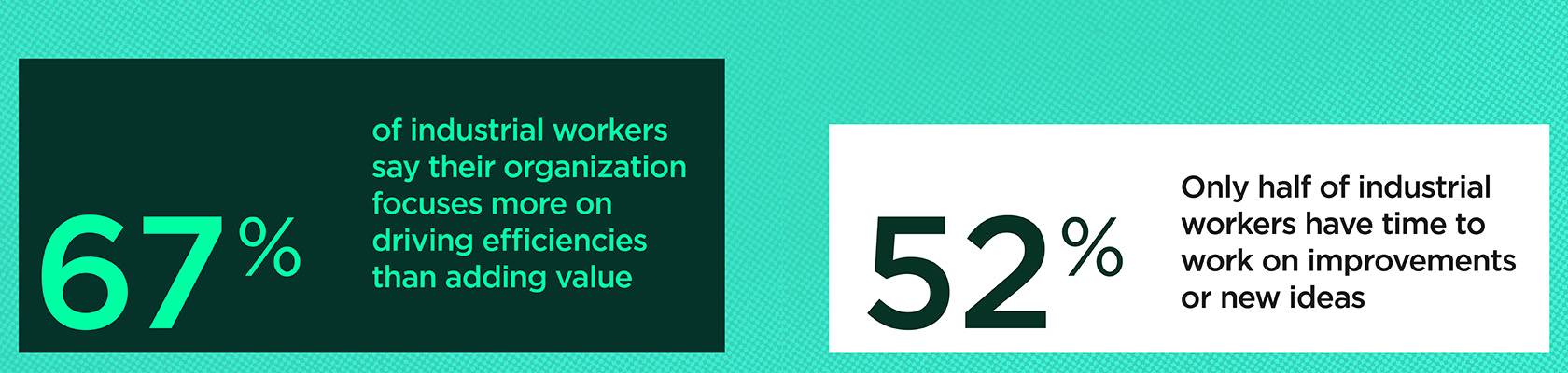
Most industrial workers say their organization focuses more on driving efficiencies than on exploring innovative ways to add value.
But it’s innovation that powers growth. Successful industrial organizations will use efficiency improvements as a platform for the next round of innovation.
“Efficiency drives shouldn't end with the target being met,” says Rossi. “That’s the moment to ask, ‘What do these efficiency savings now make possible?’”
Take the vehicle plant that introduced automated changeovers to its car-parts die-stamping equipment. While the new system reduced machine changeover times, productivity stalled for the teams working alongside it because their daily processes stayed the same.
It was only when they looked at how the team operated with the new automation, and what else could be achieved with the time saved, that the plant realized the technology's full value.
“When leaders treat every efficiency gain as the starting point for the next one, continuous improvement can become part of the culture,” Rossi says.


Why Korn Ferry for Industrial?
No one understands industrial talent like we do. Our expertise spans advanced manufacturing, energy, infrastructure, supply chain, and logistics.
We go beyond hiring to help industrial organizations build high-performing teams—from plant leadership and operations to engineering, digital, and supply chain roles. Our work is informed by real-time market data, reflecting the realities of automation, decarbonization, and global supply chain transformation.
That’s why leading industrial companies trust Korn Ferry to drive performance and sustainable growth.
Find Out More
To find out what industrial workers think and how to use these insights to grow your business, get in touch with our team.