If Everyone Has AI, Who Has the Advantage?

Three in four organizations expect AI to change their business model. Only 6% have redesigned work around it.
In 2023, we asked more than 240 CEOs and senior executives how they view generative AI. They told us it would reshape business without erasing the human role: 82% expected an extreme to significant impact, and 44% said their people would need new skills. We concluded that winning in the AI era meant keeping humans central to its integration.
Three years later, in 2026, the redesign efforts have started but have mostly stalled. Three in four organizations are revising their business models around AI. Only 6% call themselves transformative.
We surveyed 391 senior leaders directly involved in their organizations' AI initiatives, asking where AI is deployed, how it is governed, and how leaders measure its value. What separates the organizations creating real value from ones still experimenting isn’t budget, access, or ambition. It’s the structure underneath: measurement, platforms, governance, and people's judgment.
What we found:
- Only 1 in 5 organizations has a clearly defined ROI framework, even as AI investment climbs
- Only 7% of senior leaders say they’re leading their industry in AI adoption, and those organizations are built differently
- 85% of leaders say the workforce feels psychologically safe experimenting with AI, but only 1 in 10 say their workforce is extremely ready to use AI.
The main takeaway is that rolling AI out to more people is not the same as transforming the business. Organizations may drive widespread activity by deploying tools at scale, but only those that deliver measurable business outcomes have built the underlying operating model. In our research, the organizations that turn that activity into performance tend to have four things in place:
- they measure what AI delivers,
- they build the platforms and data systems that enable it,
- they develop leaders’ and employees’ judgment to use it effectively, and
- they govern its use so it’s leveraged consistently and responsibly.
We unpack each of these in order, starting with the importance of ROI.
Measurement Is the Dividing Line
Six in 10 organizations plan to increase AI investments next year. Only about one in five organizations have a clearly defined ROI framework that tracks both adoption and business impact. Those that do are roughly eight times more likely to put more than 10% of operating expenses behind AI.
Successful organizations build an ROI framework before their next budget increase. Without measurement, organizations may invest in the wrong tools, rely on guesswork, or chase leading organizations.
What Sets Front-runners Apart
We asked senior leaders how they stack up against their industry. Only 7% say they’re leading their industry in AI adoption. The rest put themselves in the middle or behind, and the maturity gap is growing. Among organizations that call their position lagging, 73% spend less than 5% of operating expenses on AI, and nearly six in 10 plan to spend the same or less next year.
When we compare organizations that rate themselves above average in AI adoption against those below average, they differ in what they’re creating or have already built. Organizations that rate themselves above average are:
- 2.5 times more likely to have—or be planning—intellectual property or monetization tied to AI capabilities.
- 5.7 times more likely to have organization-level agentic AI inside core business processes.
- 4.9 times more likely to have or be developing a centralized machine learning operations (MLOps) platform, the engineering setup that lets AI run reliably at scale.
The difference between the front-runners and everyone else isn’t how many tools they adopt. It’s what they put in place to make the work reliable and repeatable. Leaders have built shared foundations: one common platform to run initiatives consistently, connected data so teams aren’t working from mismatched versions of the business, and ways to plug new projects into existing workflows. Most organizations launch AI initiatives one at a time. Over time, they end up with siloed pilots, limited data reuse, and approaches that don’t scale. Build the platform and data connections first so the work can compound, not disconnect.
Closing the Readiness Gap
85% of leaders say their people feel safe experimenting with AI and raising concerns without penalty. Only 1 in 10 leaders call their workforce extremely ready to adopt AI-enhanced processes, and just 4 in 10 say they’re very or extremely ready. Most organizations are scaling AI faster than their people can absorb it. Feeling safe to try a tool isn’t the same as knowing how to use it well. Employees can learn a platform’s mechanics, but the judgment to trust an output, challenge it, or set it aside develops over time.
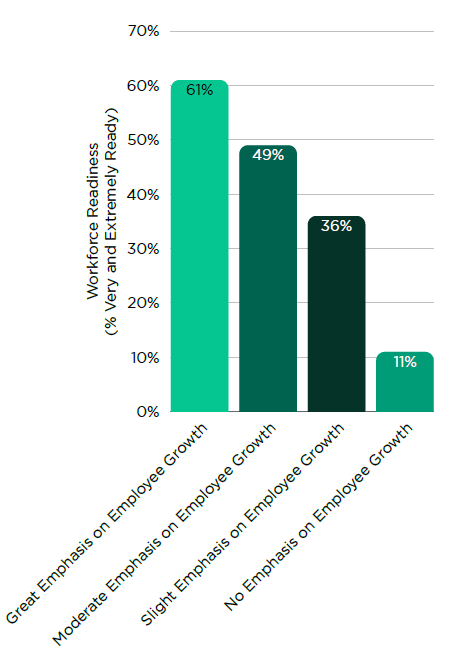
Only 16% of leaders frame AI around their people’s growth, and those who do see a different result. Among leaders who put little or no emphasis on growth, only 11% say their workforce is ready to use AI. Among those who emphasize growth heavily, that number jumps to 61%, roughly 5.5 times higher. Workforce and change readiness is closely connected to how leaders communicate the change. Leaders should frame change as an opportunity for people to learn and grow, not simply the adoption of technologies that make them more efficient.
But the framing only works when leaders back it with their real support: communication people can trust, tools to use AI well, training that builds genuine capability, and a hopeful vision of what comes next.
Governance at Scale
1 in 3 organizations report having no formal governance structures for AI transformation.
We looked at seven core governance practices, or the guardrails that decide whether AI can be trusted to scale:
- formal AI policy and guidelines
- data governance standards
- risk or compliance framework
- dedicated AI adoption task force
- ethics review board
- AI initiatives reported to the board of directors
- executive committee overseeing AI strategy.
About one in three organizations (35%) have put none of these in place, and fewer than 10% have five or more. Governance tracks maturity; organizations above their industry in AI adoption have 3.1 of these practices, compared with 1.4 for those below.
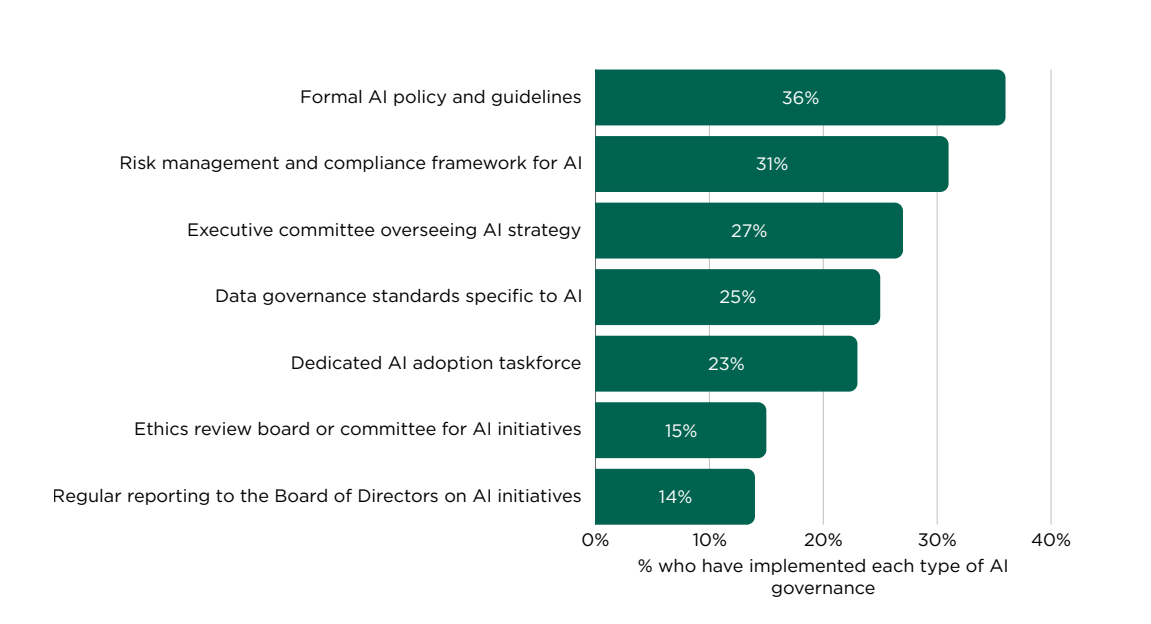
The most common practice is a written AI policy. The rarest are ethics review boards and board-level reporting.
Most companies are comfortable writing rules but far less comfortable enforcing them. That is how “silent drift” starts: AI shaping real decisions with no one reviewing the results.
For many leaders, governance is what gives them pause. It sounds like more process, more approvals, more reasons to slow down, exactly what no one wants when the pressure is to move fast. But that’s not the full picture. Clear guardrails let people use AI freely because they know where the lines are and don’t have to stop and ask permission at every turn.
The front-runners treat governance differently, not as a constraint on AI but as the thing that lets them scale it with confidence. When decision-makers can see how AI is being used and trust that it’s controlled, funding the next stage of investment becomes easier.
How Leaders Can Own the AI Advantage
When we set out to understand how organizations are creating real value from AI while others are still experimenting, we expected the answer to be about investment, access, or ambition. Surprisingly, it was none of those. Most organizations still can’t prove their investments in AI are paying off. Their people feel free to experiment but aren’t yet ready to use AI effectively. And very few have the governance to scale safely. The organizations pulling ahead have stronger foundations underneath, with the platforms, data systems, and guardrails that turn AI activity into business value.
In 2023, we described the AI Factory: the people, the data, and technology an organization needs to make AI work. That foundation still matters for successful AI transformation. Our new research adds what separates organizations that turn those inputs into advantage from those that don’t.
Four Best Practices:
Measure before you scale.
Only one in five organizations can show their AI efforts are producing measurable results, but those that can are eight times more likely to invest seriously. Measurement works best when it advances in stages:
- First steps: monitor usage and adoption. What teams use, how consistently, and where AI lands in day-to-day work.
- Next steps: track efficiency outcomes. Time saved, cost reductions, throughput improvement, and other operational gains.
- Mature steps: connect results to value creation: quality and customer-experience improvements, and business performance outcomes tied to unit economics. DBS and Klarna have built credibility by moving through this progression rather than relying on one-time pilot metrics.
Build the structure before the use cases.
The 7% leading their industries are not ahead because they bought more AI. They are about five times more likely to have a scalable platform beneath their projects, so new use cases plug into an existing system instead of becoming isolated experiments. The result is less fragmentation, faster rollout, and compounding gains over time.
Lead with growth and develop judgment.
Leaders say 85% of the workforce feel safe experimenting, but only one in 10 are ready to use AI effectively in ways that improve outcomes and protect quality. Leaders close this gap by positioning AI as development: upskilling, career growth, and an informed way of working. To do that requires supported communication, practical tools, and training people can grow with.
Govern to earn the right to scale.
A third of organizations have no guardrails. Don't treat governance as an obstacle to speed; use it to scale with confidence. A workable starting point includes four elements:
- an executive owner,
- a cross-functional review group,
- published guidelines and approved use cases,
- a process for reviewing large deployments before expansion
From there, organizations can mature toward greater transparency and accountability. Microsoft, Mastercard, and DBS are examples of responsible-AI reporting.
Everyone can buy the same models and run the same incentives. The advantage will come from what surrounds AI: the quality of the data organizations can use, the programs that help employees reskill, the decision-making frameworks that govern how AI gets used, and the management culture that encourages people to leverage it effectively. None of that can be bought, and none of it can be built overnight. Those are the capabilities that will distinguish market leaders from the rest of the field.
In 2023, we said, “humans are still wanted.” In 2026, our research sharpens the message: the organizations pulling ahead combine people, structure, and technology to create value.
Learn more about Korn Ferry’s Human + AI work and how organizational leaders are redesigning roles, workflows, and talent strategies for an AI-enabled future.
How We Did It
Korn Ferry surveyed [n ≈ 391] senior leaders between April and June 2026 to understand how organizations are operationalizing AI. We looked at where AI is deployed, how it is governed, how leaders measure value, and how workforces adapt. Every respondent is directly involved in their organization’s AI strategy or transformation.