What Predicts Organizational Success? Start With Strategic Goals

Korn Ferry research reveals the organizational factors linked to stronger performance.
Every organization has ambitions. The challenge is knowing whether they are focused, aligned, and connected to the outcomes that matter most.
It’s critical to keep sight of what your organization is really trying to accomplish—its strategic goals. With a shared vision of targeted objectives, your organization can determine the strategic levers to pull to drive business outcomes. To underpin the important intuitions of leaders, Korn Ferry identified statistically proven predictors of organizational performance. To leverage the value of these insights, you need to know where you’re heading.
- Strategic Goal: A clear and critical outcome the organization aims to achieve to deliver the organizational strategy.
- Strategic Lever: A key action, capability, or investment the organization can intentionally use to improve performance to achieve its strategic goals. Examples include transformations in leadership, talent, organizational structure or processes, culture or purpose.
Goals define what success to achieve; levers define how to get there.
We recommend that organizations have a clear, widely understood set of one to three strategic goals. Less effective strategies prioritize too much. It’s far better for an organization to succeed in focused areas than to fail at doing everything.
Organizations that are effective over time know what they are trying to achieve, understand their organization’s context, and have an evidence-based profile for success.
Why Does Your Organization Need Strategic Goals?
A strategic goal answers the question: what are we trying to accomplish? It does so at a broad level that is appropriate for leaders and the organizations they’re responsible for. Clarifying strategic goals helps direct people toward what they should do (actions aligned with the strategic goal, strategic priorities, and strategic levers) and what not to do.
A strategic goal can energize and motivate activity and allow teams and individuals to understand what they are ultimately making progress toward. When paired with an understanding of your organization’s current state and strategic levers, your strategic goal becomes a critical component of organizational Goals define what success to achieve; success.
How Can Your Organization Amplify Its Strategic Goals?
Below are critical steps to strengthen your organization’s strategic goals:
Identify your strategic goals with a focus on leadership alignment.
A leadership team identifying and aligning on strategic goals is a critical step toward improved performance—and it precedes other important steps like tracking progress or improving the operating model and organizational structure. This might sound easy, but in some organizations, leaders assume they have alignment (when really, they don’t), and agreeing on strategic goals is the catalyst the organization needs to improve performance.
What is your company’s track record of setting the right strategic goals, and what might need to change to improve this process in the future?
Contextualize strategic goals to your organization and identify your unique gaps.
Your organization’s unique context and culture matter, and they can impact how you describe your strategic goals down to the very labels you use. For example, your organization may say it focuses on “operational optimization,” while another organization calls it “operational efficiency.” Still, a third says, “our focus is to simplify how we work.” The concepts matter. So does the language you use to describe them. And just as important is understanding where your biggest gaps are.
Once you know where your organization is trying to go, the next question is how far away are you?
Identify the strategic levers you can pull to be successful.
Not all organizational activity drives business outcomes equally. A good strategic lever removes the guesswork and opinions from the equation by pointing to the factors statistically shown to predict success. For example, to achieve greater customer focus, the organization can use culture as a strategic lever by shaping the behaviors, mindsets, and ways of working needed to deliver more for customers.
The examples listed in the following sections and appendix have undergone extensive validation, providing a robust, evidence-based framework for improving your organization’s ability to achieve its strategic goals.
Korn Ferry's Strategic Goal Framework
At Korn Ferry, we begin by defining what success looks like for a specific organization. We call this the Organization Success Profile. It defines the strategy, context, talent, organization, culture, and purpose required to achieve the organization’s strategic goals, while highlighting the gaps that need to be closed between the current situation and the target.
It’s like an individual success profile but at the organizational level. For this framework, we have analyzed performance data from 8,000 organizations across 11 industries and 30 sectors. This includes firms of various sizes—revenues ranging from $1.2 billion (median) to $575 billion (maximum), and headcounts ranging from 3,600 (median) to 1.6 million (max)—and 234 different types of data, including numerous financial metrics, operational figures, employee experience and assessment data, and more.
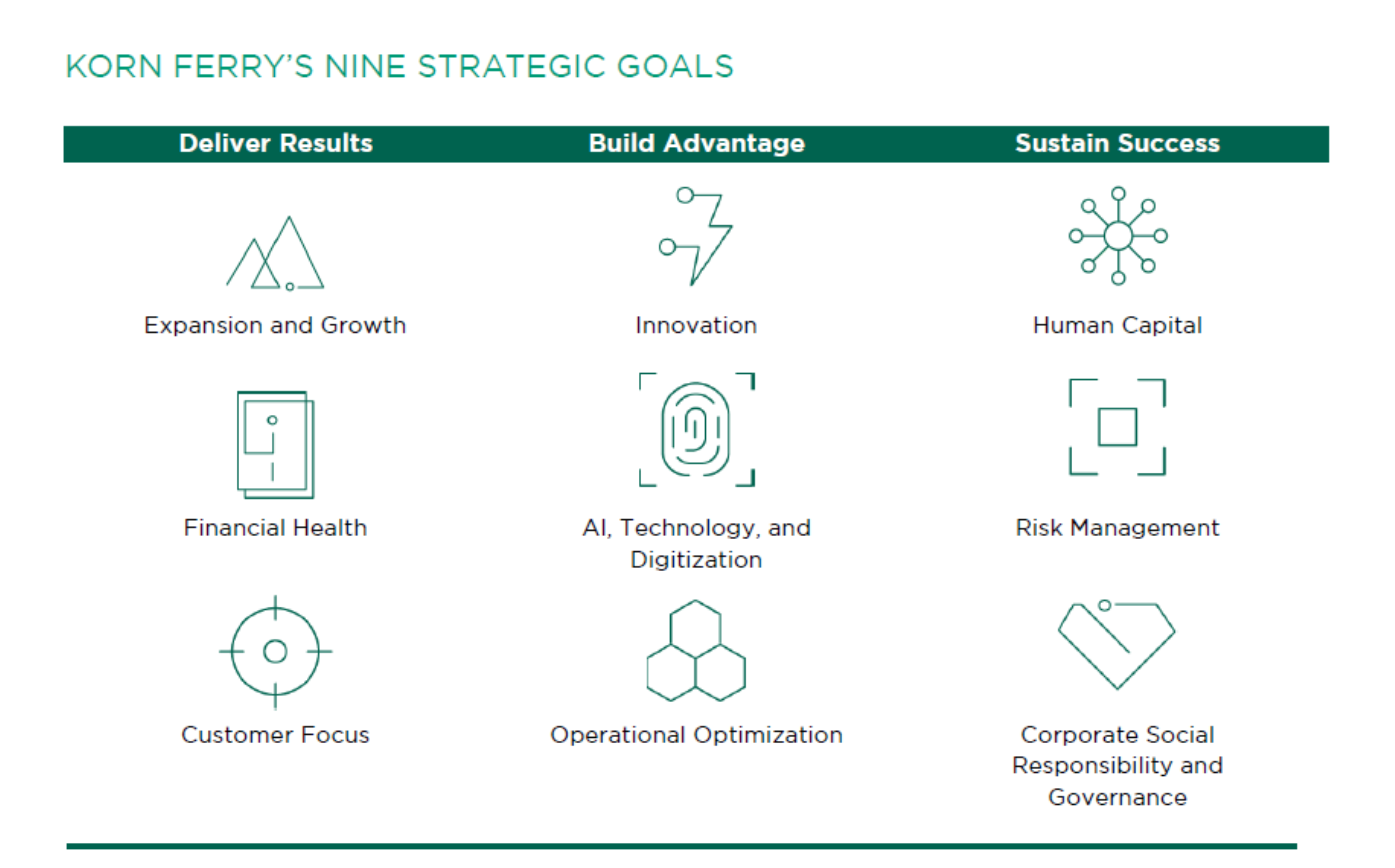
By integrating this data into measures of organizational performance on nine strategic goals (shown below), we can identify distinct patterns of success that would not be visible through any single metric alone.
These goals are grouped into three overarching categories, following a pattern of:
- goals many organizations tend to highlight (deliver results),
- how they try to outperform competitors (build advantage),
- and how they remain resilient and responsible over time (sustain success).
While strategic goal performance measures are quantitative, these three broader categories are conceptual rather than statistical. They were intuitively developed to organize strategic goals into meaningful groups.
Sample Application: Unlock Higher Performance to Accelerate Expansion and Growth
Expansion and growth starts with a vision for where the organization can increase its presence, how objectives might broaden, or which offerings have hidden potential for diversification. But ambitions to “accelerate growth” can mean different things to different leaders.
The first step is to identify the goal and build leadership alignment around what it means. What are your priorities and what are you ultimately trying to accomplish? Surfacing different answers to these questions can begin to unlock the work the organization needs to accelerate Expansion and Growth.
Once you’ve aligned around Expansion and Growth, the next step is to look at your current status relative to what you are aiming for. This process includes knowing where your organization thrives and where your most important gaps are.
With clarity on what you are striving toward and where you are relative to that goal, the final step is to determine the strategic levers to pull to be more successful. Through extensive research, Korn Ferry has insights into what actually drives Expansion and Growth and predicts success. For example, visionary leadership (the capability to provide long-term direction and context) is a validated driver of Expansion and Growth performance. It would be far more strategic to develop visionary leadership than general leadership skills. Likewise, a culture of continuous improvement predicts Expansion and Growth, so it’s smart to consider how you’ll improve your ability to iterate in the future, even when restructuring is necessary.
A Recipe for Success
Effective strategy and organizational performance are not a matter of aspiration. They’re about consistent strategic goal performance. The most successful organizations don’t try to excel at everything; they repeatedly focus on achieving the goals that matter most. By identifying and investing in the strategic levers that consistently predict performance, leaders can turn strategic ambition into measurable business results.
The organizations that outperform over time are not those that chase every opportunity—they keep relentless focus on the goals that matter most.
Learn more about Korn Ferry’s approach to organization strategy.
Korn Ferry offers support and advisory for organizations looking to identify, align, and improve their strategic goals and performance. Organization assessments like the Enterprise Health Scan help leaders understand strategic goal alignment directly, while processes like establishing an Organization Success Profile can help organizations understand their strategic goal performance and improve it in the future.
How We Did It
Subject matter experts identified quantitative indicators of performance on each of nine strategic goals (e.g., Financial Health). We created composites of these measures to triangulate signals across various types of indicators. We then used organizational lever data (e.g., Leadership Styles) to predict subsequent performance on those measures (typically one year later), which tells when a lever is correlated with a type of future performance and when it is not. Person-level data, such as competencies and traits, was aggregated to the organization level prior to analysis, giving us insights into organization-level changes, rather than person-level changes. All reported relationships were statistically significant at p < .05, which tells us that there is a low likelihood that results were observed by chance. Results reported here are from OSP V2 data frame, OSP V2 levers analysis, OCA3.0 Validation, and related work.