Why AI Workforce Strategy Cannot Be Standardized Across Borders

Regulation, culture, and readiness inform what AI can deliver in each country. Why a global playbook won’t work.
The same AI capability produces very different workforce outcomes depending on the country where it is deployed. Korn Ferry Institute research across seven countries—the United States, Germany, the Philippines, Brazil, Mexico, Greece, and Jamaica—found that every one of them showed a substantial gap between the share of work AI could theoretically transform and the share it realistically can. In many cases, that gap exceeded 10 percentage points. Regulation and culture proved as important as AI capability in determining the outcome.
For multinational organizations, AI workforce strategy must be built country by country.
AI Adoption Is Shaped by More Than Technology
Artificial intelligence is often discussed as a universal agent of transformation. In reality, regulation, labor protections, cultural attitudes toward automation, public trust, and digital readiness all shape whether AI can move from theoretical potential into practical adoption. Countries with strong infrastructure can still see constrained adoption if regulatory and cultural barriers are high. Countries with more moderate constraints can experience greater workforce impact even with less mature AI ecosystems.
Importantly, constraints are not solely limitations to economic efficiencies. Recent discussions among frontier labs raise the potential for slowing capability development. These conversations highlight the importance of guardrails while we uncover and understand the long-term impacts of new technology. Regulation also protects workers and citizens from unintended harms and supports the confidence and trust required for AI's benefits to be realized at scale. The realization of AI value depends on a complex governance ecosystem in which safety, oversight, readiness, and trust can become relevant factors alongside policy.
That is why organizations cannot rely on a globally standardized AI workforce strategy. They need country-specific approaches that account for local labor dynamics, governance requirements, and workforce expectations.
Regulation and culture are as important as AI capability in determining workforce outcomes. Localized AI workforce strategies are essential for multinational organizations.
From Potential to Impact
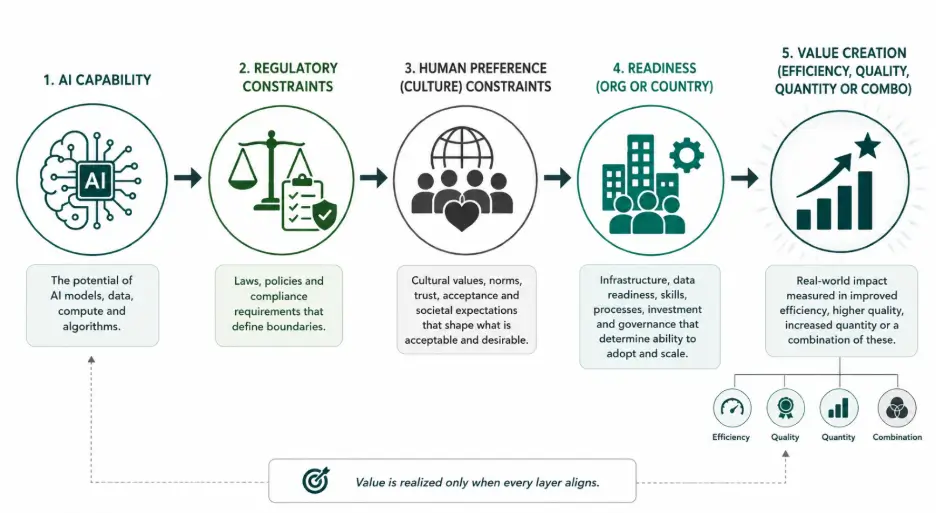
Korn Ferry Institute’s AI Impact Decision Framework (Figure 1) estimates how AI may affect national workforces. It starts with a country’s untapped AI potential: how much of the workforce is theoretically exposed to AI, based on the country’s mix of sectors and KFI’s proprietary AI scoring model. That potential is then reduced through two filters.
- The first is constraints: the regulatory and cultural factors that govern what organizations can and will deploy.
- The second is readiness: the infrastructure, skills, and governance a country needs to adopt AI at scale.
- What remains is the realizable workforce impact: the share of work AI can actually transform in that country today.
The pattern was consistent across every country studied. Each one showed a substantial drop from theoretical AI exposure to realizable workforce impact. In many cases, the reduction exceeded 10 percentage points.
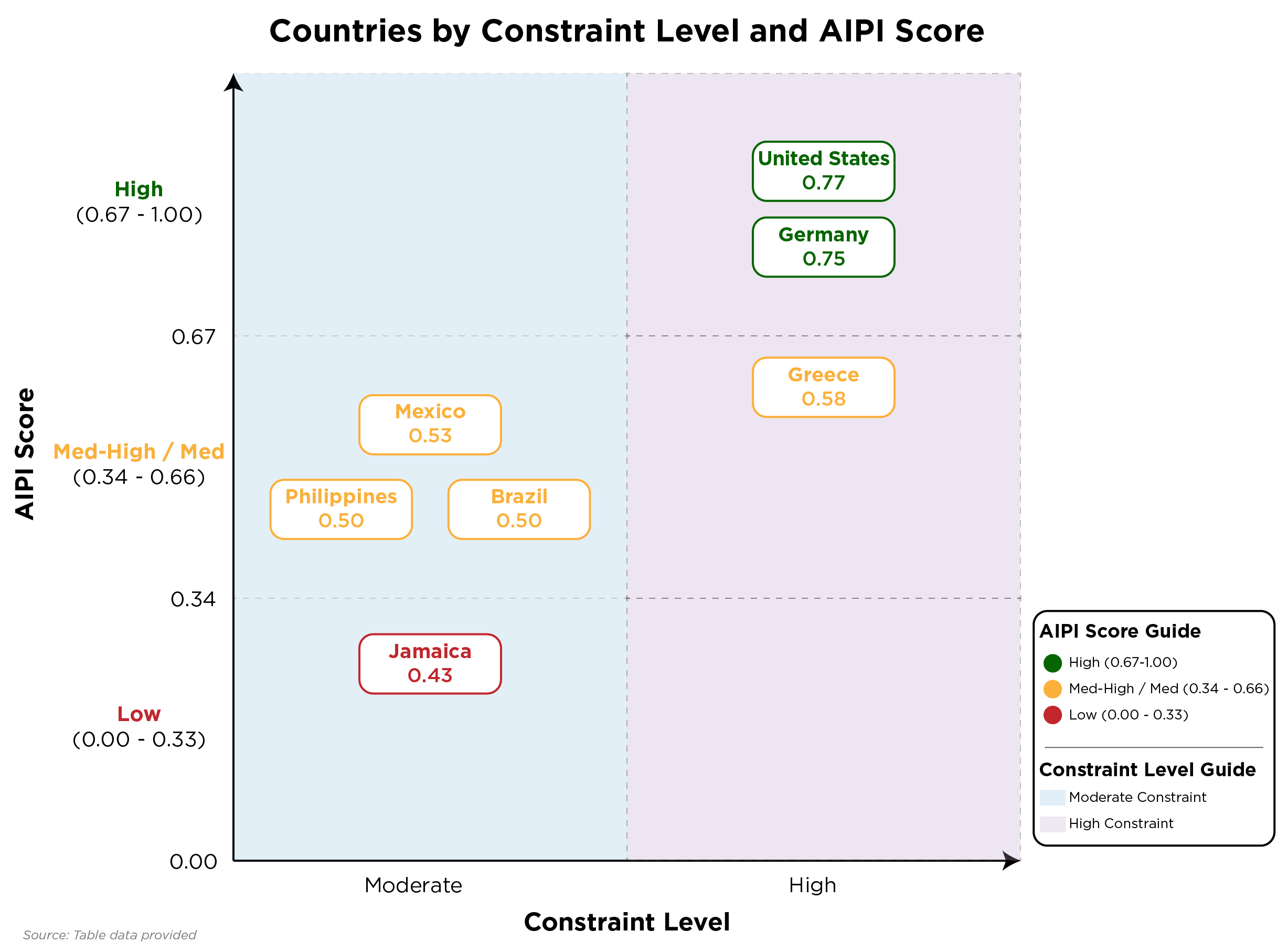
The United States is one of the clearest examples. It is home to many of the world’s leading AI companies and has one of the highest AI preparedness scores in the study, yet its realizable workforce impact remains relatively constrained (Figure 2). State-level regulations, healthcare oversight requirements, legal liability around hiring bias, and public skepticism toward AI all slow the practical pace of adoption. The U.S. workforce also remains heavily concentrated in human-centered service sectors such as healthcare, government, and retail.
Germany shows a similar dynamic. Its manufacturing base creates significant AI exposure, but strict EU AI Act requirements, mandatory works council approvals, and strong cultural concerns about privacy and worker protection substantially slow implementation. While Germany’s infrastructure readiness is high, regulation and labor governance, not technology, shape what organizations can realistically deploy.
By contrast, the Philippines showed the highest realizable AI impact in the study despite only moderate AI readiness. Its large business process outsourcing (BPO) and service economy means a high share of work is exposed to AI-enabled workflows, while its regulatory environment remains comparatively moderate. Many organizations in the Philippines are positioning AI as a tool that augments workers and shifts them toward higher-value activities.
The lesson for any country: create value through gains in quantity and quality, not efficiency alone, or risk leaving citizens and the economy behind as AI use grows.
AI capability does not determine workforce outcomes on its own. Human systems, institutional structures, and cultural expectations play an equally important role.
Figure 1
Why Regulation and Culture Matter More Than Many Leaders Expect
Many executive teams still treat AI strategy as a technology implementation challenge. Our research suggests that view is incomplete. Regulatory constraints—data protection laws, hiring transparency requirements, labor regulations, healthcare oversight mandates, and AI-specific governance frameworks—increasingly define what organizations are legally permitted to do with AI. Germany’s workplace AI requirements under the EU AI Act and its works council system sit at one end of the spectrum, while countries such as Mexico and Brazil are developing newer regulatory structures focused on accountability and oversight.
Human preference can be just as influential. Public trust, cultural expectations around human service, and sensitivity to job displacement all affect adoption. In Greece and Jamaica, for example, tourism and service industries place a particularly high value on human interaction, which makes aggressive automation strategies harder to implement regardless of technological capability. Organizations often underestimate this. A technically successful AI deployment can still fail if employees distrust it, customers reject it, or local labor expectations are ignored.
The research also challenges a common assumption: that infrastructure readiness is the most important variable. In practice, countries with moderate readiness but fewer constraints may move faster than countries with stronger infrastructure, but heavier regulation and cultural resistance. The Philippines showed higher realizable impact than both the United States and Germany for precisely this reason.
For multinational employers, this creates a more complex leadership challenge. AI transformation is more than scaling tools globally. It requires understanding how each local environment shapes adoption speed, workforce acceptance, and operational risk, and then realizing value across countries whose AI preparedness may differ widely.
A Cross-Country View of AI Workforce Dynamics
The study identified four country patterns that multinational leaders should pay close attention to:
- High-readiness, high-constraint environments: The United States and Germany both have advanced AI ecosystems, but strong regulation and cultural concerns significantly limit realizable workforce impact.
- Moderate-readiness, moderate-constraint environments: Mexico and the Philippines show how balanced governance can support stronger workforce transformation outcomes even without elite infrastructure.
- Infrastructure-constrained environments: Jamaica and Brazil illustrate how gaps in digital readiness can limit AI realization even when regulation is comparatively moderate.
- Trust-constrained environments: Greece shows how low public confidence in institutions and resistance to automation can become a major barrier independent of technology availability.
These patterns reinforce a critical point for workforce leaders: AI adoption should not be a universal technology rollout, but a strategic effort that accounts for country-by-country operating models.
Figure 2
What This Means for Executive Leaders
Workforce strategy and AI strategy can no longer operate separately. Organizations need integrated planning that considers labor laws, workforce sentiment, digital readiness, and operational design together. Global AI governance models must become more flexible: a policy framework that works in one country may create legal or cultural friction in another, and multinational employers should expect regional AI operating models to diverge further and become increasingly localized. The same AI-enabled operating model may create productivity gains in one market while generating operational, reputational, or legal risk in another. Organizational readiness matters, but it hinges critically on these other country-level factors.
Trust is becoming a strategic business variable. Organizations that ignore employee concerns about surveillance, displacement, or algorithmic decision-making risk slowing adoption and damaging their credibility as employers. Countries with the strongest cultural resistance in the study consistently showed lower realizable workforce impact, even when technological readiness was sufficient. In lower-readiness environments, organizations may achieve better results by prioritizing workforce upskilling, digital infrastructure, and governance capabilities before attempting large-scale AI deployment.
Not all AI-driven productivity creates the same economic effect. Efficiency-driven deployment models focus primarily on reducing labor requirements. For those regions with high exposure to routine work, this increases workforce displacement risk. For example, BPO and contact centers in the Philippines face higher displacement pressure. By contrast, a region that invests in sectors with higher value upside, such as research and development or engineering, can capture more value with lower displacement risk. Executive leaders should therefore treat AI workforce transformation as a localized strategic capability rather than a centralized technology initiative.
What Leaders Should Do Now
- Build Country-Specific AI Workforce Strategies
Assess AI exposure, labor dynamics, regulatory risk, workforce readiness, and human preferences by market and geography. Organizations with global labor-arbitrage strategies should consider where work is located, which activities are most exposed to AI, and where augmentation, reskilling, or role redesign will create more value than labor substitution. A single global deployment strategy is unlikely to succeed across regions with different legal, cultural, and operating conditions. - Incorporate Human Preference into AI Planning
Reactions to AI are context dependent. Treat human preference and trust as measurable transformation metrics. Communicating clearly about how AI will support work, where human oversight will remain, and how you will manage workforce transitions will improve public perceptions of trust and engagement. - Align AI Governance with Local Regulation
Bring legal, HR, and transformation leaders together to monitor evolving AI regulation at the country and regional level. The pace of AI policy development means your governance model will need to adapt continuously. - Invest in Value Creation
The strongest-performing environments in the research positioned AI as an augmentation tool rather than a pure labor substitute. Organizations that create value by increasing the quantity or quality of their work are likely to meet less resistance. Evaluate AI investments not only by their cost-reduction potential but also by their ability to expand human capability and create higher-value work. - Invest in AI-Ready Leadership
Leaders need to navigate ambiguity, workforce sensitivity, and regulatory complexity at the same time. AI transformation is a technical challenge, but it is also a cultural and leadership one.
Conclusion
The future of AI in the workforce will not be determined by technology alone. The interaction between AI capability, regulation, culture, labor structures, and institutional trust will shape it. Korn Ferry Institute research demonstrates that even countries with strong AI ecosystems can experience constrained workforce transformation when regulatory and cultural barriers are high. Countries with moderate readiness can achieve stronger outcomes when governance environments are more adaptive and workforce expectations align with using AI to support rather than replace workers.
There is no one-size-fits-all AI workforce strategy. Organizations that succeed will understand how local context shapes adoption, build workforce trust alongside technical capability, and design AI strategies that reflect the realities of each market where they operate.
How We Did It
Korn Ferry Institute’s AI Impact Decision Framework estimates how AI may affect a national workforce in five steps: AI capability, regulatory constraints, human preference (culture) constraints, readiness (organizational or country), and value creation. For each of the seven countries in this analysis—the United States, Germany, the Philippines, Brazil, Mexico, Greece, and Jamaica—we first estimated untapped AI potential based on the country’s sector composition and KFI’s proprietary AI scoring model. Sector shares were derived or reconstructed from official labor force datasets using harmonized industry groupings to match cross-country comparability.
We calculated the country-level AI scores by taking the job and job-level data that we have for those industries, weighting by the estimated percent of the country workforce that belong in each industry. We then adjusted that potential for regulatory and cultural constraints and for AI readiness to arrive at realizable workforce impact.
We used the AI Preparedness Index (AIPI) as our country-level indicator for infrastructure and ability to adopt AI. In this study, AIPI was used as a readiness constraint on each country’s ability to realize benefits from AI. Information about the AIPI score can be found at: https://www.imf.org/external/datamapper/datasets/AIPI
Country sector information was collected from various local reporting authorities, such as U.S. Bureau of Labor Statistics (BLS) or Destatis.
The countries were selected based on their variety of industries and AIPI scores to show how this framework plays out in different contexts.