
I Need a Job!
Be noticed. Land the interview. Get hired.


July 22, 2026
Excerpts from I Need a Job!, the latest book by Korn Ferry CEO Gary Burnison.

When it comes to looking for a new job, many professionals just don’t know the best way to go about it. It’s not enough to get a résumé into someone’s hands—or, these days, simply upload it into a company’s applicant tracking system (ATS).
Not only that, but as many as 70 percent of positions are now being filled by internal candidates or someone who has been referred. That’s why you must have a plan.
Ironically, when we were younger, we intuitively knew how things worked. I was reminded of this when I took my family to an ice cream shop many years ago. Sitting at a table in the corner was a kid filling out an application. Did that take me back to my high school days!
Back then, you’d go to the place you wanted to work and ask if they were hiring. If the manager or owner wasn’t busy, you’d get an interview on the spot. And if your buddies worked there, they’d put in a good word for you. In fact, you probably found out about the job from a friend who provided a warm introduction to the manager for you.
But as time went on and our careers progressed, we got the idea that technology would do all the work for us. Today, we might even convince ourselves that all we need is an online presence and AI will somehow find us.
The truth is landing your next job, and especially advancing your career, takes a lot of purposeful thought and action. It starts with a shift in mindset—as well as evolving your skill set.
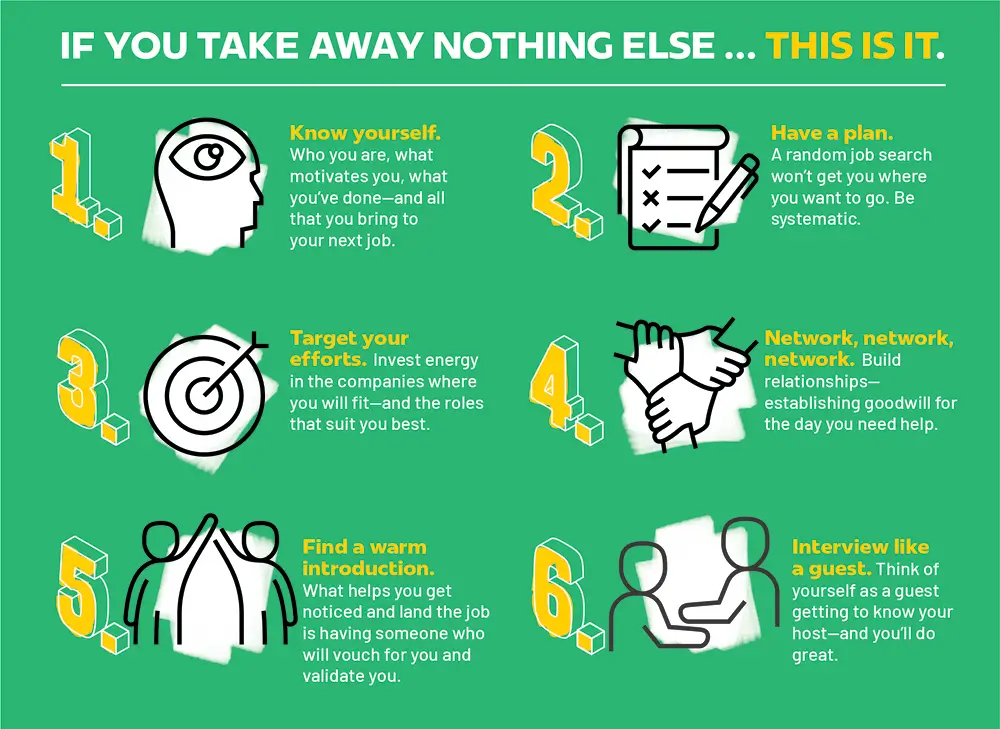
Know Yourself
Before you focus outward, it’s important to first look inward. That’s how you move onward. In other words, you need to be introspective—to know yourself. No wonder Socrates called self-knowledge “the beginning of wisdom.”
Self-knowledge—your strengths and accomplishments, your blind spots and weaknesses, what motivates you, the type of environment in which you thrive—will provide clarity in your job search. You’ll see whether an opportunity is a good fit for your skillset, your personality, and your passion and sense of purpose.
The more you understand yourself, the better you’ll be able to put your skills and experiences into perspective—including explaining to your next employer what you’ll bring to that job.


Assess for Success
As you look to land your next job, you should expect to be assessed. In fact, assessments permeate the hiring environment—and at every stage of the process.
Most people, however, don’t like being assessed. It makes them feel vulnerable. Relax! Assessments are not tests; they’re about learning who you are, how you work, what motivates you, and the kinds of roles and environments that best suit you.
So instead of viewing assessments as a process of elimination—think of them as a process of enlightenment! It’s all about you and your perspective. The more you know about yourself, the more you can learn and grow.
Putting Your I in AI
The moment you upload your résumé to a potential employer you’re entering the AI world.
Without question, virtually every company these days is using AI to find talent. Given the hundreds and sometimes thousands of applications frequently received for each job posting, companies use AI-powered ATS to automate parts of the process. ATS platforms help companies streamline recruiting and hiring—using analytics to identify and evaluate the best talent.
Candidates also have access to AI-powered software and apps—from résumé builders to cover-letter generators, interview coaching software, and more. You tap the power of AI to execute your own smart strategy—identifying the best opportunities, showcasing your background and your expertise, elevating your profile, and amplifying the story you tell your prospective employer.
While AI can help you, you are in control of where you go. Indeed, that’s how you put your I in AI.
Targeting Your Next Opportunity
To get a job you need a plan.
The more effort you put into targeting, the better you will be able to market yourself and not waste time on opportunities that aren’t a fit for you—or where you aren’t a fit for the organization. Your confidence will increase because now you’re focusing on what you want and the contribution you want to make.
Instead of starting off on a random search, you need to be systematic. For most job candidates today, targeting begins with identifying the companies they want to work for:
- Size of Organization: Small, medium, or large firms.
- Types of Industries: What interests you?
- Environment/Culture: What suits you best—fast-paced, collaborative, casual, structured, etc.?
- Your Workscape: Do you want to work remotely, hybrid, or in person?
Now it’s time for the next phase—the specific roles and responsibilities you want to pursue. Depending on your expertise, level of experience, and personal preference, your job search can be narrow or broad.
If you are looking to transfer your skills and experiences to a similar role at a different company, you will have a sharper focus. Conversely, if you want to expand your career and heighten your role—maybe even in an adjacent field—you will use a broader lens. You’ll need to define your skills, achievements, and experiences in a way that makes them relevant to your desired role.
Wherever your job search takes you, think about your most recent jobs and the accomplishments that you’ve achieved. This is what you have to offer to the companies you’re targeting.
Networking in the New World of Work
Of all the areas and aspects of looking for a job—this cannot be emphasized enough. Without networking it will be difficult at best, and impossible at worst, to land the job.
Ask anyone you know how they landed their job, and the majority will tell you that they knew someone, who knew someone. This isn’t to say they weren’t qualified. Rather, they networked to get noticed.
Networking shouldn’t begin when you’re looking for a job. The care and nurturing of your network is imperative—and ongoing. That’s why the golden rule about networking is: It’s not about you! Ideally, networking is grounded in what you can do for others.
As you build and nurture your network, you are building relationships with people who will validate you. These are people who know you from working and interacting with you. When they attest to your skills, your accomplishments, and your contributions as a team member or team leader, their words carry weight.
Not only is validation good for you, but it’s also valuable for the company that wants to hire you. Just as you want someone in your target company to vouch for you, the company is glad to get an insider’s recommendation about you. When someone speaks for you, the hiring manager has greater confidence in your abilities and your fit with the culture.


The Interview: Prep Time
Preparation is everything—and practice, as they say, makes perfect.
As you prepare for the interview, you need to know the story you are going to tell—as well as who you are going to tell it to. With this holistic approach, you will greatly increase your chances of forging a connection with a prospective employer.
Here are some tips for making the most of your interview prep.
- Know Who You Are Going to Meet
As soon as you receive notice of the interview, the first question you should reflect on is: Who will I be meeting? The answer is far more than a name and a title. You’ll want to research the person, starting with their LinkedIn profile.
Your job is to look for connection points—you share an alma mater or you both worked for the same company several years ago. Those are the type of commonalities to mention as you sit down for the interview. - Do Your Homework
Learn all you can—the leadership team, current successes and challenges, customers, and even history. If possible, get some firsthand experience with the company’s products and services. Buy them, try them, talk to people who use them. The greater your knowledge about the company, the better you’ll be able to provide context when discussing your skills and experiences.
- Have Great Examples of Your Accomplishments
At some point during your interview, you’re going to be asked to talk more about your accomplishments. The interviewer is listening for specifics to determine how well you would match the demands of the job and how well you would communicate with colleagues and customers. Ideally, your examples will address four key areas: challenges/opportunities you’ve faced, the actions you took, the results achieved, and the lessons learned. As you prepare, record yourself—then listen, watch, critique, adapt, and learn.
- The Interviewer Isn't the Only One with Questions
Along with preparing what you’re going to say, you’ll want to think about what you should ask the interviewer. Your questions should be smart and strategic, probing the job responsibilities or how the department functions. The questions you ask also show the interviewer how you think.
The Interview: Go Time
The day of the interview has arrived. But here’s the thing—the interview isn’t really about you. Instead, it’s really all about the hiring manager, other team members, and every other person you meet.
It’s a shift in thinking, but one that could help boost your confidence and make you feel more comfortable during the conversation—whether on screen or in person.
I compare this dynamic to being a guest in someone’s home for the first time. To show respect and make a connection with your hosts, you follow the protocol. You are relaxed and smiling. You are patient and attentive. The conversation flows with the give-and-take of people getting to know each other.
In your interview, you also follow a visitor’s protocol. You smile and make eye contact. As you listen carefully to the questions, you pay attention to their pace and tempo as you read the interviewer’s tone and body language. You want to be in sync so the exchange will feel much more relaxed.
An interview normally follows a certain flow: opening, middle, and close:
- The Opening: An Instant Connection
As your interview gets underway, an initial period is typically devoted to establishing rapport, often by engaging in small talk. The homework you did to research your interviewer’s background really pays off here. If you found a commonality, mention it. - The Mid-Stage: A Taste of Your Contribution
This is the main event. You and the interviewer engage in a conversation in which you learn about each other. You need to stand out in the interviewer’s mind as they get a taste of what it would be like to have you on their team and in their organization. The best way is to show the hiring manager how you would add value to the organization. The manager has specific goals that must be achieved. Your objective in the interview is to show exactly how you can help achieve them. - The Interview Close
As the discussion winds down, the interviewer will probably start summarizing or could volunteer some information about next steps (for example, meeting with other team members).
At this point, it’s very important to restate—quickly and concisely—your enthusiasm for the job and why you think you’re a good fit for the organization.
Finally, remember that an interview is a two-way street. It’s a conversation! And, like any conversation, there should be a give-and-take—with information flowing in both directions.
The Process Never Ends
Congratulations! The hard work paid off. Take the time to celebrate and appreciate what you’ve accomplished and the opportunity ahead.
But remember, the process never ends. You’re always looking for the next opportunity.
Copyright 2026 by John Wiley & Sons, Inc.
