
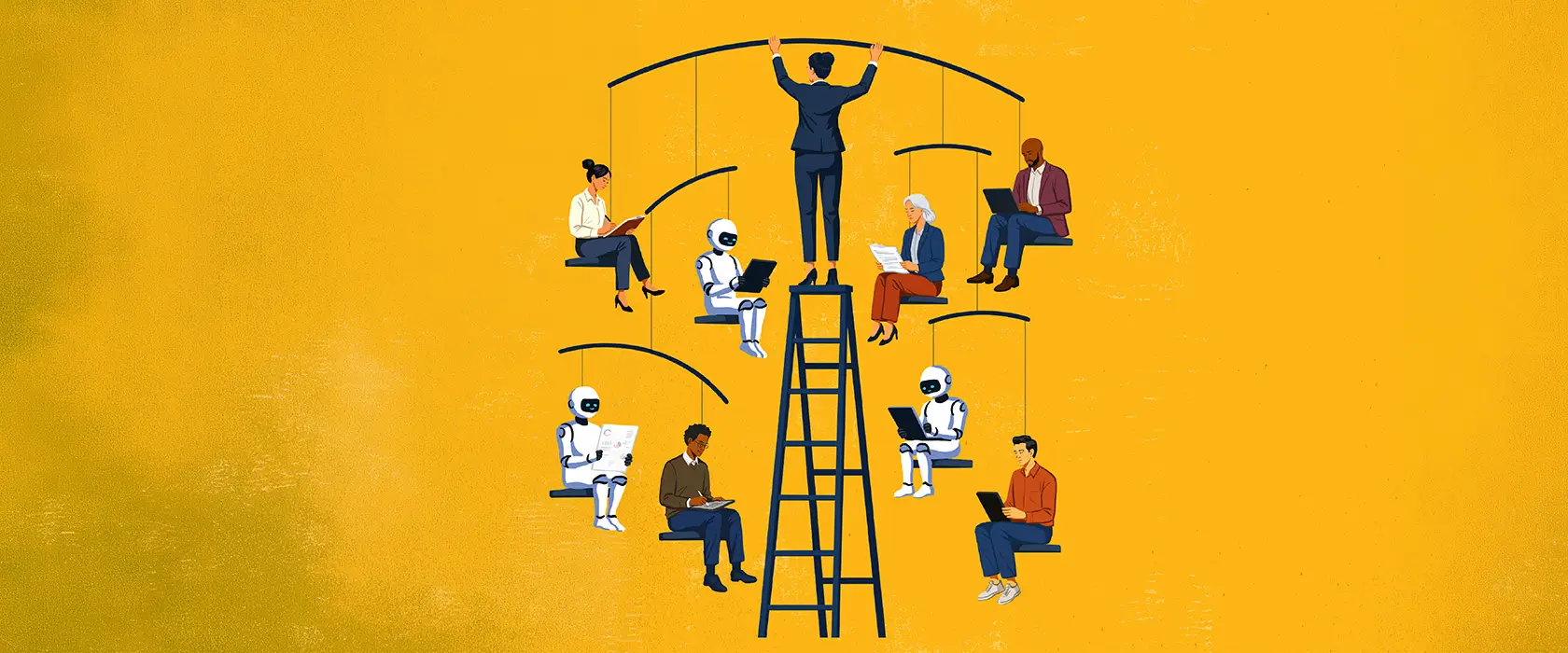
It didn’t matter where he got his MBA. It didn’t matter how many books he read on management theory and philosophy. It didn’t matter how much coaching or training he received from his firm (which likely wasn’t much). Nothing prepared him for what he now faced—a team of anxious humans spanning five generations and a network of AI agents, all waiting for him to tell them what to do.
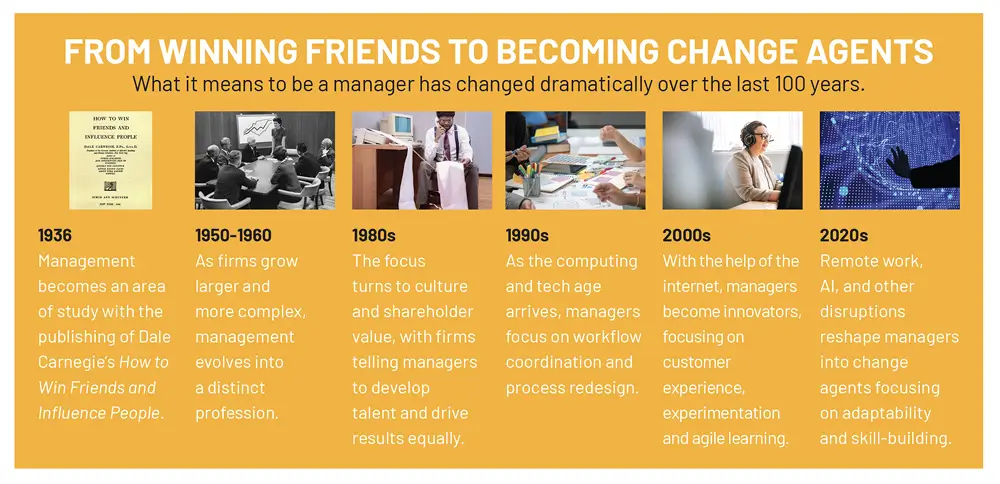
The work of management today is about as foreign and unrecognizable as it was when it first emerged as an area of focus for academics and authors in the first half of the 20th century. Dale Carnegie and Peter Drucker could hardly have imagined a universe where managers oversee dozens, if not hundreds, of employees, many of whom never come to the office, aren’t interested in advancing, and increasingly aren’t even human. “There’s been a real paradigm shift in terms of what it means to be a manager over the last five years,” says Brad Bell, director of the Center for Advanced Human Resources at Cornell University. “Conventional management training doesn’t work.”
Small wonder then that nearly 80 percent of managers—who are a critical link in any firm’s success—report being disengaged at work and roughly the same percentage say they suffer from stress and burnout, the largest of any employee group. At the same time, managers are a dying breed—41 percent of firms reduced management layers last year, and seven out of 10 Gen Z employees say they wouldn’t accept a promotion to manager.
Today, the typical manager oversees 12 direct reports, a 50 percent increase from a decade ago, with that number climbing to 100 or more at some firms that have deployed AI agents. But training managers to deal with AI agents is a lot different than training them to deal with humans. And that’s if they are getting any training in those areas to begin with. “I doubt any firm is training employees to manage AI agents, not only because they don’t want to pay for it,” says Peter Cappelli, director of the Center for Human Resources at Wharton, “but also because we don’t yet know how to ‘manage’ AI agents.”
That’s not hyperbole. Only 44 percent of managers say they received formal training. Economic conditions are leading companies to cut training budgets, with one recent survey showing that 16 percent of talent development professionals have already experienced cuts, and another quarter expect them before the year is out. Even more telling, despite ranking learning and development as a top priority in survey after survey, employees of all levels only received 40 hours of training on average last year, down 25 percent from 2024.
Firms will point out that they are redirecting money and refocusing training funds around AI. And indeed they are: 25 percent of firms expect AI training to receive more funding and resources. The problem, says Cappelli, is that it is the wrong kind of AI training. “The simple issue of checking the output of AI agents isn’t managing,” he says. Put another way, firms are racing to deploy vast networks of AI agents and putting managers in charge who have only a limited knowledge of how humans work with each other, and no idea how humans and agents interact between and amongst each other.
Paul Cheek agrees. The MIT lecturer and advisor and author of an upcoming book about the “post-human organization” argues that firms are at more risk from the combination of the “Great Flattening” and the emergence of AI agents than they realize. Right now, he says, firms are training people to use AI tools to boost productivity through efficiencies. Instead, he says they should be focused on training managers on how to introduce AI agents into the organization and redesigning how they can work together with humans. “Training has to shift to building shared agency between humans and AI agents instead of just between people."
