
Battling Boredom
A shocking number of workers are bored—and AI may only make it worse. How boredom and job redesign can be put to good use.

September 25, 2026
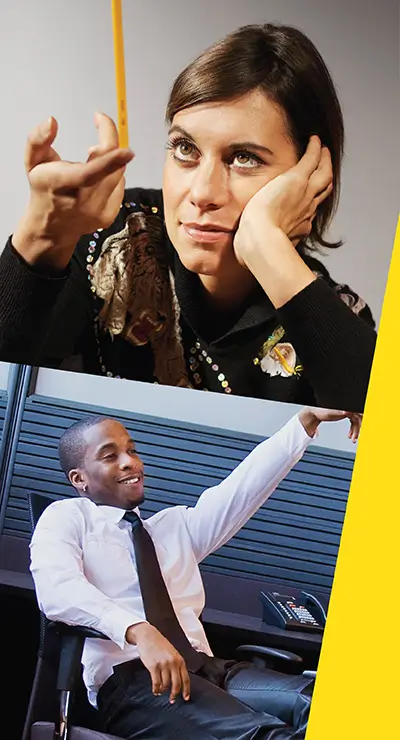
By her third year, Julie had a theory: Somewhere in America, there had to be a more boring job than hers—but she couldn’t picture it. “Stultifyingly boring” was the description she used with friends. By her second year, she could finish a month’s work in nine days. During the other 12, she refreshed four news and gossip websites on rotation.
THE PROBLEM Nearly half of workers say they are bored for the majority of the week.
WHY IT MATTERS Boredom may be one of the biggest drags on productivity hiding in plain sight.
THE SOLUTION Firms need to redesign jobs while also teaching workers how to use periods of boredom to their advantage.
Three years earlier, she had taken a senior analyst role at a regional insurance company, following an exciting interview about redesigning innovative insurance models. Her part in the redesign turned out to be minor, because the models, built mostly by others, ran themselves. By the end of the second year, she could do a month’s work in less than half the time, leaving her with little to do but refresh news sites or search for a new job that never materialized. Boredom can be painful, but Julie had done the calculus in her head: The hours were flexible, and the paychecks supported her family, so she stayed.
Who would have thought that at a moment of unprecedented global activity—power shifts, AI, conflicts—anyone would be bored? Indeed, survey after survey has revealed that many workers are overworked and burned out. But it turns out that nearly half of everyone else has quietly drifted into a realm they never expected. According to the Society for Human Resources Management, fully 46 percent of workers say they are bored for at least three days of the workweek—a grand total of 24 hours or more of workday boredom. Other research from a 2026 University of Illinois report found that 61 percent of US workers are “languishing” at work.
“People are checked out because there’s nowhere useful for their energy to go.”
The problem occurs in many fields but experts say it is rampant in the ranks of so-called knowledge workers. For them and others, boredom has now become a primary reason for leaving a job, ranking ahead of compensation, according to data from job search engine Metaintro. New employees say that new tasks initially engage them—but soon become rote. But they’re not likely to say much publicly: Who wants to hire someone who finds working dull? It’s easier—and safer—to simply endure the hypoactivity.
Of course, the world is still full of worker bees who, endlessly intrigued by their work, would find their colleagues’ boredom incomprehensible. Experts say it’s hard to imagine how much more companies would be growing—and maybe hiring—if half of their employees weren’t watching the clock tick. “Boredom is a systemic issue that often goes unaddressed, ” says Melonie Boone, PhD, founder, and CEO of Boone Management Group. “It directly impacts the bottom line.”
Experts blame much of this on a stagnant job market that’s making people stay at jobs they mastered years ago. “Boredom is a key sign of underemployment,” says organizational psychologist Cathleen Swody of Foster Talent Consulting. And, of course, there is AI, which was supposed to solve drudgery, yet seems to be doing the opposite—by stripping away the engaging parts of many jobs. A scientist who once loved designing experiments now supervises a bot that designs them. A software engineer who adored typing the perfect line of code now prompts a machine to do it. Less obviously, AI is also eating up the repetitive work that used to offer a welcome change of pace. Either way, the obvious question remains: How to get people out of the boredom zip code?

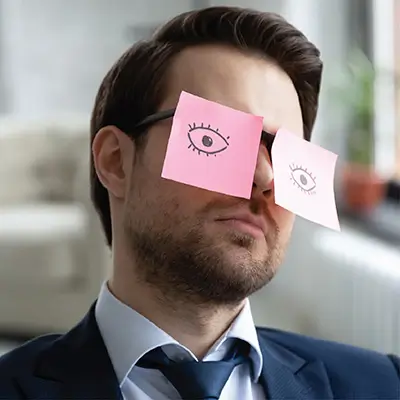
Boredom is a Management Failure
For decades, no one measured boredom in the workplace. Research instead focused on engagement, which assesses an employee’s vigor, dedication, and absorption in their job. Boredom is something else: an unpleasant state of being understimulated—what Tolstoy called “the desire for desires.” And unlike disengagement, it can be hiding in plain sight. The two get conflated because their outcomes look the same, whether working quietly or checking out. But boredom is fueled by a unique combination of low workplace resources, such as career-development opportunities, and not enough work to do, whether that means a worker is finishing the day’s tasks by 11 AM, or enduring prolonged waits for approvals or handoffs, or being staffed on a stalled project. Boredom strikes at every level of cognitive complexity, from call centers to astrophysics labs—which is part of why it’s so easy to miss.
What it isn’t is benign. Boredom is associated with burnout—what’s recently been called “boreout”—and it metastasizes fast into low life satisfaction and fewer positive day-to-day behaviors, as well as higher levels of anxiety and depression, as a 2024 Finnish study recently found. Blah quickly becomes bleak.
Many managers and executives are unintentionally inflicting boredom on their people. It happens like this: Various levels of the org chart inadvertently descend into the weeds of the level below. The C-suite, rather than handling big-picture strategy, gets their fingers in the tactical details of their direct reports; the VP level takes on director-level matters; and the director level absorbs managerial tasks. This is a death spiral for the individual contributors below, as everything meaningful has been pulled up the chain. “It’s a symptom of leadership operating at the wrong altitudes,” says Boone. Employees are functionally bored, because their roles have been hollowed out by the levels above.
Bored employees invariably try to leave. The workers who quietly reach out to San Diego-based career coach Kolby Goodman often spend their days managing the same easy-to-solve recurring problems. “I’ve seen this pattern in tons of clients,” he says. His clients are typically plenty occupied, but they’ve “checked out because there’s nowhere useful for their energy to go.” His inbox is full of employees who spend their days solving problems they don’t care about solving.


Boredom’s Long, Dull Résumé
Back in the 4th century, monks were plagued by acedia, whose symptoms will ring familiar to any cubicle worker: a restless despair that made the monks’ quarters feel unbearably cramped and their spiritual practice pointless. We know it today as the afternoon slump, which workers often address with coffee and a less-than-nutritious snack. Spiritual leaders took acedia much more seriously: It was a deadly sin, because it directly threatened the very underpinnings of monastic life. Leaders might take note.
Boredom in the modern sense of the word is a relatively new human phenomenon. Sure, the French have long had their ennui, a metaphysically tinged weariness, but the noun “boredom” only arrived in the mid-1800s, when Charles Dickens featured it a half dozen times in Bleak House to describe a world awash in industrialization and urbanization. Fast-forward a few centuries to the mid-1980s, when famed psychologist Mihaly Csikszentmihalyi presented it as a failure to reach what he called flow state: One was bored because one was too skilled for the challenge at hand. For the first time, millions of employees became aware that there was a flow state, and that they weren’t in it. They also were keenly aware of boredom during the pandemic, when Google searches of the word more than doubled, and lockdowns provided near-laboratory conditions for studying the effects of understimulation.
Channeling Boredom
Recent research suggests that boredom may not be a problem per se, but a signal. Studies suggest that workplaces should be set up to make boring time more useful.
- Build in Slack
A fully booked workday leaves no room for productive responses to boredom—like learning something new or rethinking roles. - Tolerate Experimentation
Cultures that punish minor deviations from the script eliminate productive dabbling. - Making the Meaning Visible
Connect employees to the larger goal they're contributing to. This helps reduce despair when there is no line of sight. - Provide Real Autonomy
Employees with autonomy can adjust their tasks, try new approaches, and reshape their work. - Broaden Roles
Hyper-specialized jobs trap people, since workers have nowhere to redirect energy when the tasks go flat. More generalist-leaning roles offer productive areas to turn to.
Since then, boredom studies has become a cottage industry. At large companies, internal mobility is stalling, stunting employees’ development and leaving them in the same role for years. “They check out emotionally long before they resign,” says Lacey Kaelani, CEO of job-search engine Metaintro. Recent college graduates, finding themselves frozen out of the corporate job market altogether, often rely on jobs in retail or food to survive. That’s not inherently a recipe for boredom, but boredom thrives when workers aren’t actively learning, being stretched, or gaining new skills, says Swody, the organizational psychologist. “Humans do best when they have a sense of forward momentum and trajectory. Otherwise, they get a sense that they’re not where they’re supposed to be,” she says.
Not surprisingly, AI has complicated the boredom puzzle, hollowing out interesting areas of jobs instead of just automating their most tedious parts. Companies have known this for a couple of years, but have refused to do the hard work of redesigning millions of jobs. And there’s a broader challenge: According to Dutch researchers Carina Schott and Caroline Fischer, firms need to reframe boredom entirely—not as a problem to be avoided, but as a signal worth reacting to. Much like loneliness, guilt, and jealousy, boredom is an internal signal that something needs to change.


Becoming ‘Unbored’
When people are bored, they tend to do the one thing that makes it worse. Imagine you’re at work, slogging through invoices. You plod along for 20 minutes, then click over to a gossip website or scroll a bit on your phone. Academics call this “cyberloafing,” and it’s both a sign of boredom and a coping strategy.
But cyberloafing is precisely the wrong strategy, because it’s just another unfulfilling, non-goal-directed behavior. Piling one meaningless activity on top of another only compounds the problem. Sure, scrolling—or any other temporarily distracting task—feels like relief (and it might be, for a split second), but it doesn’t address the underlying source of the boredom, according to a 2023 Dutch study. You’re still at work doing nothing meaningful; you’re still bored; your day still feels lacking in purpose.
“Humans do best when they have a sense of forward momentum and trajectory.”
Experts say the solution is the opposite behavior: seeking out activity that is engaging or goal directed. Research shows that alternating an engaging activity with a boring one improves a worker’s experience significantly. For example, switching back and forth between a fun project and administrative tasks successfully wards off boredom. Another solution is “job crafting,” reshaping tasks to involve a challenge or otherwise make them more interesting. For example, you could challenge yourself to finish a report in 90 minutes, or to create an agent to do some of the work for you, or gamify the task, or try to do the same work with a different approach. Novelty tends to help, such as mixing up who you interact with or teaching a task to others.
On an organizational level, Schott and Fischer suggest that firms train employees to manage their boredom. That can include learning something new; healthy daydreaming, such as the creative and problem-solving revelries that can lead to aha moments; or engaging in another activity, such as helping others or networking. The idea is that boredom can lead to good outcomes, including mobilizing AI to cut through repetitive work in unique ways. “Examples are incredibly helpful here,” says Swody. “You gotta make it real for people.”
Image credits: Henrik Sorensen/Digital Vision/Getty Images; Ron Levine/Photodisc/Getty Images; Chingyunsong/iStock, Fizkes/iStock/Getty Images; White Packert/Stockbyte, Jorg Greuel/Photodisc, Matt Benoit/iStock/Getty ImagesGettyImages
