

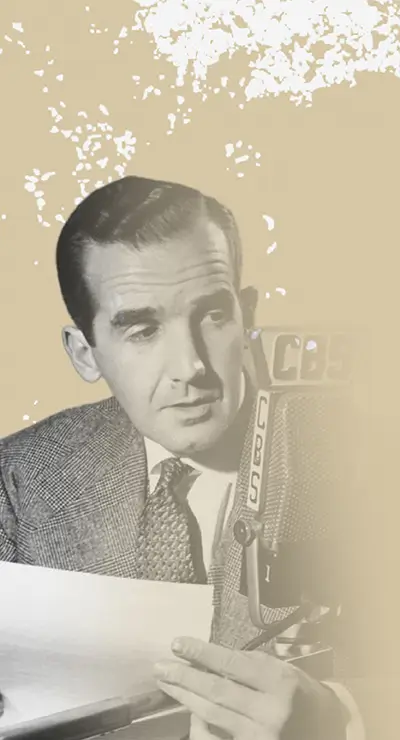
During the Nazi bombing of London during World War II, the voice of Edward R. Murrow, the famed journalist for CBS Radio News, was heard in living rooms across America. “This... is London,” he would intone in his baritone voice, bringing vivid descriptions of the Blitz to a rapt audience. At the end of each broadcast, he signed off with “Good night and good luck,” a phrase that would become his calling card during an iconic broadcasting career.
In the era before television, radio was the global technology that connected the world. Murrow was the first among a long list of legendary broadcasters whose voices were heard by generations of Americans on CBS Radio News. Founded in September 1927 by a young William S. Paley as the precursor to his eventual CBS News empire, CBS Radio News was a broadcast-news magnet for such famed radio voices as Walter Cronkite, Eric Sevareid, Dan Rather, and Judy Muller. These voices were among the many notable broadcast newsmen and women who reached the masses through its sacred place on the radio dial. Among media outlets, CBS Radio News was the gold standard, building a high trust factor and providing detailed, quality reporting about wars, domestic politics, the JFK assassination, the Civil Rights Movement, man walking on the moon, the 9/11 attacks, and every other major news event of the day.
After nearly a century on the airwaves, CBS News shut down the CBS Radio News syndication service last spring. Even though CBS Radio News was still carried by 700 stations nationwide, Paramount Global, owner of CBS News, felt it was time to pull the plug. It cited declining radio listenership and shrinking advertising revenue due to dramatic changes in the media landscape. Fewer young people listened to the radio, favoring social media, streaming channels, and podcasts. Cost-cutting in the news division became a mandate. “There are other ways to entertain yourself in the car now, and young people have grown to expect more personalized programming from their smartphones,” said economics reporter Scott Horsley on National Public Radio.
In the midst of such media transformation, the profession remains in flux, but the fallout is clear. “The loss isn’t just sentimental. It’s foundational,” said Lisa Mullins, veteran public radio reporter and anchor in Boston. “We’re seeing, in real time, the chipping away at news outlets that have earned our trust.”
Still, not everyone believes that radio news has met its demise. In a prescient comment in the 1948 CBS annual report, Paley, pointing to the compatibility between radio and television, wrote, “The long history of mass media in this country has amply demonstrated that the rise of a strong new medium does not tend to displace any of the others.” Stay tuned.
