Financial Services: Workforce 2026
Our annual survey of financial services workers reveals excitement about AI but also exhaustion. Read the results and what they mean for your business.


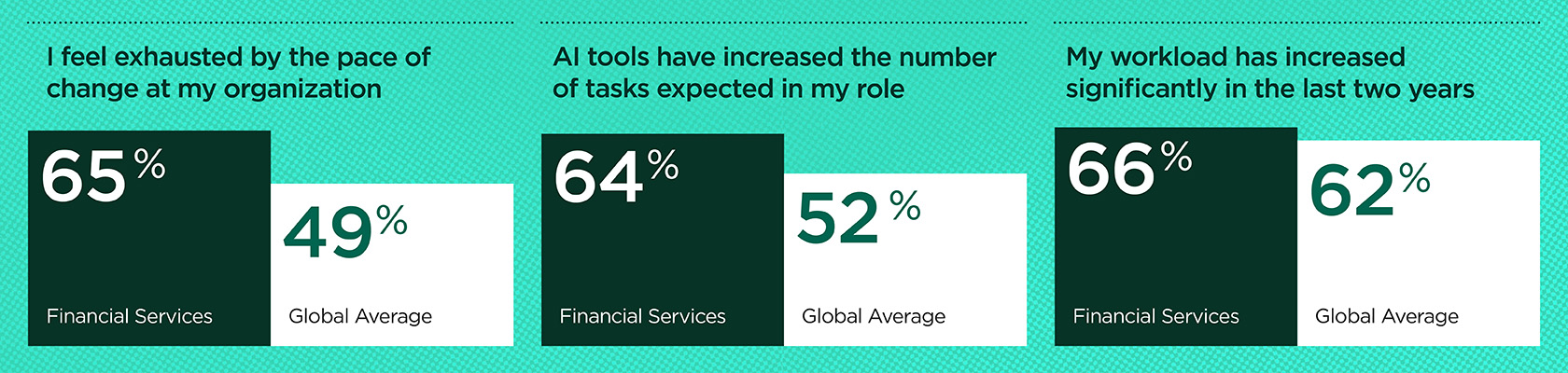
Our annual Workforce 2026 survey uncovered a surprising contradiction in financial services. AI adoption has happened faster here than in any other industry except tech. Yet workers also report the highest levels of exhaustion of any industry we surveyed.
AI was supposed to reduce grunt work and improve efficiency. Instead, many employees say their workload has grown.
Our Workforce 2026 report explains why—and what leaders can do about it.


All In with AI
Financial services employees are no strangers to data-rich, analytical environments.
So when AI arrived, it didn't feel foreign. It felt like a natural addition to their toolbox.
A banker used to spend hours or even days pulling market data and creating slides before a client meeting. AI can do most of that in a few minutes.
But there's still plenty of work left for the banker. Their role is to understand what the data means for the client sitting across the table.
Our survey shows financial services workers have embraced that shift. They see AI as a way to work more efficiently, and many believe it's becoming an important part of building their careers.
The challenge for leaders is now to keep encouraging people to use AI while making sure work evolves alongside it.

Now What?
Redesign the workflow
Rethink employees’ role and processes. Rebuild them around what AI can do and what only people can do.
Protect how juniors learn
If AI is taking over the tasks that once taught the fundamentals, firms need another way to pass that knowledge on.
Teach judgment, not just the tool
Anyone can generate an answer with AI. Fewer people can tell if it's right. That's the skill worth developing.

Moving Fast, Burning Out Faster
Financial services has always been a demanding industry to work in. But given how quickly the sector has embraced AI, you'd expect the job to be getting easier.
Instead, our survey found the highest levels of exhaustion among any industry we surveyed.
Part of the reason is that AI hasn't simply replaced work. Someone still has to check its output, challenge its conclusions, and take responsibility when it's wrong. That work didn't exist two years ago. Now it sits alongside everything that came before.
"AI doesn't get tired, but the people managing it do. If you don't redesign the work around this new way of working, you're asking someone to carry the old job and add on a new one at the same time."
Roberto Zimmermann, Korn Ferry
Most organizations are tracking how many people are using AI. Far fewer are tracking whether those same people have the capacity to use it well.
You can move faster without asking people to do more. But only if you redesign the work itself.
Now What?
Track capacity, not just adoption
Track how many people are using the new tools. Then check whether they still have room to do their jobs well. Both numbers belong in the same report.
Make this a shared C-suite call
A CHRO can't solve this alone. The CEO, COO, and CIO all have a role because this is as much an operating decision as a people one.
Look at the real numbers
Every new AI tool should come with a decision about what it's replacing, who is accountable if it goes wrong, how much time people need to check its output, and whether the overall workload has actually gone down.


The Office Flex Fix
Financial services has a reputation for long hours. Accountants pulling all-nighters to close the books before year-end audits. Analysts still at their desks at midnight finishing a deck for an 8 a.m. client meeting.
Today's finance professionals have more choices than they once did. Financial services firms are competing with technology companies, fintechs, private markets, and advisory businesses that often offer more modern, flexible working models.
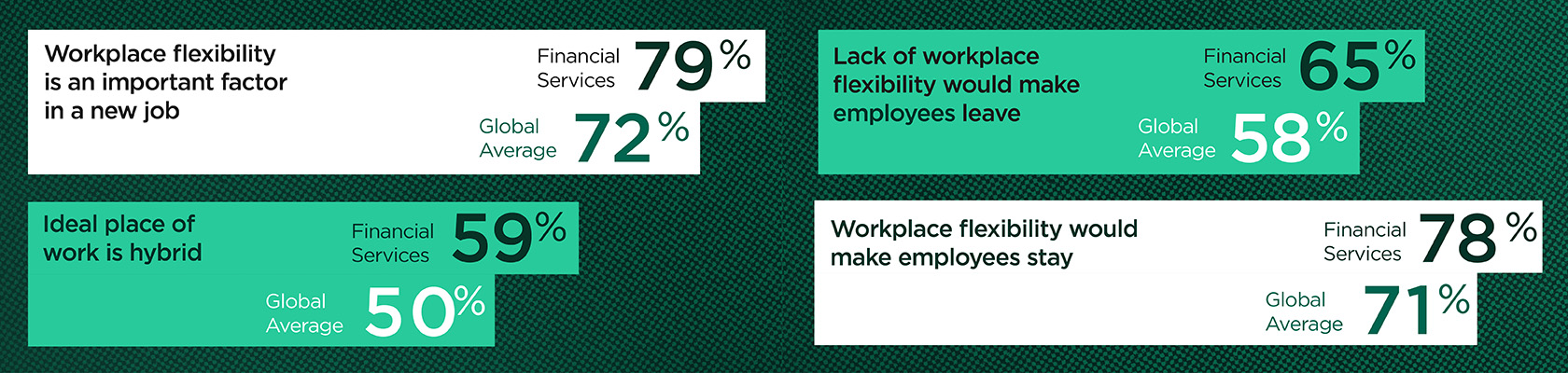
Our survey found that financial services workers place more value on flexibility than workers in any other industry we surveyed. They also say it's one of the biggest reasons they'll stay with an employer—or leave for another.
"Flexibility is a proxy for trust. Employees are asking whether the organization still manages people by presence, or whether it's mature enough to manage by outcomes."
Roberto Zimmermann, Korn Ferry
For financial services, workplace flexibility is now part of attracting and keeping talented people.
Now What?
Stop scoring presence
Days-in-office trackers measure presence. Tie performance to what the role is meant to deliver instead.
Know what needs a room
Client pitches and onboarding might be better in a collaborative office space. Tasks that require deep thought, such as research and drafting, might be better done elsewhere. Draw that line by role and client need instead of a blanket policy.
Train managers to lead hybrid
A flexible policy means little if managers still expect people to follow old office habits, such as checking in constantly or treating absence as disengagement.


Why Korn Ferry for Financial Services?
Nobody understands financial services talent like we do. Our expertise spans Wealth & Asset Management, Investment Banking, Consumer & Commercial Banking, Insurance, Private Equity, Real Estate, and FinTech.
We go beyond placement to help financial firms build and develop high-performing teams. And the insights used to inform our process and advice is grounded in the financial industry’s largest HR and compensation database, ensuring decisions reflect real market conditions.
This is why the world's largest financial services firms choose Korn Ferry.
Want to Chat?
Now you know what today’s financial services workers want. Connect with our financial services team to learn what that means for your organization.