A Concise Summary of Validity Evidence for Korn Ferry's Competencies, Traits, and Drivers (KFCTD) Self-Assessments

A Snapshot of the Science
Organizations increasingly expect talent assessments to deliver both scientific rigor and measurable business impact. The Korn Ferry competencies, traits, and drivers (KFCTD)1 assessment framework was designed to meet both requirements by combining strong psychometric foundations with practical insights that support well-informed workforce decisions (Lewis et al. 2021).
KFCTD integrates three critical domains of human performance: self-assessed competencies reflecting observable workplace behaviors; traits capturing relatively stable personality tendencies; and drivers representing motivational priorities and values. This integrated framework provides a more complete understanding of individual characteristics that impact job performance than traditional single-domain assessments, allowing organizations to evaluate fit relative to specific job requirements rather than relying on generalized personality indicators alone.
The KFCTD also incorporates advances in assessment design that address a key limitation of traditional self-report tools: susceptibility to faking and impression management. By using forced-choice item formats scored with item response theory (IRT), the KFCTD produces normative scores that are more resistant to response distortion and directly relevant to predicting job performance (Lewis et al. 2021; Lewis et al. 2024). Results are interpreted within the context of success profile fit and framed in terms of likelihood of success (Korn Ferry 2025; Lewis et al. 2023), helping organizations place assessment results within a comprehensive view of talent when considering hiring, retention, engagement, and performance outcomes.
Reliability Evidence
Detailed reliability evidence for the KFCTD includes internal consistency estimates derived from large calibration samples and two-week test–retest stability estimates based on a dedicated Korn Ferry Institute study. These estimates indicate that the KFCTD assessment demonstrates acceptable to strong reliability across its major measurement domains.
Across competency scales, internal consistency coefficients average approximately .80, with most scales ranging from the low .70s through .90 (Lewis et al. 2021). In a two-week test–retest study using intraclass correlation coefficients (ICCs), the average stability coefficient across all scales was approximately .70, with nearly 90% of scales classified as demonstrating good or excellent stability (Lewis 2024).
Validity Evidence
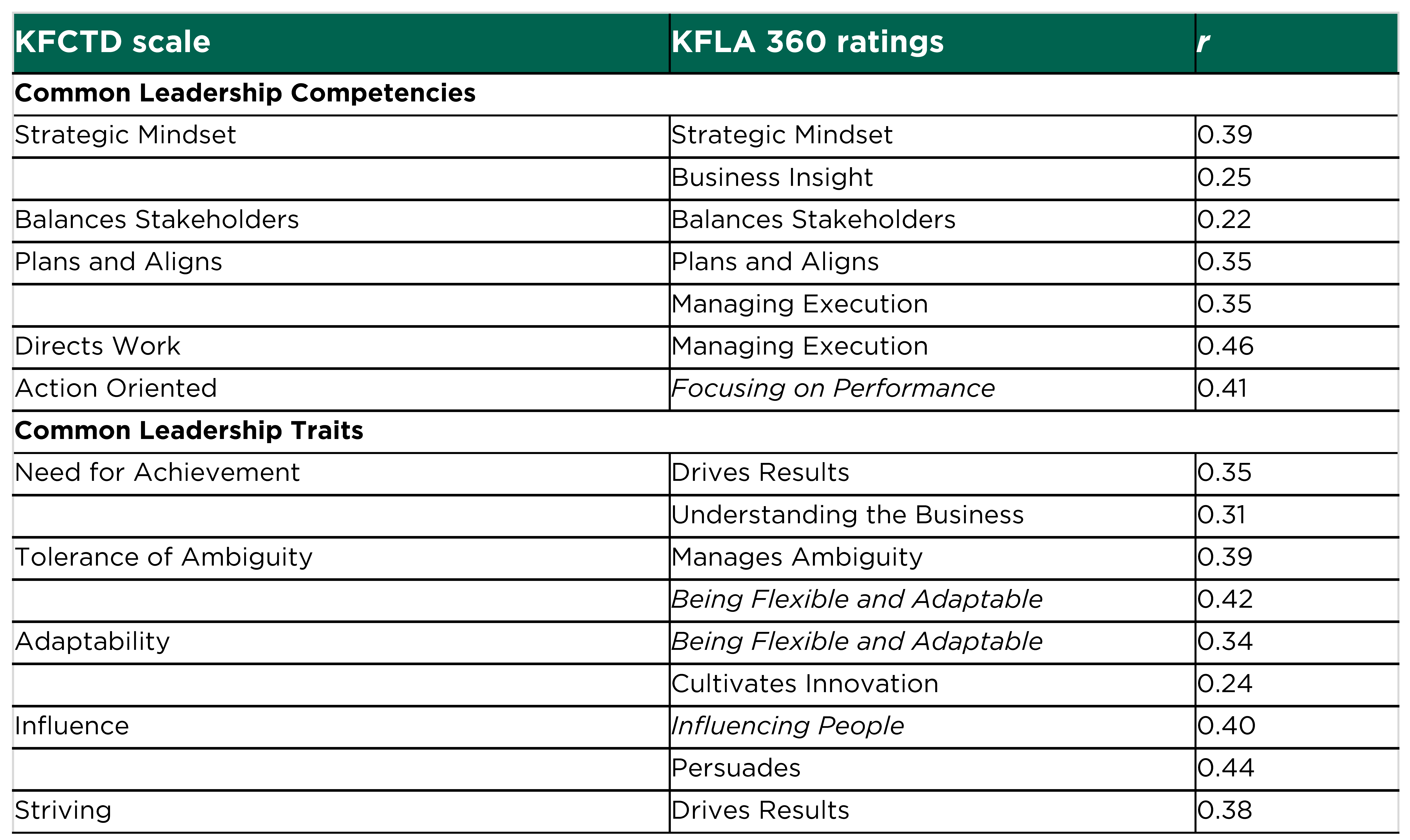
Criterion-related validity evidence examines the empirical relationship between KFCTD scores and relevant job performance measures. The illustrative correlations below use KFCTD scales commonly featured in leadership success profiles and their associations with outcomes from the Korn Ferry Leadership Architect (KFLA) 360 multi-rater assessment.
These correlations were obtained from a sample of over 2,900 professionals using a latent variable modeling approach within a bi-factor multi-trait multi-method (MTMM) framework, separating domain-specific competency variance from rater-type variance across managers, self, peers, and direct reports (average model fit was CFI = .96, RMSEA = .03). Because these ratings reflect observed leadership behavior captured by multiple raters in real organizational contexts, the magnitude of these correlations is particularly meaningful.
These results demonstrate a clear and consistent pattern: KFCTD scores meaningfully predict the leadership behaviors that organizations care most about.
Table 1. Correlations Between Selected KFCTD Scales and KFLA 360 Leadership Outcomes
The following case examples illustrate how this integrated assessment approach translates into measurable organizational impact across selection, engagement, leadership effectiveness, and workforce performance outcomes.
Case Study 1:
Selection Accuracy and Performance Odds
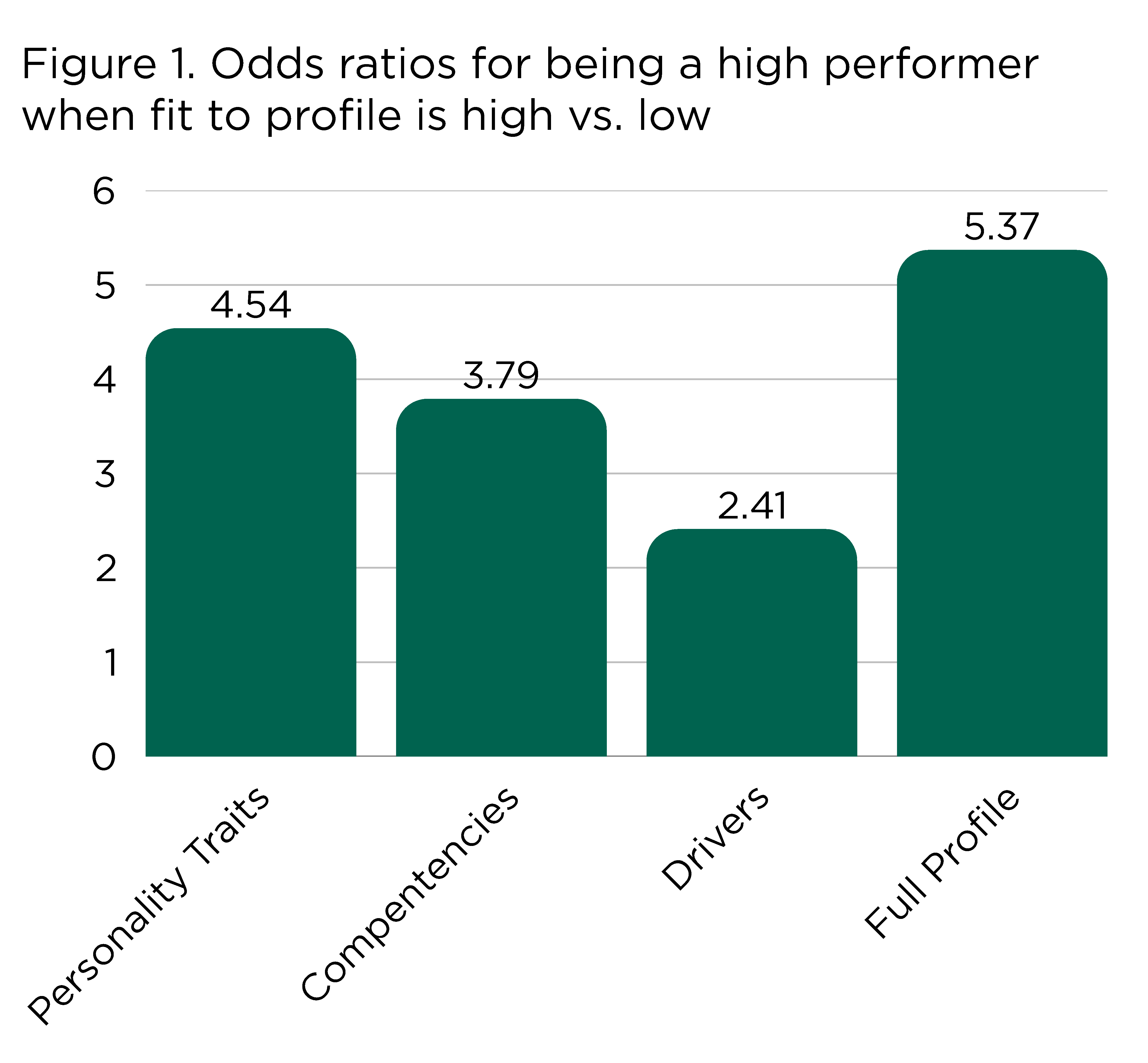
Selection research involving approximately 750 applicants evaluated against role-specific success profiles demonstrated substantial shifts in performance probability based on level of assessment fit. Candidates identified as higher fit showed significantly greater likelihood of achieving strong performance ratings, illustrating how even modest improvements in selection accuracy can meaningfully improve workforce outcomes when applied at scale. Using all domains assessed by CTD showed the greatest impact, but higher fit for any one domain significantly improved the likelihood of strong performance (Lewis et al. 2024).
Figure 1. Odds ratios for being a high performer when fit to profile is high vs. low
Case Study 2:
Fit Matters
A Korn Ferry Institute study of over 120,000 professionals spanning every major industry, eleven global regions, and all job levels examined how alignment between individual traits, drivers, and role-specific target profiles influenced engagement outcomes (Lewis et al. 2023).
Key findings included:
- Individuals with high fit to their success profile were, on average, 7.5 to 8 times more likely to be highly engaged compared to those with low fit, and approximately 2.7 times more likely than average-fit professionals.
- The positive relationship between success profile fit and engagement held from approximately 1.8 times greater likelihood at the low end to over 27 times in some regions. Industry had little to no moderating effect, supporting the conclusion that success profiles are stable across sectors.
- Approximately 90% of the sample did not meet the threshold for optimal profile fit. Modeling showed that shifting even a portion of employees to higher-fit levels could yield a 29% to 37% increase in highly engaged employees.
Case Study 3:
Leadership Impact on Climate and Engagement
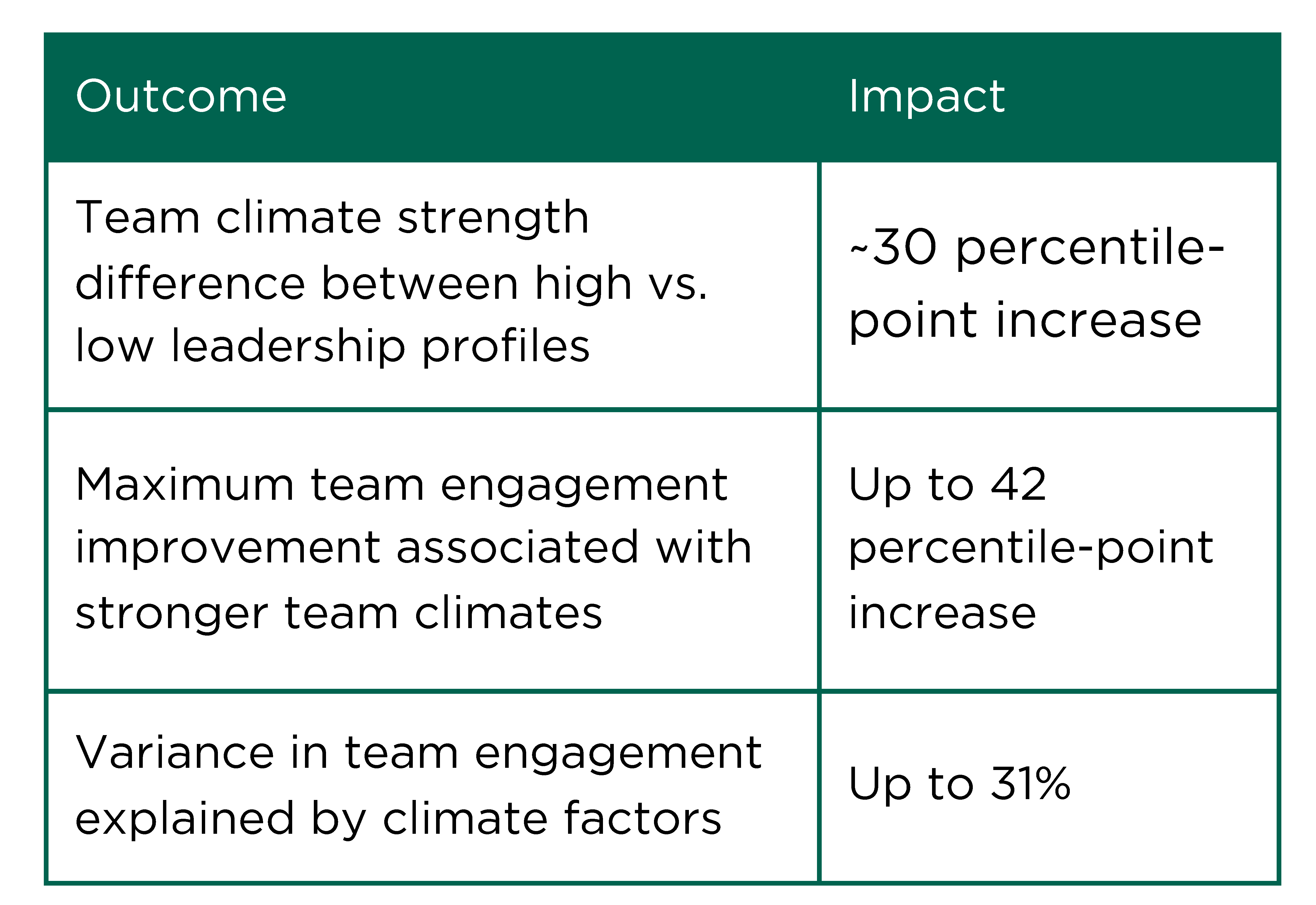
A multi-level study combining data from nearly 3,000 employees across more than 500 teams examined how KFCTD-measured leadership characteristics influence team climate and engagement. Stronger leadership alignment corresponded with substantial improvements in team climate strength and measurable increases in employee and team engagement (Lewis et al. 2025).
Table 2. Team Outcomes and Their Impact
Case Study 4:
Longitudinal Predictive Value
A longitudinal validation study demonstrated that KFCTD results predict future leadership effectiveness and engagement outcomes. Leaders completed the assessment at baseline, engagement was measured approximately six months later, and performance indicators were collected roughly one year afterward (Lewis et al. n.d.).
Key outcomes included:
- KFCTD competency and trait profiles significantly predicted future leadership effectiveness ratings at follow-up.
- Leadership characteristics measured at baseline demonstrated meaningful relationships with subsequent engagement outcomes, indicating that early assessment results forecast later workforce impact.
- Engagement fully or partially mediated the relationship between leadership characteristics and performance outcomes, suggesting that KFCTD scores influence results both directly and through improved leader-driven engagement environments.
Case Study 5:
Probability of High Performance
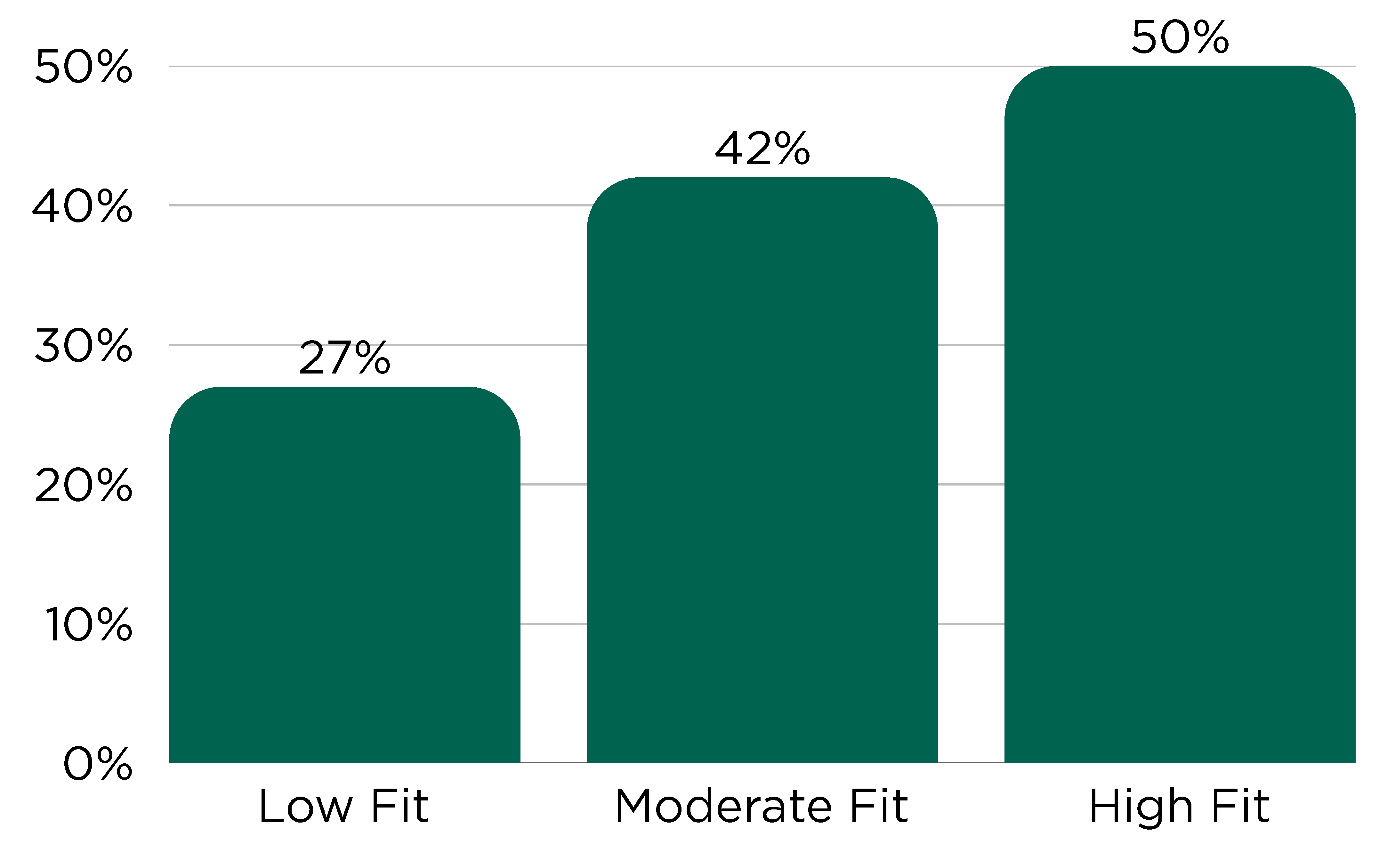
Results from a validation study involving more than 350 employees across multiple job levels, functions, and regions showed a strong relationship between success profile alignment and performance outcomes.
Employees whose assessment profiles closely matched role requirements were nearly twice as likely to be identified as top performers compared with those demonstrating low alignment. Even moderate improvements in fit produced meaningful increases in performance likelihood.
Figure 2. Chances of being designated a "top performer" by KFCTD fit level.
Summary and Practical Implications
Across multiple studies involving thousands of employees, leaders, and applicants, KFCTD results consistently demonstrate meaningful relationships with performance, engagement, leadership effectiveness, and organizational outcomes. By integrating competencies, traits, and drivers within a job-specific framework, the assessment provides organizations with actionable insights that improve hiring decisions, leadership deployment, and workforce effectiveness.
When used as part of a structured talent strategy, KFCTD supports more confident, transparent, and evidence-based decision making while delivering measurable return on investment through improved performance, engagement, and talent outcomes.
1 KFCTD, originally known as KF4D, are core assessments delivered through the KF AssessTM portfolio of solutions, including the Korn Ferry Leadership Solution (KFLS).