Why Boards Should Bet on Transformative Experience

Companies Led by Battle-Tested Executives Are 3x More Likely to Be Future-Ready
Boards spend months debating whether a candidate can lead through disruption. Our analysis suggests that the evidence may already be sitting in the résumé.
The Korn Ferry Institute analyzed the published biographies of CEOs, CFOs, and CHROs across S&P 500 companies. We scored each executive on six types of career experience:
- Cross-sector experience
- Cross-functional experience
- Global experience
- Consulting experience
- Educational breadth
- Challenging experience, including M&A, turnarounds, integrations, change management, divestiture, and crisis response
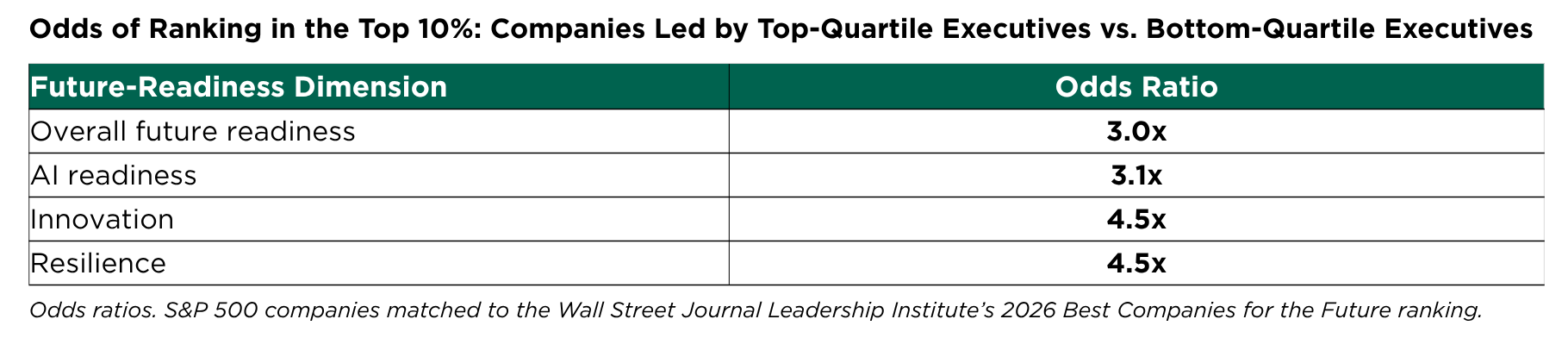
We then matched those profiles against the Wall Street Journal Leadership Institute's 2026 Best Companies for the Future ranking. A pattern was clear. Companies whose top executives scored in the top quartile on transformative experience were roughly three times more likely to rank in the top 10% for future readiness overall. They were also 4.5 times more likely to rank in the top 10% for innovation and resilience.
These findings do not prove that career experience causes future readiness. But they do suggest that some career paths offer useful evidence about how leaders learn, adapt, and respond when conditions change. Companies led by executives with more transformative career experiences were more likely to rank among the strongest future-ready performers.
Why This Matters Now
In a predictable market, management wins. Set the goal, build the plan, track performance, correct the deviation.
That playbook is no longer enough. AI is changing cost structures and competitive positions faster than annual planning cycles can absorb. Geopolitical risk is reshaping supply chains. Regulation is moving unevenly across markets. Organizations can no longer optimize their way through conditions that keep changing.
What organizations need instead is the capacity to see change early, make decisions with incomplete information, and adapt while conditions are still shifting. That capability matters at every level of the organization but is particularly critical at the top. Senior executives face the greatest ambiguity, and their decisions shape the organization's tolerance for risk, speed of response, and willingness to change.
The practical question for boards is not whether agility matters, but how to identify it before you hire.
Not All Experience Builds Adaptability
Twenty years in the same function can build deep expertise. It does not necessarily build adaptability. What changes how a leader thinks is transformative experience that is varied, difficult, and consequential:
- Variety exposes leaders to different functions, geographies, markets, and business models. It broadens the range of patterns a leader can recognize.
- Difficulty forces leaders to learn when the familiar playbook no longer works.
- Consequence makes the learning stick because the stakes are real for employees, customers, investors, and communities.
Biographies do not reveal character or motivation. They also cannot tell the full story of a leader’s impact. But they do show the terrain a leader has crossed. When a career includes repeated exposure to varied, difficult, high-stakes assignments, the odds are better that the person has built adaptive capacity. Our data suggests those odds are measurably better for the company, too.
Two Experience Types Stood Out
Among the six dimensions we scored, two had especially strong relationships with future-ready outcomes.
Global Experience Was Associated With Supply-Chain Readiness.
Leaders who had operated businesses across multiple regions were more likely to have firsthand exposure to different regulatory systems, distribution models, customer expectations, and market-level risks. Companies led by executives with stronger global experience scored materially higher on supply-chain resilience.
Challenging Experience Was Associated With AI Adoption and Innovation.
Executives who had led through M&A, turnarounds, spin-offs, or crises were more likely to be running companies that had adopted AI at scale. The strongest single relationship in the study was between challenging experience and a company's ability to bring frontier skills (or leading-edge capabilities) into the organization.
The implication is that agility is not one generic quality. Match the experience type to the strategic priority.
What Has This Leader Had to Learn?
Executive selection processes often emphasize tenure, pedigree, and past performance. Those factors matter, but our findings suggest boards should also ask a different question:
What does a leader’s past reveal about their capacity to navigate the future?
Leaders who have moved across markets, functions, business models, and periods of disruption may have developed a different capability than those whose careers unfolded in relatively stable conditions. They may be better prepared to recognize unfamiliar patterns, make decisions with incomplete information, and adapt as conditions change.
The implication is not that résumés replace judgment. It is that experience can provide useful evidence about how leaders have been tested—and whether those tests resemble the challenges the organization is likely to face next.
The findings become easier to see in practice. While no outcome can be attributed to a single executive, the following examples illustrate how prior experiences can help shape the capabilities that support future-readiness.
Case 1: A Leadership Reset Restores AI Competitiveness
A large technology manufacturer appointed a new CEO after a period of losing ground. Its share price had fallen sharply while the sector advanced.
The incoming leader brought experience across multiple sectors, multiple functions, and advisory work. More important, the leader had a track record of steering organizations through major change.
The transformation agenda that followed emphasized engineering discipline, customer focus, and renewed investment in emerging technology. Investor sentiment improved. The share price recovered and then outpaced the industry. The company now ranks among the top 20 in the S&P 500 for AI readiness.
No strategic outcome belongs to one executive. But when a company faces disruption, a leader who has done transformation work before may be better positioned to reset direction and mobilize the organization behind it.
Case 2: Global Experience Strengthens Supply-Chain Readiness
A global consumer-products company built a senior team with deep experience running businesses across multiple regions.
That exposure appeared in how the company managed a complex supply chain spanning agricultural inputs, packaging, production, distribution, and cold-chain logistics. Public disclosures point to investments in climate-risk assessment, supplier coordination, predictive disruption alerts, and sourcing models that balance local execution with global flexibility. The company ranks among the top 20 in the S&P 500 for supply-chain readiness.
Leaders who have operated across markets often anticipate disruption differently because they have already encountered it somewhere else.
What Boards and CEOs Should Do Now
Read Experience, Not Just Tenure.
In succession reviews and external searches, look beyond years in role. Focus on breadth of difficult, high-stakes assignments.
Use AI to Make Experience Analysis Scalable.
Executive biographies, leadership profiles, company announcements, and public career histories can now be analyzed across entire candidate slates. What once required extensive manual research can now be done consistently and at scale.
Treat Experience as Evidence, Not Proof.
Career history should inform executive assessment, not replace it. Biographical signals should complement interviews, assessments, references, and judgment about values and motivation.
Assess the Team, Not Only the Individual.
Boards and CEOs should view executives as a portfolio of experiences. The question is whether the team collectively covers the breadth your strategy requires.
Match Experience to Priority.
Different challenges require different experiences:
- Global experience for resilience and supply-chain complexity.
- Transformation experience for AI adoption and innovation.
- Cross-functional and cross-sector experience for new markets and business models.
Define the experiences your strategy requires, then look for leaders who have lived them.
Build the Bench Deliberately.
Stretch assignments, international roles, turnarounds, integrations, and crisis-response roles are not rewards for high performers. They are how adaptive capacity gets built.
Close the Gaps Before You Need Them.
Define the challenges the organization will face, identify the experiences successors need to meet them, and revisit as strategy shifts.
The goal is not to predict the future perfectly. It is to build leaders who are less dependent on the future being predictable.
Our findings suggest that experience can provide an important clue. Leaders who have taken on different challenges, in different settings, under different conditions may be better prepared for what comes next. A résumé is not proof. But it may be the best evidence available before the next disruption arrives.
How We Did It
We collected publicly available biographies of CEOs, CFOs, and CHROs at 2025 S&P 500 companies via CapIQ. A large language model (GPT-5.2) scored each biography on six experience dimensions using a five-point scale, with higher scores indicating more diverse, developmental, or challenging experience. Scores were standardized within role, then aggregated to a company-level profile and an overall composite. Company profiles were linked to the Wall Street Journal Leadership Institute's 2026 Best Companies for the Future ranking.
Reported figures are odds ratios comparing top-quartile to bottom-quartile companies on the likelihood of ranking in the top 10% of each dimension. Correlations cited in the text: global experience and supply chain readiness, r = .32, p < .001; challenging experience and AI adoption, r = .19, p < .001; challenging experience and frontier-skills innovation, r = .37, p < .001. The analysis is correlational and does not establish causation.
This research builds on prior Korn Ferry Institute research showing that scientific assessment of senior leaders is associated with stronger financial outcomes.