The CMO Squeeze
Are CMOs in the hot seat? Budgets are down, AI continues to upend business, and market uncertainty abounds. A leading CMO discusses how marketing leaders can still deliver a strong ROI despite challenges.

The CMO Squeeze
NOTE: While this transcript has been reviewed, it may contain errors. Please review the episode audio before quoting from this transcript.
Jill Wiltfong:
CMOs are facing more pressures than ever. Tell me what's changed recently in terms of expectations.
Gabie Boko:
The focus seems to be on justifying your spend and justifying your existence.
[Rob Reiner as Max Belfort – ‘The Wolf of Wall Street’ movie]:
$26,000 worth of sides?
Jill Wiltfong:
Have you had to make any adjustments to your strategy?
Gabie Boko:
I have definitely had to pull back. You see people going all in and then losing their way.
Jill Wiltfong:
The CMO squeeze.
[CMO]:
Hi. Just checking in. Did you have a chance to look at my marketing proposal?
[CFO]:
I did. Talk me through it a Bit.
[CMO]:
So, we're planning on setting up pop-up installations in malls all across the country. It'll be super curated with staff on hand to let people interact with our products. And there'll even be a DJ playing music and snacks being served. We're calling them Pop-up Parties. So, what do you think?
[CFO]:
That sounds incredible. I love it. So innovative.
[CMO]:
Really?
[CFO]:
Yes. Just one eeny-weeny, teeny-tiny adjustment.
[CMO]:
Name it.
[CFO]:
I need you to do all this on half the budget.
[CMO]:
But how?
[CFO]:
Who needs a DJ and snacks? Music is overrated, and so is food. Problem solved. You know, we make such a great team,
[CMO]:
Right. Looks like it's gonna be one of those quarters.
Jill Wiltfong:
Hi, I am Jill Wiltfong, Chief Marketing Officer for Korn Ferry. And this is "Briefings" our deep dive into topics that corporate leaders need to care about.
Well, listen, I love my role, but objectively speaking, you could argue CMOs are facing more pressures than ever. Budgets are down an average of 15% this year, but demands to prove the value of marketing efforts, the so-called ROI, keep growing. Most importantly, it's the CMO in most firms who's expected to integrate all the millions of dollars companies are spending on artificial intelligence into everything from advertising to content development, and more. This, before the technology is even mature. And let's not forget how little time CMOs have to do all of this. Their average tenure is the shortest of all C-suite jobs. So, let's explore the CMO squeeze.
Before we start, if you're watching us on YouTube, please be sure to like, subscribe and leave a comment to let us know your thoughts on this topic.
I am joined today by a good friend, Gabie Boko, Chief Marketing Officer for NetApp in Silicon Valley. As a marketer with over two decades of experience, I can think of no one better to speak on this topic. So welcome to the podcast, Gabie.
Gabie Boko:
I am so excited to be here. Not just because it's you, but because you and I have great conversations. So this is gonna be fun.
Jill Wiltfong:
Yes. What I find really interesting about your background is you started your career thinking you were going to be a lawyer. What made you shift to marketing? Why did you choose this route?
Gabie Boko:
Yeah, I think it probably carries over to even what I like today, I am a slight bit of an introvert. I do geek out on things like data and getting a little widgety. So, law for me was one of those things where I was passionate about, you know, reading the books and being in the library and going through the briefs. And then I woke up one day and said, "Oh no, that's really boring. I can't do that my whole life." That's like something fun I wanna do. And I remember going home to my mom at some point and I was crying and I was like, "I'm never gonna be a lawyer and I don't know what to do with my life!" And she handed me a newspaper and she's like, "Well, first thing you need to do is get a job."
Jill Wiltfong:
Fair enough. So now it's been a good little while that you've been doing this, this marketing thing. Tell me what's changed recently in terms of expectations and what you do as a CMO. Have you seen a shift there in what you're expected to work on?
Gabie Boko:
The focus seems to be inordinately on justifying your spend and justifying your existence through the metric of business or revenue to the company. And I think that that's a hard place to be in for marketers, right? I think it's incumbent upon marketers to try to find a way to pull that back and say, "We're more than just that and here's how you need to adopt it." But I think that's first point of entry for most companies. And most CMOs get stuck there.
Jill Wiltfong:
Many marketers have smaller budgets this year. Have you had to make any adjustments to your strategy to cope with that?
Gabie Boko:
Absolutely. Absolutely. I talked up at the top at one, right? Where are we gonna advertise? I'm not gonna do much advertising. I'm gonna do it very prescriptively, some search and some out-of-home. I have definitely had to pull back. Listen, I think marketing is great, right? Because you can have a very wide mix and you can dial those levers up and down. For me right now, digital is one that I keep on a slow simmer because I need other things to work in order to feed the engine to get me scale. Digital is my scale engine.
[Leonardo DiCaprio as Jordan Belfort – ‘The Wolf of Wall Street’ movie]:
Yes.
[Rob Reiner as Max Belfort – ‘The Wolf of Wall Street’ movie]:
Jordie! Look what you got here.
[Leonardo DiCaprio as Jordan Belfort – ‘The Wolf of Wall Street’ movie]:
What?
[Rob Reiner as Max Belfort – ‘The Wolf of Wall Street’ movie]:
Look at this. $26,000!
[Leonardo DiCaprio as Jordan Belfort – ‘The Wolf of Wall Street’ movie]:
Okay. No, no, no. This can be explained. Dad, we had client, we had Pfiz, the Pfizer clients.
[P.J. Byrne as Nicky Koskoff – ‘The Wolf of Wall Street’ movie]:
Right. The porterhouse from Argentina.
[Leonardo DiCaprio as Jordan Belfort – ‘The Wolf of Wall Street’ movie]:
The expensive champagne and the wine, we had to buy champagne and-
[Jonah Hill as Donnie Azoff – ‘The Wolf of Wall Street’ movie]:
I ordered the side so-
[Rob Reiner as Max Belfort – ‘The Wolf of Wall Street’ movie]:
Sides? Sides? $26,000 worth of sides!? What are these sides? They cure cancer?
Jill Wiltfong:
That's a scene from "The Wolf of Wall Street" where Rob Reiner plays a Chief Financial Officer of sorts who serves up a tongue lashing over how the company's funds are being spent.
Gabie, when it comes to budgets, we know the CFO holds those purse strings. And funnily enough, you and I were on a podcast recently about bridging the CMO-CFO divide, where you actually talked about how CFOs get frustrated by CMO metrics or sometimes the lack thereof. Can you share a little bit more about your perspective there?
Gabie Boko:
Yeah, I have decided and discovered that I don't need to be best friends with my CFO. I have also discovered that my metrics on my day-to-day, you know, like leads, MQLs, SQLs, pipeline, that doesn't interest him. I have to, and have started to pivot to say, "What are the metrics that are most important to you?" For him it's, you know, investment and investors. How is market share in helping that? Right? And how can I start to prove those metrics out? I think what I've gotten to is I just need to be a really good partner and I need him to see that I'm that versus, "I'm right or he's right."
Jill Wiltfong:
Let's switch gears and talk about tech for a second, a space you know very well. Generative AI is one of the biggest changes we've all experienced in whatever function you're in. For marketing, nearly 9 in 10 marketers have used or experimented with AI. How has AI changed the way you and your team are operating today?
Gabie Boko:
I like marketing as the first person in. Jump in the pool. I'm ready, let's try it. I don't know what's gonna happen, but I'll try it. I think marketing should be that, that risk thing, that risk assessor. I think AI, for me right now, is I am trying to have a balance. It's my job to have my team risk, but I need to have a balance. I've seen many, many trends. I'm not gonna tell you how old I am, but when you look at all the trends, right? You see people going all in and then losing their way. I think we saw that exclusively on, let's just call it the digital focus that came out of COVID. People went all in on, you know, hybrid meetings and digital meetings and meeting online and what that means for experiences online and, you know, really upping the ante. And now that people wanna be face to face, that signals an old school. We're done with that. I think what I'm just trying to do is perfect a hover state. I need to be somewhere in the middle and say whatever happens, at least we're on the train.
Jill Wiltfong:
One of my very favorite things about you is your positivity. So, I wanna end on a fun story and whether it's AI related, or maybe it has nothing to do with AI, tell me about your favorite marketing campaign that you've ever led. What made it exciting? I suspect it might inspire some of us.
Gabie Boko:
Oh, you know, I'm gonna go a little old school on my campaigns. My favorite campaigns were when I was younger, quite frankly, and I have two of them. One is, I did this when mail was a thing and not email.
Jill Wiltfong:
"What is mail?" People are googling that right now.
Gabie Boko:
When the post office was a thing. Precursor to all digital lists, but it was really about customer lists and how do you reach those customers. We had an issue where people didn't understand all the terminology. Technologies can be a little like word salady. And so, I did a campaign over a year of all the terms we use and I got so much response and so many customers and even competitors trying to imitate it. That, to me, was like, just, you know, when you have a concept and it's like, "I'm just trying to make it easy for people who wanna understand us understand us," and then it kind of goes, it jumps the shark and you see other people doing it. That's one of my favorites.
And then my second favorite, again, is super old school. It's a bus tour.
Jill Wiltfong:
Oh no. Like a wrapped bus.
Gabie Boko:
And it wasn't even my idea, but it was, you know, it's this back-to-basics, like when all else fails. Where do you wanna meet your customer's needs? How do you wanna tell a story and what's the most unique way you can get there? I think both of those vehicles are like, listen, nothing is wrong whenever you're trying to do that. Right? You don't have to do it the way everybody else does. And sometimes standing out from the crowd is what makes marketing the most fun. So yeah, those are my favorite.
Jill Wiltfong:
Well, Gabie, my dear, marketing bestie, it has been great chatting with you. Let's definitely do it again.
Gabie Boko:
Let's totally do it again. I like talking to you.
Jill Wiltfong:
All right, well that is it for me for now. Up next, be sure to stick around 'cause we're gonna have some important news from the business world from "This Week in Leadership." So stay tuned.
Rupak Bhattacharya:
Hi, and welcome to "This Week in Leadership." I'm Rupak Bhattacharya. And here's a quick look at what else is happening in business.
[Interviewee]:
People that are leading that really have never been equipped or trained to lead.
Rupak Bhattacharya:
Two thirds of British managers failed to receive training before they took their managerial role. That's despite one third demanding it. Experts say that while letting managers sink or swim on their own may have passed muster in the past, a more intentional approach is needed for today's much more complex business environment.
[Interviewee]:
Implement reverse mentoring.
Rupak Bhattacharya:
At a time when nearly half of managers call Gen Zers difficult to work with, a handful of firms are asking Gen Z workers to mentor their older colleagues. Studies have shown that this so-called reverse mentoring may help improve relations between different generations in the workforce.
[Interviewee]:
Why CEO turnover is increasing.
Rupak Bhattacharya:
According to a new analysis of Fortune 100 firms, only 19% of modern CEOs have spent their entire tenure at just one firm. A precipitous drop from 44% back in 1980. One major factor is that boards have become more appreciative of the diversity of experience brought by outside CEOs.
For more insights on business and leadership, head to kornferry.com/insights.
Jill Wiltfong:
The Executive Producer of "Briefings" is Jonathan Dahl. Today's episode was produced by Rupak Bhattacharya, Nadira Putri, and Teresa Allan. And it was edited by Jaron Henrie-McCrea. It contains reporting by Russell Pearlman, Arianne Cohen, and Peter Lauria.
Our video segment contains original artwork by Frazer Milton, Hayley Kennell, Jonathan Pink, and Sasha Kostyuk.
Don't forget to read our magazine, available at newsstands and at kornferry.com/briefings. That's it for Korn Ferry “Briefings”. I'm Jill Wiltfong. See you next time.
Gabie Boko:
No, we won't say that. Here, let's do it again. I was gonna be mean to you but I can't be mean to you. It's just not fun.
Subscribe to series:



Podcast Guest
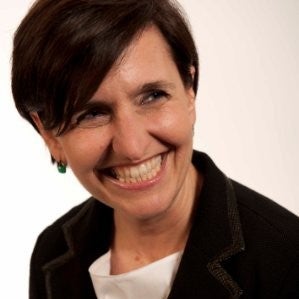
Gabie Boko
Chief Marketing Officer
NetApp
Gabie brings over 22 years of tech marketing experience, blending data-driven innovation with customer success. Her expertise spans software, cloud services, and digital strategy. She has successfully led organizational transformations at HPE, Sage, SAP, and Cognos.