Ghosted…Again!
Professional ghosting started with firms ghosting candidates and candidates ghosting firms.
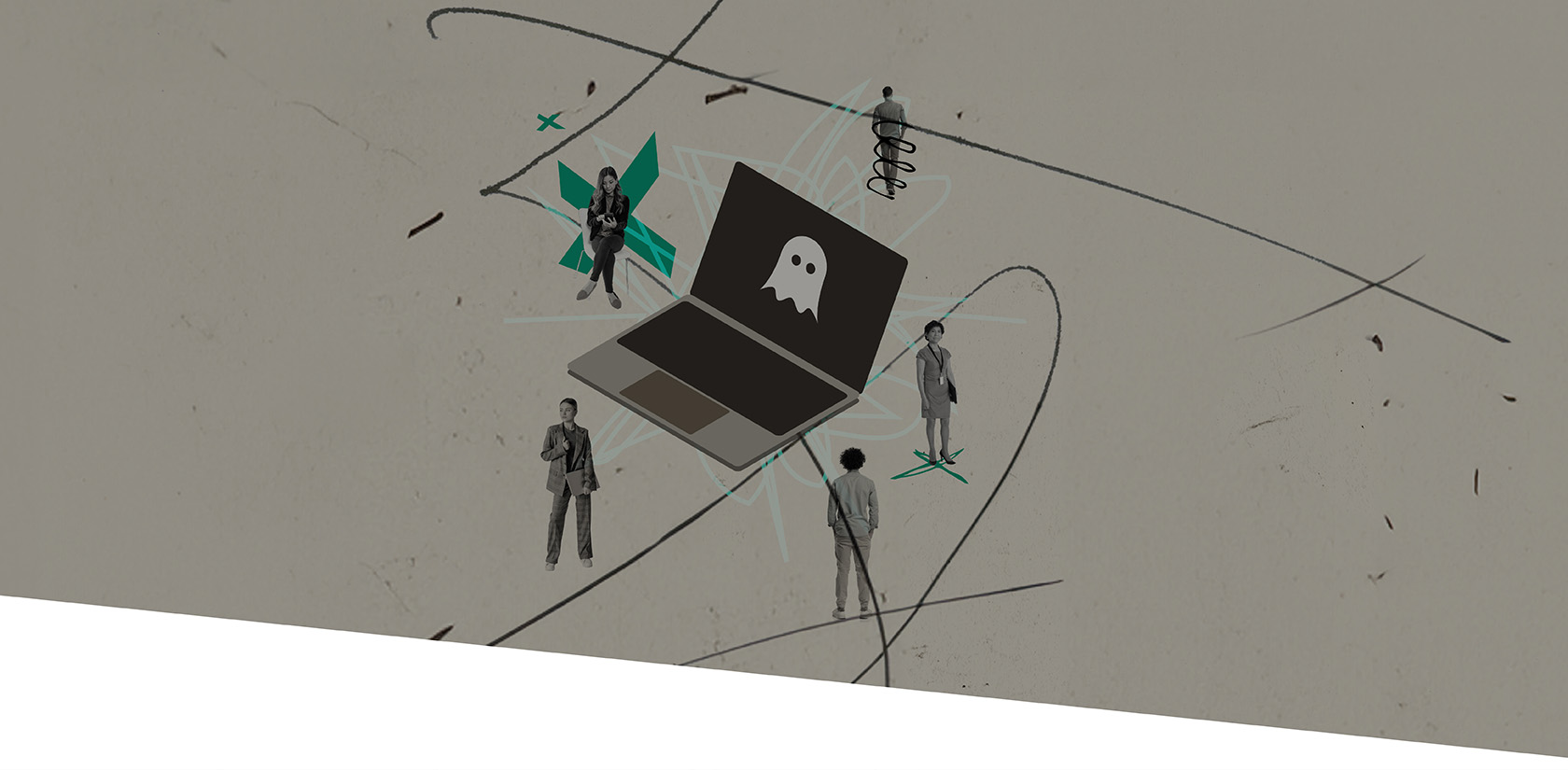
Ghosted...Again!
NOTE: While this transcript has been reviewed, it may contain errors. Please review the episode audio before quoting from this transcript.
Jill Wiltfong
Hi, I'm Jill Wiltfong, Chief Marketing Officer for Korn Ferry, and this is Briefings, our deep dive into topics that corporate leaders need to care about.
You need to reach your colleague or your boss so you make the phone call, send the email, write the text, all with the best of intentions—and then nada, zip, zilch, crickets. Congratulations, you've been officially ghosted.
The New York Times has called the phenomenon an "epidemic of unsatisfactory conclusions and unexplained rejections." The issue might seem trivial, but it's actually critically important for leaders to address it—and fast—because when work relationships break down, companies break down.
So given that, today, let's see how precisely leaders can get people to give up the ghost on ghosting as we take a closer look at how we can all keep from getting ghosted again.
Before we start, if you're watching us on YouTube, please be sure to like, subscribe, and leave a comment to let us know your thoughts on this topic.
With us now is Frances Weir, a business psychologist with many years of experience plumbing the depths of why working professionals behave the way they do—and how they can possibly adjust certain behaviors to improve performance and collaboration. Frances, thanks for joining me.
Frances Weir
Thank you so much for having me again.
Jill Wiltfong
So you've actually said that ghosting has a basis in evolutionary psychology, which is a pretty striking idea on the face of it. Were our caveman ancestors, Frances, not responding to one another in a timely fashion? Tell me what you mean when you say this is rooted in evolution.
Frances Weir
Sure. I think there's an evolutionary component in that we have very strong preferences to be in group. Historically, that's where we found safety.
Layer in something like social psychology—there are studies where people will give answers they know are wrong just because the group says so. These deeply rooted preferences create an “us” and a “them,” and with that comes a desire to put distance between the two. That can absolutely be a precursor to ghosting.
That’s why we tell someone starting at a new company—or an applicant—to build rapport as much as possible. Often the most effective way to do that is by establishing similarities, creating an “us.”
Jill Wiltfong
Alright. For someone who has been ghosted, psychologists might say they experience something called the Zeigarnik effect. That's where we tend to ruminate on things that haven't achieved resolution. You've also said being ghosted can affect our brain chemistry. What’s going on inside us when we get ghosted? Why does it feel so bad from the perspective of the brain and the psyche?
Frances Weir
Maybe it's best to explain what feels really good first. Humans interacting like this—engaging through storytelling, reflecting back—that activates attachment, fires our mirror neurons, and increases oxytocin, the feel-good hormone.
With ghosting, there's none of that. There’s no human-ness in a one-sided exchange. And what’s worse is it usually follows an exchange that might have felt warm or engaging.
[Cip from the movie Transcendence]
Jill Wiltfong
That's a scene from the movie Transcendence, in which Johnny Depp plays an AI researcher who has uploaded his consciousness into a computer. We're not far off from that today with reports of people sending AI avatars to take meetings in their place.
Francis, given AI's power to augment communication, do you think it can help cure the ghosting epidemic—or could it possibly make it worse?
Frances Weir
There’s a lot of research showing relationships are integral to human wellbeing and happiness. So I find it hard to believe that removing humans from the process will improve outcomes.
Maybe I’m cautious, but for now I’d say the best use case for AI is in candidate management or client relationship management. I’d sooner task AI with closing the loop than with building the relationship.
Jill Wiltfong
Finally, if you’ve been ghosted—and it’s probably happened to all of us—what steps do you advise people to take, both to protect themselves psychologically and possibly to remedy the situation with their colleague who’s done the ghosting?
Frances Weir
Ghosting can feel like an erasure of identity, and that’s what gets to us most. It triggers feelings of “I don’t matter” or “I’m not important.” A good antidote is to engage in activities or relationships that reinforce your identity and remind you who you are.
As for reaching back out: research suggests we get further with kindness than anything else. If you do choose to continue reaching out, do so with empathy, curiosity, even concern. Even if they never respond, you’ll lose a lot less of yourself in the process.
Jill Wiltfong
Very good advice. Frances, thank you for sharing your thoughts. A lot to chew on as always.
Frances Weir
Thank you so much for having me.
Jill Wiltfong
We’ve looked at ghosting from the personal point of view. When we return, we’ll talk to a people strategy expert to see what responsibility companies should be taking—and why, if you’re being ghosted, it might just be your fault. Stay tuned.
Jill Wiltfong
We’re back talking about a ghosting epidemic in the workplace that could spell doom for company culture. With us now is Roger Philby, Global Lead of Korn Ferry’s People Strategy and Performance Practice. He spends lots of time not ghosting, but helping leaders and organizations improve communication and build critical connections. Roger, thanks for being here.
Roger Philby
Of course, good to see you again, Jill.
Jill Wiltfong
So that last clip we showed featured Rachel McAdams in The Notebook, chastising Ryan Gosling for supposedly ghosting her. Of course, ghosting in the business world changes the stakes from broken hearts to broken balance sheets.
Roger, you’ve said much of the reason ghosting is getting worse at the office comes down to remote work. Tell me about that.
Roger Philby
Ghosting is easier when you don’t feel connected or seen. Remote work has definitely made it easier to bump a remote call than to avoid someone showing up in person. This detachment makes ghosting more acceptable and easier. There’s no friction to it, which is the issue.
Jill Wiltfong
You also have an interesting take—that if you’re being ghosted, it might actually be your fault. How so?
Roger Philby
I had an amazing coach who was a shaman. I once complained that a client wasn’t responding to my witty, brilliant communication. He told me: “Your communication is getting the response it deserves.”
I do think ghosting is often a symptom of a poor value exchange. Not always—some people are just plain mean—but usually it reflects a lack of value for the other person. So if I’m getting ghosted, I ask myself: what am I doing that makes it acceptable for them to ignore me?
Jill Wiltfong
That’s leadership expert Simon Sinek describing the awful feeling of being ghosted. But research also shows ghosting can harm not just the person being ghosted, but the person doing the ghosting too. So, it’s bad all around.
Roger, what should leaders be doing to stop this behavior from continuing at their companies? How can they make it easier for colleagues to have difficult conversations instead of avoiding them?
Roger Philby
I always say: if ghosting is happening, don’t address ghosting—address the trust issue first.
Invite someone for a coffee, even a virtual one. Share something about yourself. Clarify the value exchange: “This is what I hope to get from you. What would be valuable for you to get from me?” Give them an exit ramp, not an escape hatch. That way they don’t just ignore you.
Jill Wiltfong
I’d like to end on a personal anecdote. You’ve shared about being ghosted yourself recently. Tell me what happened and how you worked through it.
Roger Philby
In this case, I was communicating with a client who wasn’t responding at all. I had to rethink the value of our relationship. The truth was—we didn’t have one.
So, I called someone I did have a relationship with and asked them to connect me. Suddenly, we were booked for a call. I asked to meet face-to-face, and now that client and I have a trusted advisor relationship. They’re a great client for Korn Ferry today.
Jill Wiltfong
As always, great to have your candor and experience here. Appreciate you being here today.
Roger Philby
No problem. Thanks, Jill.
JILL WILTFONG:
The executive producer of Briefings is Jonathan Dahl. Today’s episode was produced by Rupak Bhattacharyya and Zachary Dore, and it was edited by Jaren Henry McRae.
It contains reporting by Russell Pearlman, Ariane Cohen, Peter Lauria, and Meghan Walsh. Our video segment contains original artwork by Fraser Milton, Haley Kennel, Jonathan Pink, and Sasha Kotzek.
Don’t forget to read our magazine—available at newsstands and at kornferry.com/briefings.
That’s it for Korn Ferry Briefings. I’m Jill Wiltfong. See you next time.
Subscribe to series:




Podcast Guest
Frances Weir
Business Psychologist
Frances is a British Business Psychologist who has driven People Strategy & Operations for some of the world's biggest brands. She is a trusted expert in Leadership Development, Executive Coaching and Psychometric Assessment.

Podcast Guest
Roger Philby
Global Lead, People Strategy & Performance Practice
Korn Ferry
Roger Philby is our UK Head of Consulting and Global Leader of Korn Ferry’s People Strategy & Performance Practice, based in London.He advises C-Suite leaders across the FTSE100 and Fortune 500 on their most pressing talent challenges, whilst defining the vision and direction of Korn Ferry’s approach to People and Talent Strategy.
With a background in industry, before joining Korn Ferry, Roger started an award-winning, global organizational consulting firm in 2003, existing to PE in 2024. His industry experience covers 30 years across Energy, Utilities, Technology, Financial and Professional Services, across 61 geographies.