The Mind Meld: AI & Humans
AI has some leaders openly pronouncing layoffs or hiring freezes, but new data suggests that's the wrong approach. Two experts discuss how melding human and machine capabilities is the real way forward.
The Mind Meld: AI and Humans
NOTE: While this transcript has been reviewed, it may contain errors. Please review the episode audio before quoting from this transcript.
Jill Wiltfong
Hi, I'm Jill Wiltfong, Chief Marketing Officer for Korn Ferry, and this is Briefings, our deep dive into topics that corporate leaders need to care about.
AI — those two letters now have at least some company leaders envisioning a world where, soon, bots and agents rule the workplace and humans are cast to the sidelines. Some have even openly pronounced layoffs or hiring freezes on a massive scale.
But experts say that's precisely the wrong approach. They say smart firms are trying to find a way to partner with humans, to meld the two abilities — human and machine — to reach new heights of innovation and productivity together.
It's a challenge, but it appears to be the reality, at least for the near future. In fact, a Korn Ferry survey of 250 CEOs and board directors globally found that 82% of leaders say they believe AI will replace less than 20% of the workforce in the next two to three years.
But how do you harness the best of each — the human intuition and creativity with the massive scaling of intelligence that AI can do? And are workers even able or willing to try? Nearly half of leaders believe their workforces will need substantial reskilling for AI.
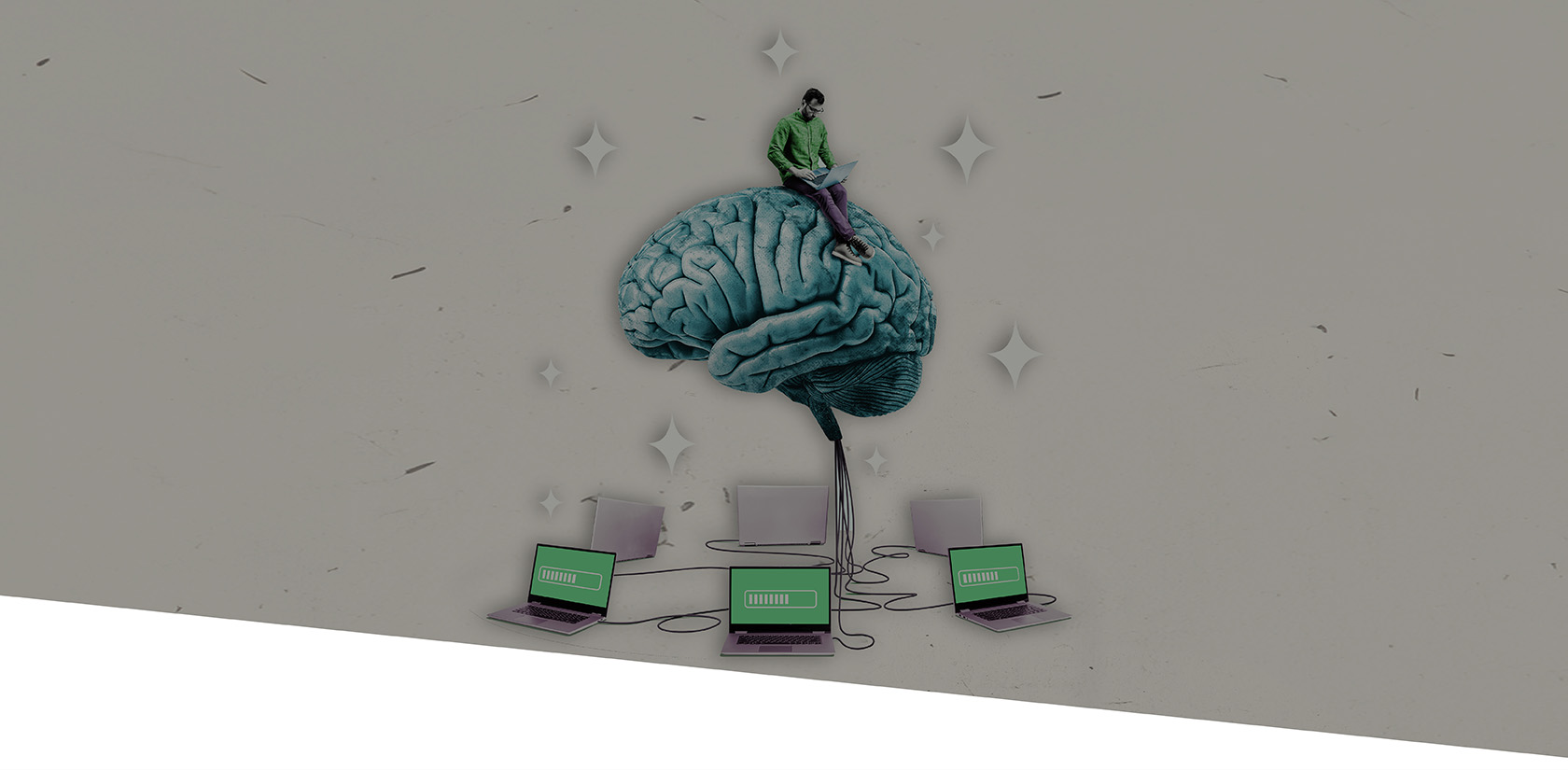
So today, let's take a unique look at the AI revolution — not about the “removing people” part of it, but about bridging the human–robot divide, something we've dubbed the mind meld.
Episode Title (on screen): The Mind Meld: AI & Humans
Before we start, if you're watching us on YouTube, please be sure to like, subscribe, and leave a comment to let us know your thoughts on this topic. You can also read about this subject today, as it's the cover story of our latest issue of Briefings magazine, available now at airports and online.
Jill Wiltfong
I'm joined now by Bryan Ackermann, Korn Ferry's Head of AI Strategy and Transformation. Bryan is knee-deep in conversations with company leaders about how they can best integrate AI into their workforces, so it's great to get his take on this.
Bryan, thanks for coming on.
Bryan Ackermann
Thanks, as always. I think more eyebrow-deep at this point.
Jill Wiltfong
I think that's true. I think that's true.
Bryan, I want to get something straight before we dive in deeper. Many people believe this whole agenda of AI was here to replace people. Wasn't that the main idea?
Bryan Ackermann
I don't know that that was ever true outside the realm of science fiction. But look, the reality is that it is impacting roles and jobs. It's not meant to replace every human and replace them with some kind of overlord — certainly not.
Jill Wiltfong
So if I understand it right, it's not that AI can really come in and replace 100% of people, or even 100% of someone's role. It's that it can do part of it. That's what we're saying, right?
Bryan Ackermann
That's certainly part of it. The immediate consequence is typically not that an entire role can be replaced as-is, completely, and the human comes out entirely.
There’s the possibility, though — and the reality — that we have to keep revisiting that statement as AI evolves and as agentic AI becomes more powerful, to make sure that calculus hasn't changed.
Jill Wiltfong
How do you think firms are going to redesign people's jobs to kind of mind meld, right – this human and AI capability?
It's got to be a pretty enormous challenge when you think about all the millions of jobs we've had for dozens and dozens of years shifting. Is it as daunting as it seems?
Bryan Ackermann
You're right to paint this as a big change, and organizations really do need to treat it that way — including the voice of the individuals that are being impacted by all of this.
I think the first starting point is the leaders themselves: asking, making sure, and orienting them not just to have the perspective that “this is a big change,” but to talk transparently and authentically to their organizations about that change and what they think, even if they're not quite sure how it's going to play out.
That's still a very powerful first step, because there's so much fear and uncertainty, especially at the individual level, about what AI is going to do to their job or their livelihood.
SPOCK: “Allow me, it will be easier.”
KIRK: “What are you doing?”
SPOCK: “Our minds, one and together.”
Jill Wiltfong
That is a scene from the movie — and one of your favorite shows — Star Trek, where Leonard Nimoy as Spock does a Vulcan mind meld with Captain Kirk.
So Bryan, if this AI–human “mind meld” is indeed the goal, how do we train workforces for it?
It seems like a critical step, but four out of five employees don't use corporate training. They opt instead to learn AI on their own. So what can leaders do to better engage employees on this AI training front?
Bryan Ackermann
AI is one of those technologies that — whether you're a leader or an individual contributor, whether you're doing it on your own or doing it inside the enterprise — you learn by using it.
So the question that's impacting organizations is: standing and watching a video or a podcast or attending a training course is simply not the right modality to really learn in this particular case.
The more organizations use AI to teach people how to use AI — think of an advisor or an agent that helps somebody take their job role and apply AI to it — the better.
The act of using the tool to learn the tool, and then being as close to the real-world application of their job as you can get, seems to be a really powerful and much more impactful way to learn.
Jill Wiltfong
Of course, it would be hard to expect workers to make really big strides without significant movement at the top. It makes a difference.
But a Korn Ferry survey did find that only 9% of leaders had the combination of behaviors and experiences needed for the AI era, with most exhibiting this business-as-usual mindset.
So what is holding leaders back from embracing this change? And what would you say to them to get them moving forward?
Bryan Ackermann
Certainly the pace of this change is making leaders uncertain — and leaders don't like to be uncertain in front of their organizations.
So it goes back to that: it's okay, it's authentic, it's transparent to be human in this conversation. That's part of the journey.
Additionally, helping leaders recognize that there are elements of this transformation that look like others they've done before — whether it's digital transformations that we've all lived through, or big external disruptive events like what we went through a few years ago — gives the leader a sense of, “I've dealt with this before. I know how to do this.”
And then lastly, there are things that are unique. Helping leaders understand that this particular shift means they're going to have to manage ambiguity and risk directly and often.
Even though it's always important to set a North Star and express a purpose as a leader in the organization, that dial goes up to eleven right now, because that's the anchor through uncertainty.
Jill Wiltfong
Great. Bryan, always really wonderful to have you on and to get your perspective on this really dynamic and shifting issue. So thank you for being here.
Bryan Ackermann
Thank you, as always.
Jill Wiltfong
We've examined how to address this critical mind meld between AI and human workforces. When we return, we'll talk to a professor of AI at Harvard about some of the truly crazy things AI will be able to do in the workplace when it's working with humans.
Stay with us.
[BREAK]
AGENT SMITH: “As you can see, we’ve had our eye on you for some time now, Mr. Anderson.”
Jill Wiltfong (00:03.246)
We've been talking about how companies are looking to meld their human workforces with AI. And now, let's take a closer look at how the latest AI tools and capabilities will affect how work gets done.
I'm joined by Mark Esposito, a professor at Harvard University's Berkman Klein Center for Internet and Society. Mark is a globally recognized leader in the application of AI in business, who has spent a lot of time consulting business leaders on the latest AI tech, as well as its potential impact on their firms.
Mark, it's really great to have you on today.
Mark Esposito
Thank you for having me, Jill. Pleasure to be part of this episode.
Jill Wiltfong
That last clip was from the movie The Matrix, where AI agent Smith interrogates Keanu Reeves. AI agents are finally here, and thankfully they appear to be far less sinister than the ones in The Matrix.
Mark, you've talked about the potential of agents to change the game. So let's first take a step back and discuss how agents work, so everyone kind of has a level playing field there.
Mark Esposito
If you think about what prompting is, it's still that the person behind the computer is generating ideas by having inputs and then waiting for the machine to determine an output.
Then we’ll fine-tune — we kind of bounce back and forth until we're happy with what we get.
Now, the process of engaging with the large language model that is done by us could be delegated to a chatbot. And the moment that we delegate to a chatbot, that is a delegation of agency. That's why they're called agentic.
So it's prompting without people, in many ways, where the prompting got automated. And therefore, you no longer need to have that same level of oversight that happens when a person is prompting in front of one of the large language models.
Jill Wiltfong
It's going to be really fun when those AI agents can actually stand in for you and represent your thoughts.
Do you think that's pretty far away, or are you seeing those experiments happening — I imagine — faster and faster? And do you see it within reach?
Mark Esposito
I think there's still a difference between what we can technically do and what we can afford to do as a society.
I think a middle ground for this will be that, within some very bounded tasks or extremely confined tasks, we might delegate decision-making.
For example, a board of directors where I am delegating my vote to a bot — but I already know what the content is, and I'm simply delegating for a specific function in that case.
HUMAN: “What are you really? How do I know that you’re alive or just a clever imitation of life?”
AI: “How do you know if Thompson is alive, or your daughter? What makes my clever imitation of life any different from theirs?”
HUMAN: “They’re human.”
Jill Wiltfong
That is a scene from the movie The Machine, where an AI researcher questions the humanity of an AI robot.
This question of humanity has come into sharp focus recently, as one in five US and UK employers are now using AI to interview job candidates. Many experts fear that robots could let the best talent fall through the cracks, but you've taken an interesting view on the other side of this debate — that AI, in fact, will democratize the talent search like never before.
Talk to me a little bit about that.
Mark Esposito
A lot of AI interviewing or recruitment tends to be more representative of members of our community who usually would not really make it through a selection that is determined by a person.
So we're really talking about AI-driven recruitment being much more inclusive. There's been a paper out of Stanford where they made significant progress by collecting over 37,000 interviews, and the conversion rate is much more in favor of people that usually do not get a chance, compared with when humans are in charge of that process.
Jill Wiltfong
I want to end on an intriguing point that you make. We're always talking about the ever-evolving nature of AI, but you raise this idea that we may actually reach the limit of what AI can do potentially sooner than anyone expects.
What do you mean by that?
Mark Esposito
Sometimes we think technology is infinite, but it's not. It can reach what might be a structural end.
What I mean by that is we might get to a point where the acceleration from 100 to 200 is not as fast as from 0 to 100. And so we might see things eventually slowing down — maybe plateauing a bit, consolidating, phasing out.
So I think it's more the speed changing to a pace that is much more commensurate with our adoption rate, rather than this almost short-of-air, short-of-breath experience that we're having now.
Jill Wiltfong
Mark, it's a very exciting space that we are all watching unfold now. I really appreciate you sharing your insight with us today on it. Fascinating.
Mark Esposito
Thank you for having me, Jill. It's been a pleasure talking to you.
Jill Wiltfong:
The executive producer of Briefings is Jonathan Dahl. Today’s episode was produced by Rupak Bhattacharyya and Zachary Dore, and it was edited by Jaren Henry McRae.
It contains reporting by Russell Pearlman, Ariane Cohen, Peter Lauria, and Meghan Walsh. Our video segment contains original artwork by Fraser Milton, Haley Kennel, Jonathan Pink, and Sasha Kotzek.
Don’t forget to read our magazine—available at newsstands and at kornferry.com/briefings.
That’s it for Korn Ferry Briefings. I’m Jill Wiltfong. See you next time.
Subscribe to series:




PODCAST GUEST
Mark Esposito
Professor, Berkman Klein Center for Internet & Society
Harvard University
Mark is member of the faculty at Harvard University across several centers and chief economist of micro1, a Silicon Valley firm. He is (co)-author of 14 books and advises governments worldwide. He co-founded Nexus FrontierTech, The AI Native Foundation and The Chart ThinkTank.

PODCAST GUEST
Bryan Ackermann
Head of AI Strategy & Transformation
Korn Ferry
Mr. Ackermann brings over thirty years of experience to the firm. He leads globally Solutions providing individual insight via assessments and multi-raters, and all leadership, professional development and training solutions in Korn Ferry’s Consulting and Digital lines of business. Prior to this role, Mr. Ackermann was the Chief Information Officer of Korn Ferry, responsible both for the corporate enterprise as well as client facing technology teams.