The Best Culture Depends on Your Strategy

The culture that helps an organization grow, innovate, or manage risk is not always the same. Korn Ferry Institute’s research reveals how cultural priorities shift with strategic goals.
Leaders want a high-performing culture. The challenge is that high performance can mean different things to different organizations.
An organization pursuing innovation faces different demands from one focused on operational optimization. Similarly, organizations prioritizing AI, expansion, or risk management may benefit from different cultural strengths.
New Korn Ferry Institute research provides insight into these differences. As part of the validation of our organizational culture model, we examined 20 dimensions of culture and their relationships with performance across nine strategic goals:
- Expansion and Growth
- Financial Health
- Customer Focus
- Innovation
- AI, Technology, and Digitization
- Operational Optimization
- Human Capital
- Risk Management
- Corporate Social Responsibility and Governance
The findings point to an important consideration for leaders: A high-performing culture is best understood in the context of what the organization is trying to accomplish.
The culture that helped an organization succeed in the past may not be the culture it needs for what comes next. When strategy changes but culture does not, established ways of working may make new priorities harder to execute. Understanding that fit can help leaders determine what to preserve, what to strengthen, and what to
de-emphasize as the organization moves forward.
The question, then, is not only whether the culture supports performance today, but whether it supports where the organization is trying to go next.
Culture is broader than a handful of characteristics.
Organizational culture is a system. The mindsets and abilities employees bring, along with organizational systems and structures, influence how people make decisions, work together, respond to change, and execute strategy. Decades of research have linked culture to organizational effectiveness, including aspects such as employee attitudes, innovation, and operational performance. Research also suggests that different cultural characteristics relate differently to outcomes such as innovation. Further, differences in organizational culture translate to enterprise-level financial performance.
Korn Ferry's updated organizational culture model reflects that breadth. It measures 20 dimensions of culture, organized around three forces:
- Perform describes how the organization executes.
- Connect describes how people interact and work with one another.
- Transform describes how the organization learns, changes, and evolves.
Figure 1. Organizational Culture Model
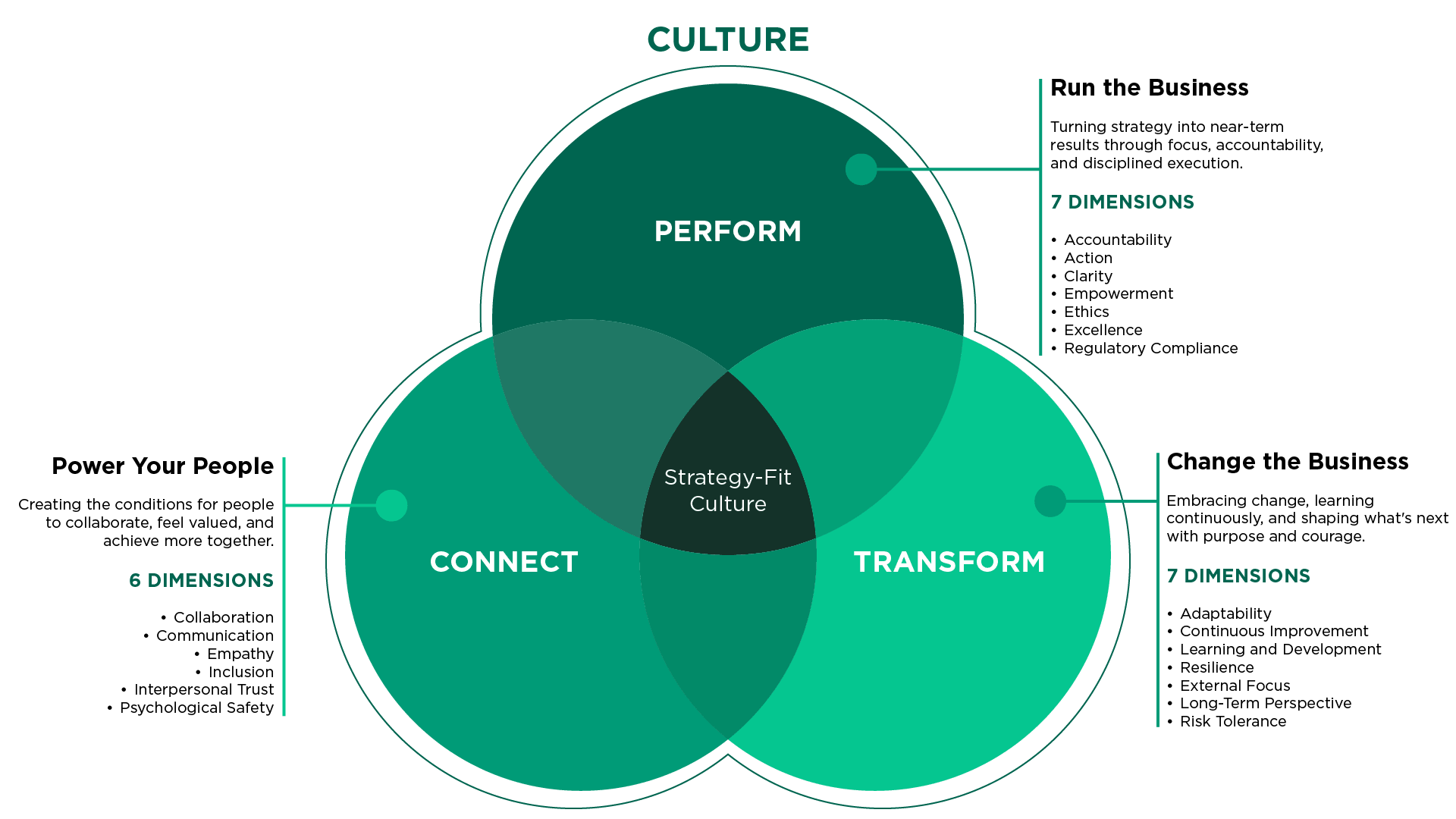
Examining the relationships that the culture dimensions have with performance across the nine strategic goals allowed us to look at both what appears consistent across priorities and where different cultural aspects emerge.
The findings of this research show both common themes and important differences.
The ability to transform shows up across priorities.
One pattern in the study is particularly notable.
Before looking at which cultural dimensions matter most for specific goals, it's worth noting that all 20 dimensions showed a positive relationship with success across all nine strategic goals we examined. While those relationships varied in strength, the pattern suggests that each dimension captures a meaningful aspect of culture that relates to organizational performance.
Within that broader pattern, Transform characteristics show up frequently among the strongest relationships. When we looked at the five cultural dimensions showing the strongest relationships with performance for each of the nine strategic goals, Transform dimensions accounted for more than half of them.
This does not mean Transform dimensions account for 60% of culture's impact, or that Perform and Connect characteristics are less important. Rather, capabilities related to learning, adapting, and improving appear frequently among the dimensions with the strongest relationships to strategic goal performance.
Several single dimensions also recur across priorities. Continuous improvement appears among the top five for six strategic goals, while both adaptability and learning and development each appear for five.
Together, these findings suggest that culture broadly relates to performance across strategic priorities, with the capacity to evolve emerging as a recurring theme. At the same time, as we look across single strategic priorities, the cultural characteristics that stand out begin to shift.
A different picture emerges when we examine each strategic goal individually.
A second pattern emerges when we compare single strategic priorities: Some priorities share similar cultural profiles, while others look quite different.
The strategic goals of Innovation as well as AI, Technology, and Digitization, for example, have substantial overlap. Four cultural dimensions appear among the strongest relationships for both: adaptability, learning and development, long-term perspective, and inclusion. The overlap is notable given that both priorities involve navigating change, developing new capabilities, and preparing the organization for new ways of working.
Other priorities show considerably less overlap. The strategic goals of Innovation and Risk Management, for example, share only one dimension among their respective top five: learning and development. Innovation is distinguished by adaptability, long-term perspective, inclusion, and excellence, while Risk Management brings greater prominence to ethics, empathy, interpersonal trust, and continuous improvement.
The differences also appear in the strength of single relationships. For example, learning and development showed a significantly stronger association with Human Capital performance than with Financial Health in our research
(a .46 correlation versus .28). This illustrates how the relevance of the same cultural characteristic can vary depending on the strategic priority.
These differences do not suggest that learning and development is unimportant to Financial Health or that trust is unimportant to Innovation. Rather, different cultural characteristics rise to prominence depending on the strategic goals.
A change in strategy may call for a change in emphasis.
These differences become particularly relevant when an organization's strategic priorities shift.
Consider an organization increasing its emphasis on Innovation after a period focused heavily on Operational Optimization.
There is continuity between the two. Adaptability and learning and development appear among the strongest relationships for both priorities in our study. But there are differences as well:
- For Operational Optimization: Communication, interpersonal trust, and continuous improvement also stand out.
- For Innovation: Inclusion, excellence, and long-term perspective become more prominent.
The implication is not that an organization needs to replace one culture with another. Instead, a shift in strategy may call for a shift in cultural emphasis.
Some existing strengths may continue to support performance, while other cultural characteristics may become more relevant as employees encounter different expectations, tradeoffs, and ways of working.
This gives executive teams a more focused set of questions to consider:
- What does our strategy ask of the organization?
- Which aspects of our culture support those priorities today?
- Which cultural aspects may warrant greater or less emphasis?
- Where could current ways of working make execution more difficult?
Evaluate culture in the context of where the organization is going. Understanding the culture an organization has today provides one perspective. Connecting that information to strategy adds another: How well does our current culture support where we are trying to go?
Korn Ferry's organization success profile provides a structured description of the multiple characteristics associated with achieving an organization’s strategic goals, including culture, business context, talent, organization, purpose, and strategy. Considering these elements together can help leaders understand which organizational levers best support their strategic goals. A culture assessment specifically provides a complementary view of how employees experience one of those levers—culture—today.
When considering which aspects of culture to change first, leaders can identify where current cultural strengths align with strategic priorities and where a different emphasis may be helpful. Rather than approaching culture change as a broad effort to improve everything at once, leaders can focus attention on the aspects of culture most relevant to what the organization is trying to accomplish, saving time and resources.
High-performing culture depends on the performance you are pursuing.
Our research points toward a more nuanced view of high-performing culture. Many aspects of culture contribute to how an organization functions, while the cultural characteristics that stand out most vary across strategic priorities.
For executive teams, that leads to a practical question as strategies evolve:
Will the culture that got us here help us get where we want to go next?
Strategy provides direction. Culture influences how people collectively pursue it. Understanding the relationship between the two can help leaders see where culture supports their ambitions and where a shift in emphasis may help.
Learn more about Korn Ferry Change.
How We Did It
Findings come from our 2026 global validation study of Korn Ferry's updated organizational culture model, which measures 20 dimensions across the Perform, Connect, and Transform forces. The study included 1,425 participants across four countries. The model demonstrated strong measurement fit (CFI = .935, TLI = .932, RMSEA = .032, SRMR = .028) and a consistent factor structure across China, Germany, Mexico, and the United States.