2025 Global CEO Succession in Large- and Mid-Cap Companies
The Choreography of Leadership Transition
411 companies changed CEOs in 2025. Does how each transition was staged matter as much as who was chosen?


CEO succession remains a defining board responsibility—and in 2025, it was happening at a meaningful scale. Across more than 3,600 S&P Global Large- and Mid-Cap companies, 411 changed CEOs, an overall turnover rate of 11%.
Most succession analysis focuses on turnover rates, tenure, or the profile of incoming and outgoing CEOs. Those metrics matter, but they do not fully explain how leadership change is experienced by investors, employees, or the market. Succession is not just a staffing event. It is a governance process that unfolds through a sequence of visible decisions, including how succession is publicized.
“How a transition is staged can shape stakeholders’ confidence in the board’s control of the process just as much as the identity of the successor."


The 2025 CEO Succession Story
The top-line CEO succession story in 2025 is one of continuity under pressure. The 11% global turnover rate is broadly consistent with other 2025 benchmarks, but the patterns underneath vary widely. Developed markets recorded higher turnover than emerging markets (13% vs. 10%), and state-owned enterprises higher than non-state-controlled companies (15% vs. 10%).
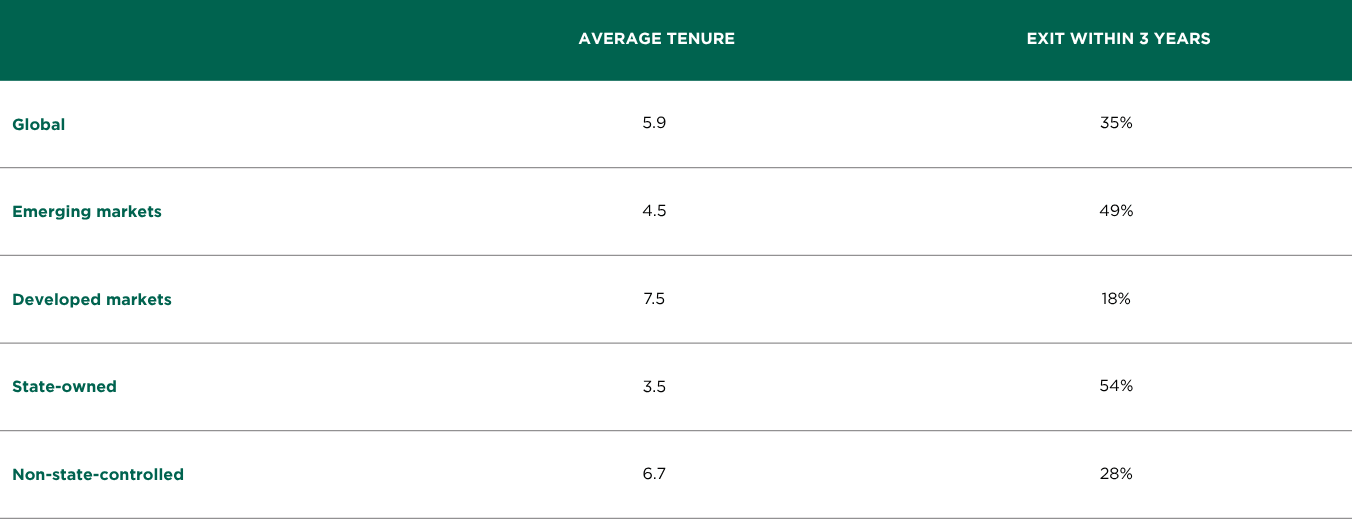
Outgoing CEOs averaged 5.9 years in the role, though more than one-third (35%) had served less than three years. However, tenure varies significantly across markets and ownership structures.
Tenure of Outgoing CEOs
Nearly one-quarter of incoming CEOs (26%) were appointed from outside the organization, more often in emerging markets than developed ones (29% vs. 21%). Developed markets appear to hold stronger internal pipelines; emerging markets rely more on external hiring to access new capabilities.
Origin of Successors
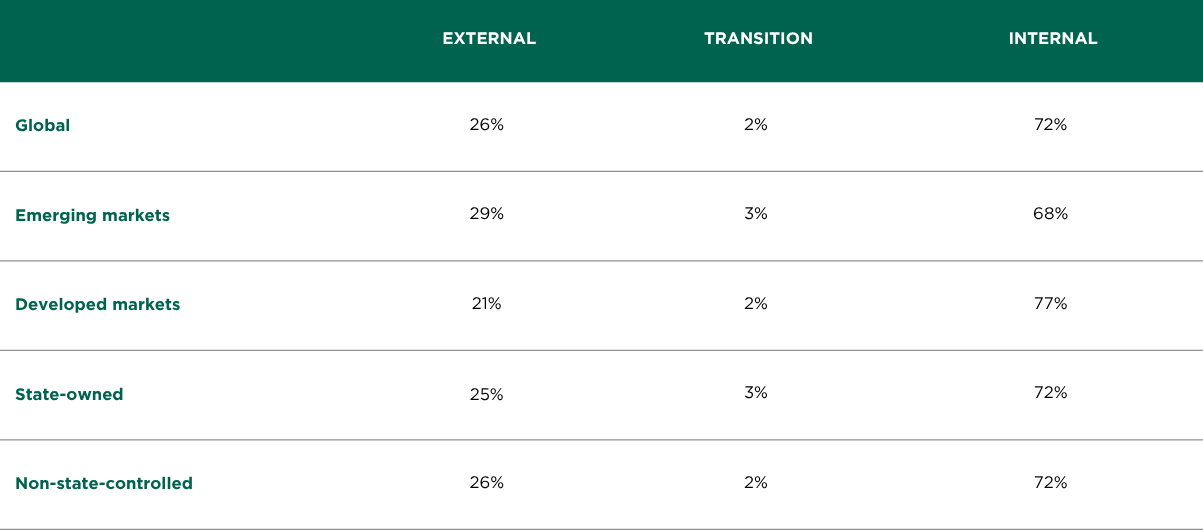
Note: “Transition” refers to external successors who were recruited and placed into other roles within a year prior to their CEO appointments.
Prior CEO experience remained an important filter in CEO succession, particularly for external hires. Nearly two-thirds of external successors (68%) had previously served as CEOs, compared with just over one-third of internal appointments (35%). Overall, 44% of new CEOs had prior CEO experience, and for one in five (20%), the CEO role was also their most recent position before appointment.


Why the Transition Process Matters
Expectations are rising faster than preparation.
Leadership transitions unfold under intense scrutiny. Investors, employees, regulators, and customers all look for signs that the board has a clear plan and that the company will remain stable through the handoff. When a CEO transition appears disorganized, the costs can extend well beyond the top job.
- Delayed decision-making. When boards do not clarify who is in charge, strategy, capital allocation, restructuring, and talent can stall as executives hesitate to act.
- Short-term performance disruptions. Operating leaders turn cautious, and critical initiatives lose momentum while the company waits for a stable leadership mandate.
- Loss of internal talent confidence. High-potential executives question whether the organization offers a credible path forward, reducing commitment when the company needs stability most.
- Negative market reactions. A disordered CEO transition can unsettle investors, especially when the board appears reactive rather than prepared.
- Inefficient CEO replacement decisions. Time pressure limits assessment, successor preparation, and the board's negotiating position.
- Inadequate ramp-up. Successors start before they can absorb context or align with the board.
Poorly managed CEO and C-suite transitions are estimated to destroy nearly $1 trillion in market value each year across S&P 1500 companies.
In 2025, the average transition period spanned approximately 78 days: the incumbent announces departure, the successor is named, the incumbent formally departs, and the new CEO starts. This is more than an administrative sequence. It is a public narrative about preparedness, confidence, and control.
Typical Unfolding of Leadership Transition
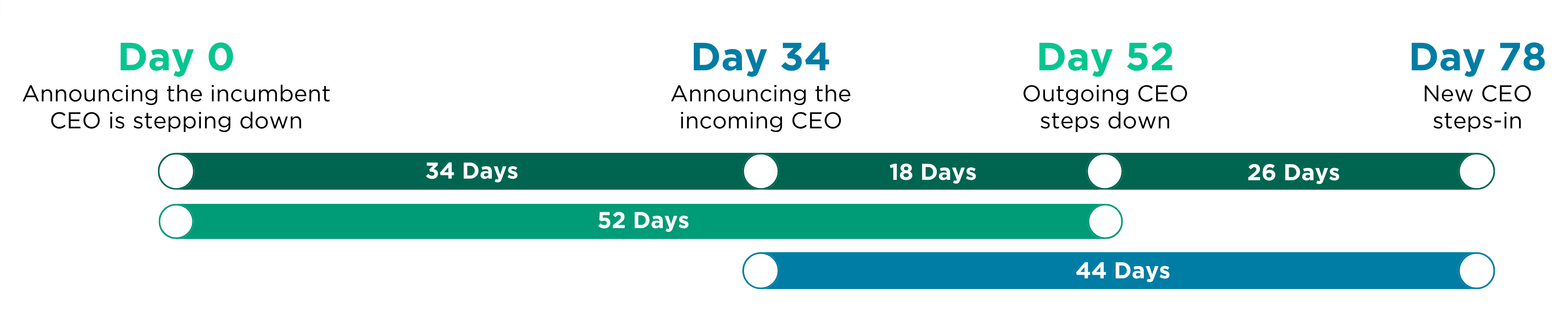
Globally, boards announced successors before the predecessor’s official departure in 53% of cases, on the same date in 24%, and only after the predecessor had formally departed in 23%. Naming early reduces uncertainty, gives the incoming CEO time to learn the business, and signals a board managing the handoff deliberately.
75 days to prepare when the successor was named before the outgoing CEO departed, against 6 days when named on or after that date.
That gap shows up in market performance. Six months after turnover, companies that named successors early outperformed their industry benchmark by 1.1 percentage points, while those that delayed trailed theirs by 2.7.
3.8 percentage points separated early and delayed successor announcers against their industry benchmarks in market performance after two quarters.


What Boards Should Learn
“CEO succession should be assessed not only by who is leaving and who is chosen, but by how the transition is orchestrated.”
Boards often devote significant energy to identifying and evaluating successors. That remains essential, but the 2025 data suggest transition design deserves equal attention. Naming the successor early, clarifying the outgoing CEO’s timing, and aligning governance changes with the appointment all contribute to a more credible handoff. A fragmented transition can create unnecessary speculation. A well-staged one can demonstrate discipline, reassure stakeholders, and preserve momentum.


A Stronger Agenda for Boards
Boards should treat succession as both a talent decision and a market-facing governance process. Five practices separate boards that lead transitions from those that react to them.
1. Build succession plans around multiple scenarios.
Planned retirements, strategic resets, unexpected exits, and externally driven changes each require a different transition pathway. Boards are increasingly likely to face leadership changes under compressed timelines, heightened scrutiny, or external constraints. A single generic succession plan is rarely enough; boards should prepare for different situations and establish scenario-specific protocols so they can act with discipline should the moment arise.
2. Strengthen leadership bench strength continuously, not episodically.
Boards should regularly audit the depth and readiness of the enterprise leadership pipeline—not only named CEO successors—against the future demands of the business. That means using objective assessment, exposure to enterprise-level challenges, targeted development plans, and clear evidence of readiness progression to understand where the organization has credible internal options and where external talent may be needed. This discipline should become part of ongoing board oversight, treating CEO succession as an always-on activity rather than a last-minute decision.
3. Manage communication as carefully as selection.
CEO succession is more than a leadership change; it sends strategic and performance signals to the market. As a result, succession is under growing scrutiny and has become a visible test of board governance. Boards should align in advance on the transition narrative: why the change is happening, what it means for strategy, what role the board will play during the handoff, and how continuity will be maintained.
4. Reduce ambiguity when constraints prevent early disclosure.
In some situations, such as a sudden CEO departure, boards might not be able to name a successor quickly. Even then, they can still signal control by clarifying interim leadership, decision rights, and the transition timeline. They should also reassure the market that the rigor of the succession process will not be compromised by the unexpected nature of the transition—and explain how the board will maintain that discipline.
5. Engage transition expertise when complexity is high.
Boards may also benefit from working with advisors who specialize in leadership transition. Their value lies not only in candidate assessment, but in helping boards structure the handoff itself—from succession scenarios and readiness evaluation to stakeholder communication, onboarding, and alignment between the outgoing CEO, incoming CEO, and board. This can be particularly helpful when transitions are complex, externally sourced, or highly visible.


What Boards Should Do Now
CEO succession is no longer simply a question of replacement. It is a test of board readiness, governance discipline, and organizational credibility. The transition itself sends a signal: the sequence of announcements, appointments, and exits tells stakeholders whether the board is leading the process or reacting to it.
Audit your succession choreography, not just your succession slate. Pressure-test whether your top candidates are truly ready. Decide in advance how a transition will be communicated, not only who will be selected.
In a market that rewards clarity and punishes uncertainty, the question is not solely whether the board can choose the right next CEO. It is whether the board can manage the transition in a way that inspires confidence from day one.
Prepare for Leadership Transition
Explore how Korn Ferry's Board & CEO Services help boards plan succession, stage transitions, and prepare leaders.

Our Experts




Global Vice Chair, Board and CEO Services, Global Leader, Board and CEO Succession

We analyzed CEO transitions during calendar year 2025 among S&P Global Large- and Mid-Cap companies. The global dataset included more than 3,600 companies across 25 developed and 24 emerging markets.
CEO transitions were identified using the S&P Capital IQ platform. We then reviewed company announcements, regulatory filings, executive biographies, and credible business and financial media coverage to verify each transition and code the characteristics of the outgoing CEO, incoming CEO, and succession process. Variables coded included age, tenure, gender, internal versus external appointment, prior CEO experience, functional background, transition timing, use of an interim CEO, and the predecessor's post-transition role. The final sample excluded CEOs whose effective appointment dates fell outside 2025, even if their appointments were announced during 2025.
Monthly stock price following each CEO transition was tracked for up to six months. These financial outcomes were linked to the succession-event database to examine the relationship between post-succession performance and key succession characteristics, including succession approach, successor profile, and the timing of successor identification.
