
Confidence: Shaken and Stirred
Can organizations handle massive, simultaneous disruptions?Corporate leaders aren’t so sure.


September 26, 2025
You don’t become the top boss without a pretty good track record of tackling risk. At one time or another in any CEO’s career—perhaps at multiple times—they’ve probably faced a massive problem that was seemingly out of anyone’s control. Whatever it was, the CEO not only confidently solved the problem, but also took the business to new heights. Most board directors have similar experiences, too, either while serving as the top leader themselves or working on a strong, high-performing team.
But in 2025, so many massive problems seem to be out of control simultaneously: trade policies changing daily, geopolitical upheavals, AI’s disruption of nearly everything, and economic slowdowns worldwide—to name just four. The world’s corporate chiefs have noticed, and they’re not exactly brimming with confidence that they can handle them.
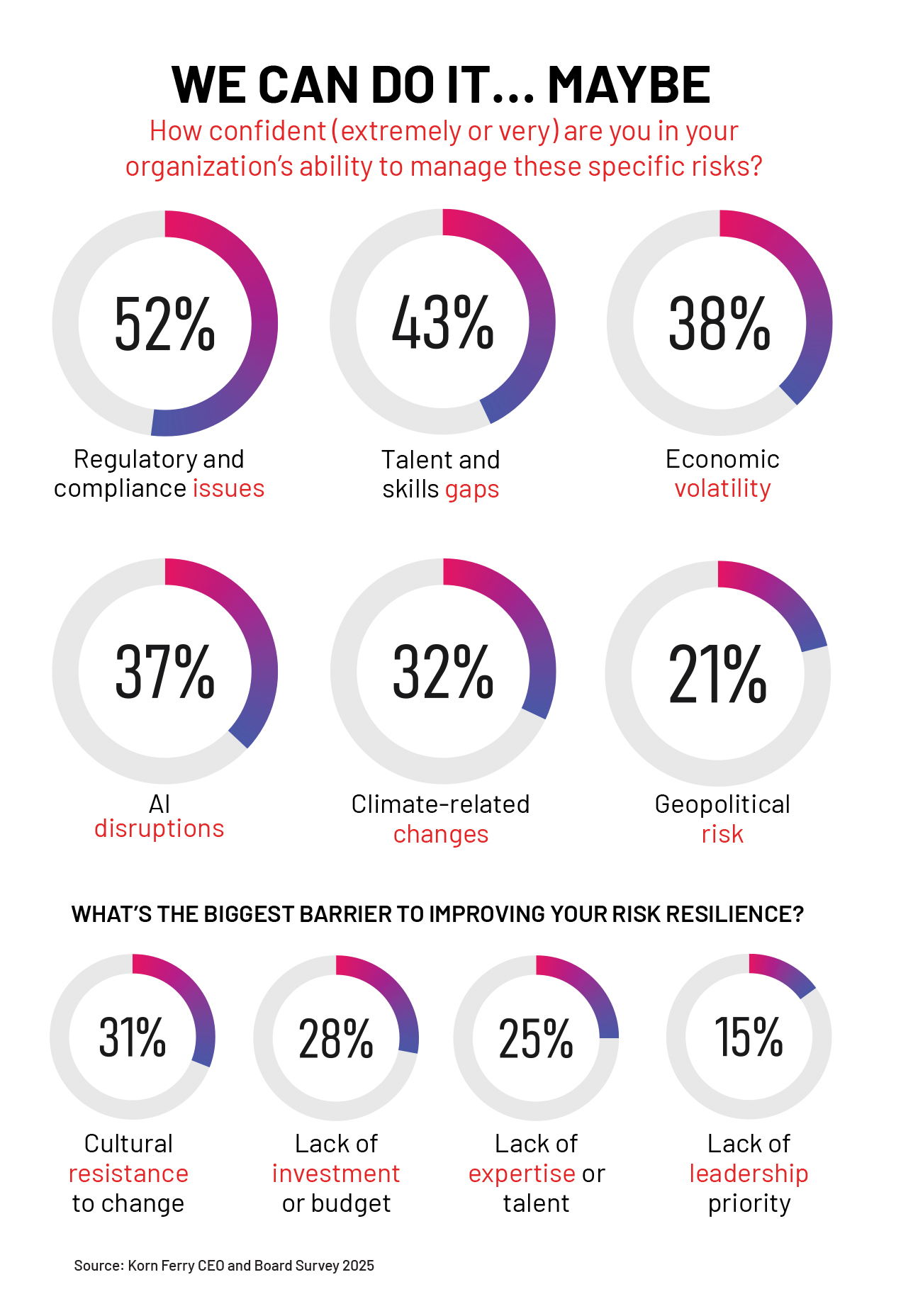
In its first annual top leadership survey, Korn Ferry asked 250 CEOs and board members at large organizations across the world about the dangers their firms currently face. Some 63 percent of respondents said their firm’s risk had increased since 2024. (Only 3 percent said it had decreased.) Just 11 percent said they were extremely confident their organizations could handle that risk, and just 51 percent said that they were extremely or very confident. “The low confidence figures are stunning,” says Jane Edison Stevenson, a Korn Ferry vice chair and global leader of the firm’s Board and CEO Succession practice.
Of all the major risks they face, CEOs and directors say they’re least confident about geopolitical risk. That’s understandable, says leadership consultant Jimmie Lee, since the current US administration is upending several decades of norms. This has pushed many leaders worldwide into being more reactive than proactive. “We don’t know how to predict what comes next,” Lee says. Just 21 percent of respondents said they were extremely or very confident about handling geopolitical risk; fewer than half were moderately confident. But it’s not as if corporate leaders feel overwhelming assurance about handling any of the big issues facing them. Indeed, in only one area of risk did more than half of CEOs and directors express confidence about their firms’ preparation: regulatory and compliance risk. Even then, only 52 percent of them did so.
Experts say CEOs and directors need to project confidence, even if they’re uncertain, in order to be effective. Employees can be left demoralized—and become less productive—when they sense the boss is directionless. Similarly, outside investors might agitate for change if they feel a CEO or board can’t execute. CEOs can strengthen their confidence, Lee says, by reminding themselves of purpose—both their own and the organization’s. Having purpose in mind allows them not only to make long-term strategic decisions, but also to intelligently consider any necessary course corrections. “Your ‘why’ is your insulator,” he says. At the same time, bosses should remind themselves that risk isn’t all bad. “Many times people look at risk as a four-letter word and don’t realize that it can be an opportunity to capitalize on change,” says Dennis Carey, a Korn Ferry vice chairman and co-leader of the firm’s Board Services practice.
From a director’s perspective, there’s nothing particularly new about the process of how to analyze risk, says Arie Brish, a management professor at the Bill Munday School of Business at St. Edward’s University who currently sits on corporate boards in the US and UK. Make a list of all the risk factors, calculate the probability of each one occurring (high, medium, or low), and estimate its potential impact on the business (again: high, medium, or low). Focus on the risks that are both high probability and high impact. What’s challenging, Brish says, is having the discipline to create an objective list of risks and engage in honest conversations about them with management, then prompt management to develop responses. Don’t take no for an answer, he says. “I’ve heard too many times comments from executives such as ‘Just talking about it will impact morale.’"
Photo credits: DNY59/Getty Images; Roman Prysiazhniuk/Getty Images
