
Growing Pains: Can the Mystery Be Solved?
Top-line growth—critical for business success—remains stubbornly low at firms globally.


September 26, 2025
The problem started right after the pandemic ended: Software agency Iversoft just couldn’t grow sales. And it wasn’t for lack of trying. Company CEO Graeme Barlow says the firm, a longtime developer of mobile apps, tried most everything. Iversoft broadened its offerings, and it searched for and acquired new customers.
THE PROBLEM Once robust, revenue growth at most firms has been flat for many years.
WHY IT MATTERS Over the long term, firms need strong growth to survive.
THE SOLUTION Figure out what obstacles are holding back innovation and other growth drivers.
And yet, for four straight years—even as Barlow and his team put more and more stressful hours into finding growth—Iversoft’s revenues hovered around the same number. At a low point, Barlow said, “We thought our business model was broken.”
But the weirder thing was this: If Iversoft’s model was broken, then so were many other companies’. Barlow discussed his company’s problems with other software developers, and even some of his big-company customers with global operations. Nearly all of them were facing the same mystery: They weren’t growing sales much, either, and very few of them had figured out why. It was humbling, Barlow says. “It’s like you need to throw out everything you know about making things work.”
In the corporate world, it’s a given that growing profits is what matters most; that’s what many business-school textbooks say, at least. And based on the numbers, companies have done a fantastic job of it over the last two years. Earnings per share were in the high single digits in 2024, which is the main reason stock markets worldwide have continued the tear (a few significant hiccups aside) that began after the COVID lockdowns ended.
“Did companies forget how to grow? There’s a grain of truth to that.”
But a glance under the hood shows that much of that profit growth hasn’t come from attracting new customers and creating new innovative products. Rather, it’s a result of slashing costs and buying back shares. The revenue side looks considerably bleaker. In 2024, big companies grew by about 5 percent—the lowest annual growth of any non-recession year in the 21st century. Making matters worse, that revenue growth wasn’t “real” in many cases, since the gains often came not from companies’ marketing acumen or product superiority, but from passing along higher costs to customers. This year isn’t shaping up to be much better, either, with roughly 5 percent revenue growth expected once again. More troubling, during the first quarter, 32 percent of S&P 500 firms reported lower-than-expected sales results, the highest number since the first quarter of 2020.
Among themselves, many business executives admit they’re worried. Sure, uncertainty about tariffs, a global economic engine that seems to have finally finished a post-COVID surge, and changing consumer tastes might account for some of the lack of growth, but it’s not like the major economies of the world are in recessions. Indeed, the lack of growth has become a mystery—the kind businesses usually solve. “Did companies forget how to grow? There’s a grain of truth to that,” says Dan Prokop, a senior lecturer at Cardiff University, where he researches business innovation.

.jpg)
Growth, From Heyday to Now
From a growth perspective, leaders may only be realizing now how good they had it in the decade following the Great Recession. For one thing, consumers around the world were feeling wealthier. People across Asia, Central Europe, and Latin America were spending more on both everyday and big-ticket items, while everyone in the US seemed to ignore inflation and just kept buying. The result: From 2010 through 2023, annual revenues at S&P 500 firms rose 83 percent, from under $14 trillion to about $25 trillion.
Even when consumers weren’t feeling so spendy, experts say, the circumstances were perfect for companies to appeal to them with new products and services. After all, there were no major wars overwhelming nations or supply chains. Perhaps most importantly, for most of the 2010s, interest rates either came down or stayed low. Indeed, from 2010 to 2017, the US federal funds rate was under 1 percent, and it didn’t pass 3 percent until late 2022. “When you were thinking about pursuing new ideas, when interest rates were effectively zero percent, nearly everyone said, ‘Let’s try it,’” says Adam Echter, a partner and leader of global industrials at Simon-Kucher, a consultancy that helps firms with pricing and sales growth. Even the rapid surge of inflation after the pandemic didn’t stop many firms from increasing revenue significantly. Many passed along price increases and added a couple of percentage points on top. For the most part, consumers kept buying.
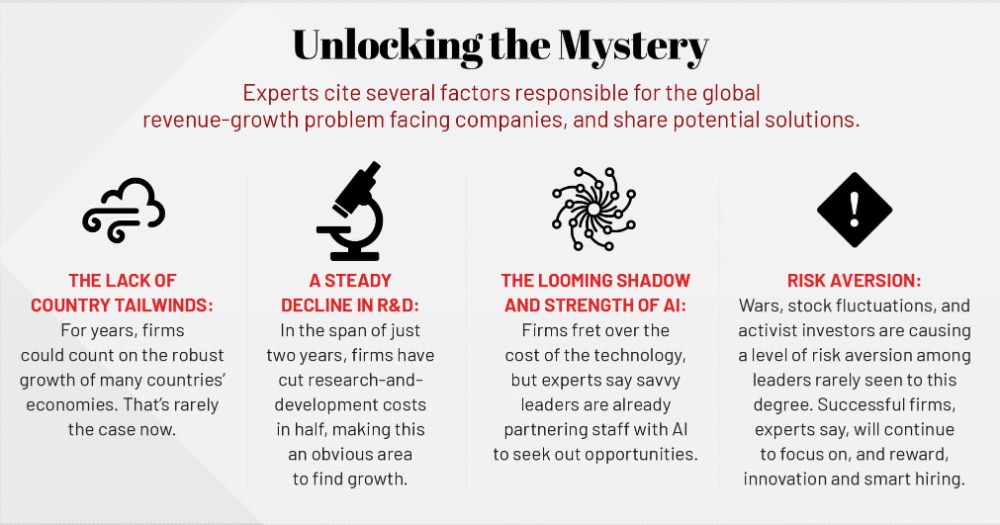
But as any leader can attest, those heady times have vanished. Outside of AI infrastructure and defense, few industries have much of a tailwind. Things look pretty dour at the country level, too. China’s rapid growth rate of the early 21st century is a fading memory. The US economy has, for the better part of two years, plodded along. And much of Europe is stagnant. Meanwhile, interest rates went up when inflation took off a few years ago, which made it harder for consumers to buy stuff on credit. Crucially, this drove up costs for any company wanting to expand their business, since so few have enough cash on hand to fully finance a major expansion. “If you have very high interest rates, companies just don’t want to invest. They feel it’s better to save money,” Prokop says.
Out-of-the-Ordinary Patterns
Experts say this is no ordinary-looking slowdown. The current uncertainty around trade policy, immigration, and wars has made companies of every size question how much they can grow in the near future. Take the airline industry, for example: Going into 2025, airlines were projected to bring in more than $1 trillion in revenue from ferrying people and cargo, according to the International Air Transport Association, a 5 percent gain from 2024. This summer, however, the association stated that trade wars had dampened demand and slashed its growth projection to just 3 percent.
Another oddity behind this slowdown: artificial intelligence. Many believe that AI could help segment customer groups more effectively and determine what new products and services they might pay for. However, at this point, not many firms are that far along in implementing AI, and all the resources going to AI can’t be used to grow the business. Experts say that this uncertainty is a major distraction for leaders. Marshal Davis, who runs the marketing agency Ascendly, says both he and his clients have found it difficult to make big decisions on projects recently. “These are muddy waters we’re trying to see through,” he says.
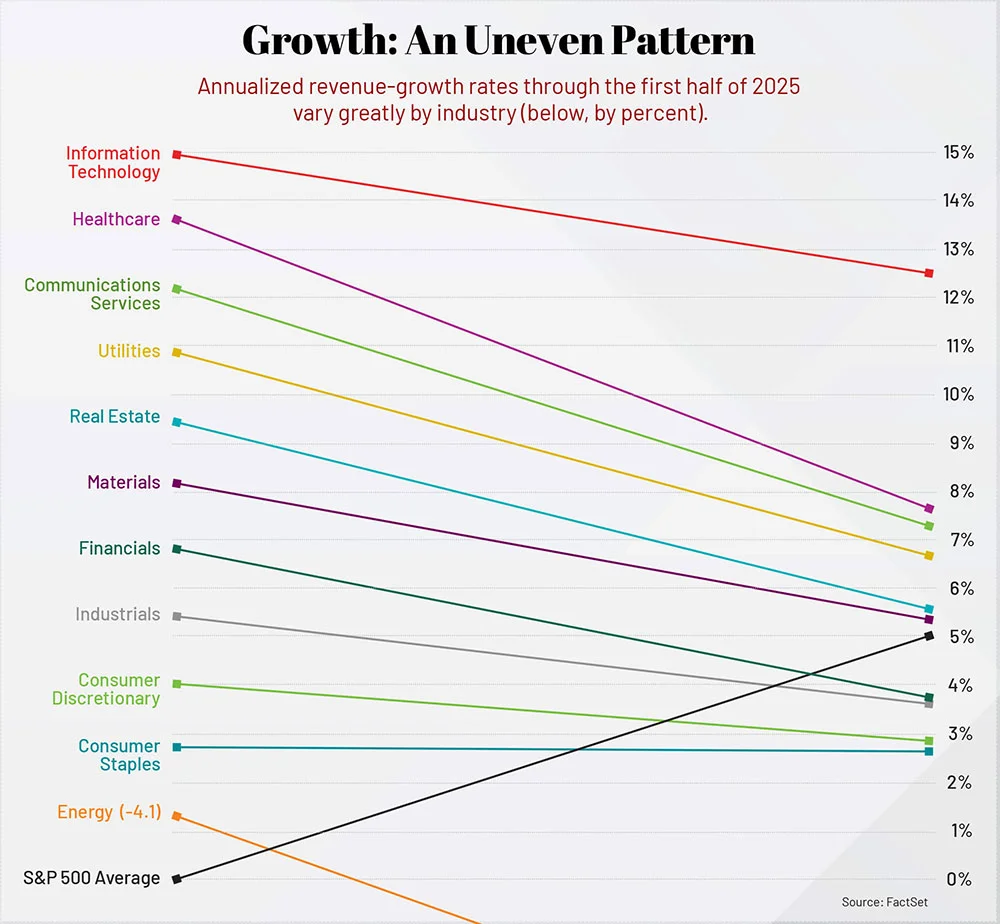
Some experts also say that when it comes to growth, corporate leaders need to look at whether they’re getting in their own way. Unfamiliar with such slow growth, some leaders have been paralyzed by indecision. They enjoyed a decade during which they could sell an ever-increasing amount of stuff, then a couple of years when they could both pass along higher inflation costs and increase prices. “Now many leaders don’t have either of those,” Echter says.


The Fear of Taking Risks
Put it all together, and experts say they’re seeing a boatload of leaders afraid to take on risks for the sake of growth. Risk is needed; product innovation almost always takes significant amounts of time, experimentation, and money to come to fruition. And by definition, some of that experimentation never pans out. But growth in spending on research and development, after accounting for inflation, has declined significantly, according to Moody’s. Back in 2021, company R&D spending rose, after inflation, by nearly 13 percent. In 2023, the most recent year for which data is available, spending rose only by 6 percent.
At the same time, even an innovation that looks perfect in the lab (or on a spreadsheet) may not catch on with customers. Failed product launches and research that doesn’t pay off can attract activist shareholders, who then demand accountability from company leaders for the so-called wasted effort. A lack of economic growth elsewhere makes those failures easier to spot. “Previously, organizations had the fear of missing out. Now they have a fear of messing up,” says Lou Turner, Korn Ferry’s head of sales and service in EMEA. Too many leaders, he says, would rather do nothing than do something horribly wrong.
“These are muddy waters we’re trying to see through.”
That risk aversion has become embedded in the very systems companies rely on. At many organizations, an inordinate number of people need to sign off on projects, which can delay, or even derail, innovations and product expansions. Some organizations have set their internal return-on-investment benchmarks so high that every project looks too risky. At the employee level, workers have been pushed over the last two years to be productive, which usually entails a focus on cutting costs rather than raising revenues. In that environment, taking the time to try something new can be frowned upon or, in some instances, punished.
Changing Mindsets
In the end, what appears to be needed is a shift in mindset. Experts say that in the current environment, getting executives to sign off on taking more risk can be a tough task, but that innovating new products and services is the only sustainable way to grow. The firms on Korn Ferry and Fortune’s World’s Most Admired Companies list have committed far more resources to research and development, as a percentage of revenues, than their slower-growing peers. These firms have accepted that innovating runs the risk of failing, and that such risk should be embraced. Innovation doesn’t have to be around a specific product or service, either. Sometimes it means spending more time researching people who aren’t customers now and thinking about how an existing product can become useful to them.
Experts say a more risk-minded shift needs to influence all of a company’s systems, including, of course, embracing AI as a tool to help find more growth opportunities. Employees who partner with that technology should be rewarded, not punished. Barriers to innovation need to be lowered. Importantly, leaders need to market their commitment to innovation—not only to customers but also to employees and investors. “If you want to be revolutionary, you need to sell the revolution,” Prokop says.
Other strategies revolve around pricing and rethinking relationships with customers. Echter says that many leaders have lost touch with the value of their own products and services. An organization might not realize that a product whose price hasn’t changed for years is effectively reducing customer expense—and could possibly push through an increase that would boost firm revenues. “Your product is more valuable, but you have to do the math,” Echter says.
Then there’s rethinking where, exactly, the business provides value to customers. That’s how Barlow, the Iversoft CEO, finally cracked his growth mystery. He and his team sat with customers and prospects to discuss not only their immediate needs, but also future software challenges and opportunities. Iversoft moved away from doing one-off projects and started developing long-term retainer relationships with its customers.
Both salespeople and software developers built out revenue pipelines. The new approach also cut the time required for bookkeeping, which freed up employees to look for other customers. In a year, revenue doubled.
Image credits: J Studios, Cuong Viet/Getty Images; Ralf Hiemisch, Cuong Viet, Lumpy Noodles, Shams Suleymanova, VectorMine, Pavel Rogozin/Getty Images; Francesco Carta Fotografo, Cuong Viet/Getty Images
