
Spreading Its Wings—Too Far, Too Fast
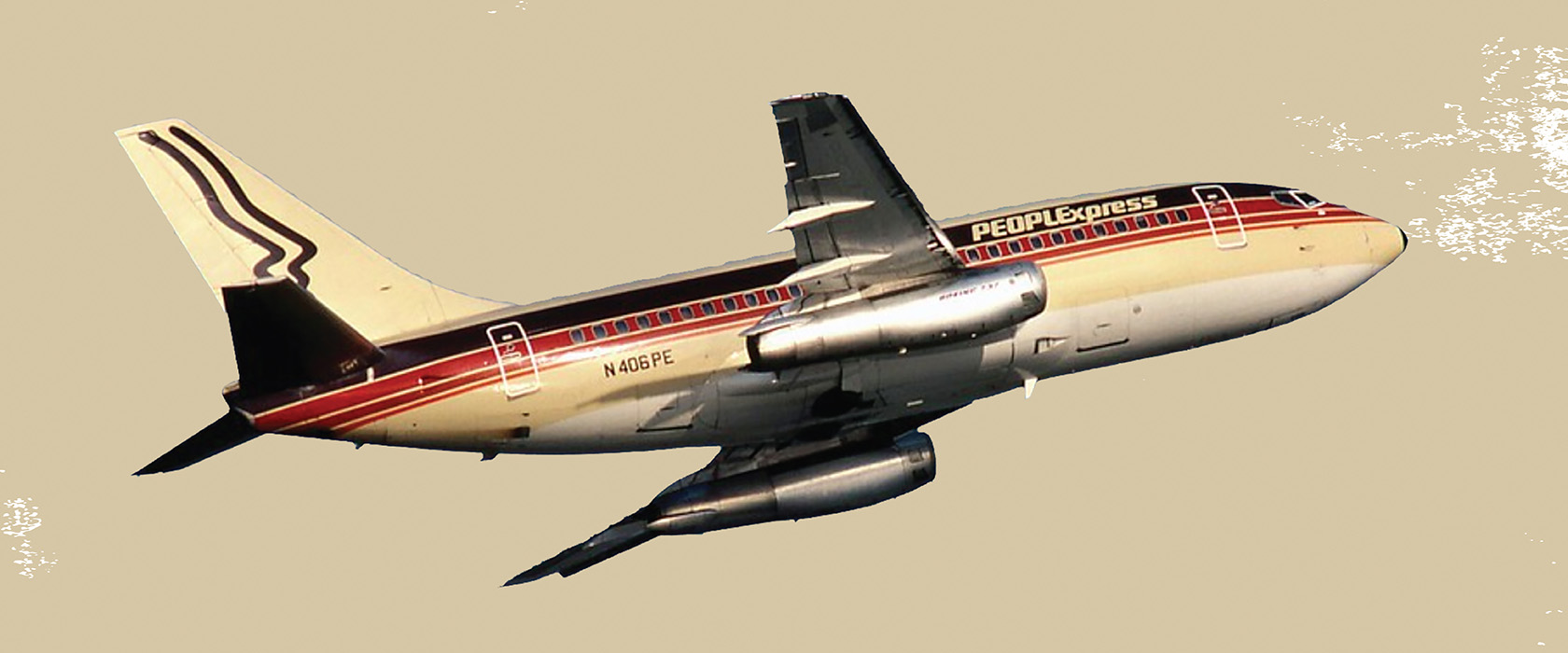
PEOPLExpress, the original big-discount airline, may go down as one of the more influential failed businesses.
September 26, 2025
Any air traveler knows the drill: If you want just about anything extra, you’ll be charged for it. Charged for checked bags. Charged for seat selection. Charged for sodas and snacks.
It hasn’t always been that way—but back in the early days of airline deregulation under the Reagan Administration, a new no-frills carrier burst onto the scene with an unprecedented policy of offering super-low fares and charging (in cash only) for everything else. The company’s à la carte menu included $3 per checked bag and between 50 cents and a dollar for sodas and snacks. What caught travelers’ attention were the fares: as low as $19 from Newark to cities like Boston, Syracuse, and Cleveland, all at a time when the major airlines might charge ten times as much on these routes.
The company, PEOPLExpress, was the brainchild of its founder, Don Burr, who seems to have inherited his swagger from his ancestor Aaron Burr, the US vice president. In 1981, he launched the airline in a previously dusty corner of Newark International Airport, with just regional flights. “Burr became known for a successful start-up in a lousy industry,” says David Lewin, professor emeritus of management at UCLA’s Anderson School of Management. But Burr had in mind more than a successful regional airline. Two years after launching, he inaugurated non-stop service to London’s Gatwick Airport at bottom-of-the-barrel prices (think $149 one-way), and no-frills travelers went nuts.
By 1985, he had bought Frontier Airlines, creating an empire with routes to 130 cities. The name PEOPLExpress struck fear into executives at major airlines, who were still accustomed to the protected world of government-regulated fares.
But as with many successful but short-lived businesses, the airline expanded way too fast, creating enormous debt. “They went up, and flamed down,” says Lewin, who once hosted Burr as a speaker at Columbia Business School. He observes that Burr, who was celebrated as a dark knight in airline circles, lacked a balanced C-suite, which left him blind to the nuances of threats and opportunities. (Burr could not be reached for comment, but has generally cited overexpansion as an issue.)
In hindsight, PEOPLExpress, which was purchased by Continental Airlines in 1987, was also a victim of failed logistics, with competitors telling maintenance and food-service firms to ignore the company. The lesson, says Lewin, is that expansion requires infrastructure, as well as strong predictive models for future demand. “It was an entrepreneurial gem for a little while,” he says, “then it tried to expand, and fell off the face of the Earth, making a very large thump.”
Photo credits: Bob Garrard
