
Snap Decisions in Black Swan Era
Tariffs, market swings… do leaders need a new set of skills for today’s fast decision-making?


May 30, 2025
The world knew that things were going to be different this year, with a new US administration coming in and geopolitical tensions mounting. But few could have anticipated the head-spinning moments that have occurred and are likely to continue through the year. It’s reaching the point where 1,000-point drops in the stock market become almost normal, as do press conferences about trade-war retaliations across the globe. Some analysts have taken to calling such moments a new wave of black swan events, defined as world-altering occurrences, like the 9/11 attacks, which used to be rare.
Facing all of these disruptions in recent years, leaders have come up with two acronyms to describe them. There’s VUCA (short for Volatile, Uncertain, Complex, and Ambiguous). Or, for the more pessimistic, there’s BANI (Brittle, Anxious, Non-linear, and Incomprehensible). But when it comes to the sheer number of changes—and the uncertainty they create—2025 makes the last five years look like the Stone Age. The Economic Policy Uncertainty Index, which measures ambiguity generated by policy changes, media sentiment, and business forecasts, has more than doubled since October. Today, it’s even higher than it was during the worst of the COVID-19 pandemic.
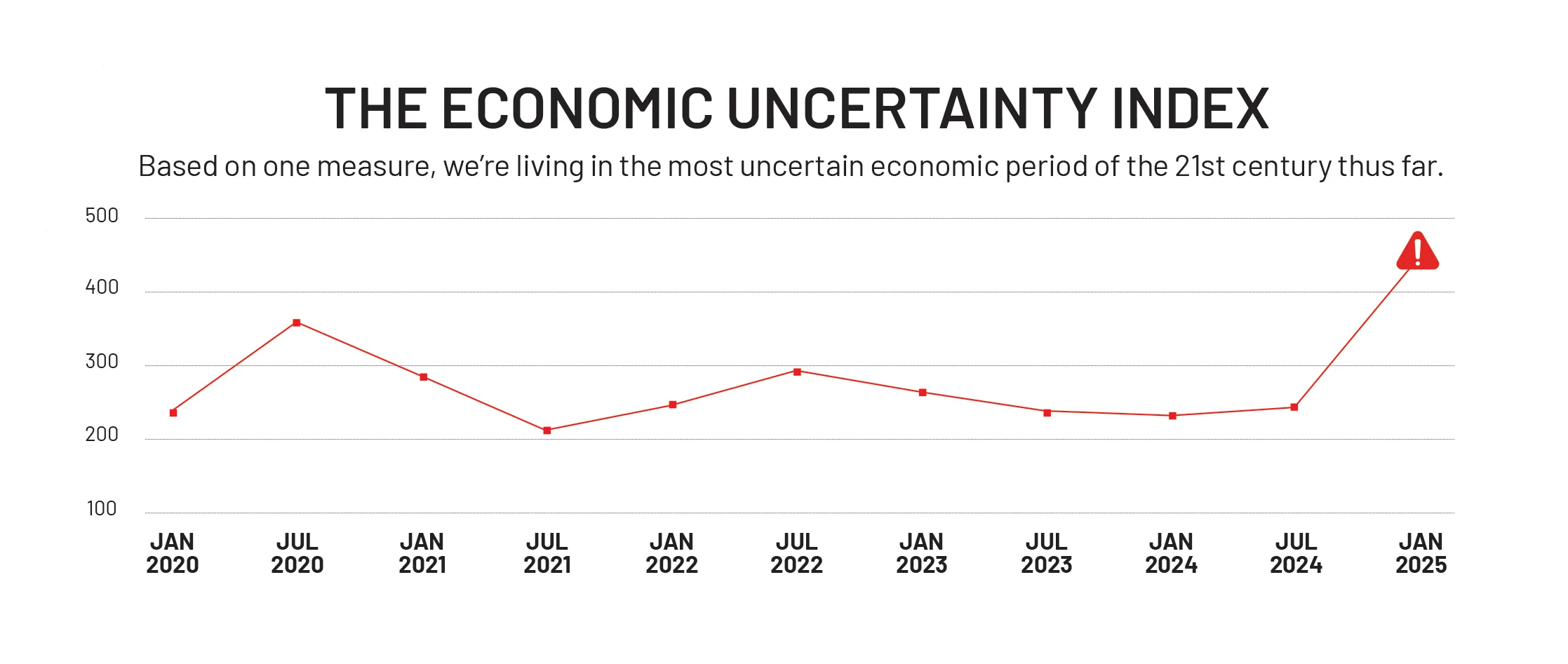
With so many massive swings in business occurring, leaders find themselves pushed to make moves far faster than before. The impact of these steps can literally make—or cost—an organization hundreds of millions of dollars, without even accounting for how the disruptions are impacting its culture or the collective engagement of its employees. Indeed, in 2025, one day can be the difference between a CEO looking brilliant… or foolish. Most leaders find it hard enough to take action when there is a lot of time to plan; making effective snap decisions can seem impossible when organizations typically respond at the speed of a tanker ship. “We really don’t know what’s around the corner, and it’s harder to do a good job,” says Beth Napleton, founder and CEO of LevelEDUp Leadership.
Leaders assumed conditions would follow a certain pattern based on who won the US presidential election. When conditions didn’t, firms were quickly tested on how to adjust. In this constantly changing news environment, CEOs sometimes feel they have no choice but to make a snap decision, fearing that if they don’t, they’ll face a backlash from investors, employees, customers, or governments. If those stakeholders aren’t forcing the issue, a supplier, vendor, or competitor may do so, says Meredith Moot, a senior client partner in Korn Ferry’s Global Industrial practice. “You have to keep up with the fastest decision-maker in your ecosystem,” she says.
Experts say early preparation can go a long way toward helping, as the best snap decisions aren’t made in the heat of the moment; rather, they come after leaders have laid the groundwork for them by asking good questions and analyzing information. Leaders should always be analyzing trend lines and patterns. “The key is to keep one’s cool,” says Jim Kerr, founder of Indispensable Consulting. Before making a decision, executives should consider both the short- and long-term implications. Experts say most are very good at the former; at the latter, less so.
Savvy leaders won’t sit idly by, however: They’re asking teams to game out a multitude of scenarios, including the costs of making a decision, then unwinding it if market conditions change again quickly. CEOs also are asking for the implications of scenarios that might have only a very slim chance of occurring, Moot says. In some circumstances, staying the course might be the right move, Kerr says, but leaders should know that this is in fact a choice, not something arrived at by default. Leaders must weigh the cost of doing nothing (because the situation may change) against the notion of being too late.
Photo credits: DNY59/Getty Images; Rubberball, Dev Images, Ruslanas Baranauskas Photo Library, Peter Dazeley, Liudmila Chernetska, Hallopino, Charlie Drevstam, Kutaytanir, Mohamad Faizal Bin Ramli, Eduleite/Getty Images
