
The Pandemic Anniversary
Many want to forget the horror and trauma that COVID-19 brought the world five years ago, but businesses are still learning some critical lessons.

May 30, 2025
It was the summer of 2020, and the world was in the throes of the COVID-19 pandemic. While trying to patch together his wireless-charging business, Dan Bladen noticed that his real-estate customers were making a big bet: They were remodeling their workplaces in a way that suggested they anticipated people would eventually return to the office—but not every day. The workforce they envisioned would be more hybrid, and everyone would share the same desk, conference rooms, and overall space.
Amid all the disruptions of the pandemic (social distancing, wearing masks, giving hazard pay to frontline workers, hunting for toilet paper, etc.), Bladen thought that this idea—working all the time out of the same space—had legs. He moved quickly to reinvent his seven-year-old company, and by early 2021, the firm had a new line of business, workplace-management software, and a new name, Kadence. Soon, Bladen and his teams were amazed to find themselves selling their first software license, inspiring an agility and adaptation in them that has lasted to this day. “Somewhere along the way, we found our sweet spot,” he says.
It’s been five years since much of the world went into lockdown amid the COVID-19 nightmare, a time that many would like to forget. The virus itself has claimed more than 7 million lives worldwide, according to the World Health Organization. And while we may never be able to accurately calculate the total economic loss—of workdays, business, and changes in consumer behavior worldwide—the estimates range from around $2 trillion all the way up to more than $15 trillion. Without a doubt, recent history can be split into two periods: Before COVID and After COVID.
Without a doubt, recent history can be split into two periods: Before COVID and After COVID.
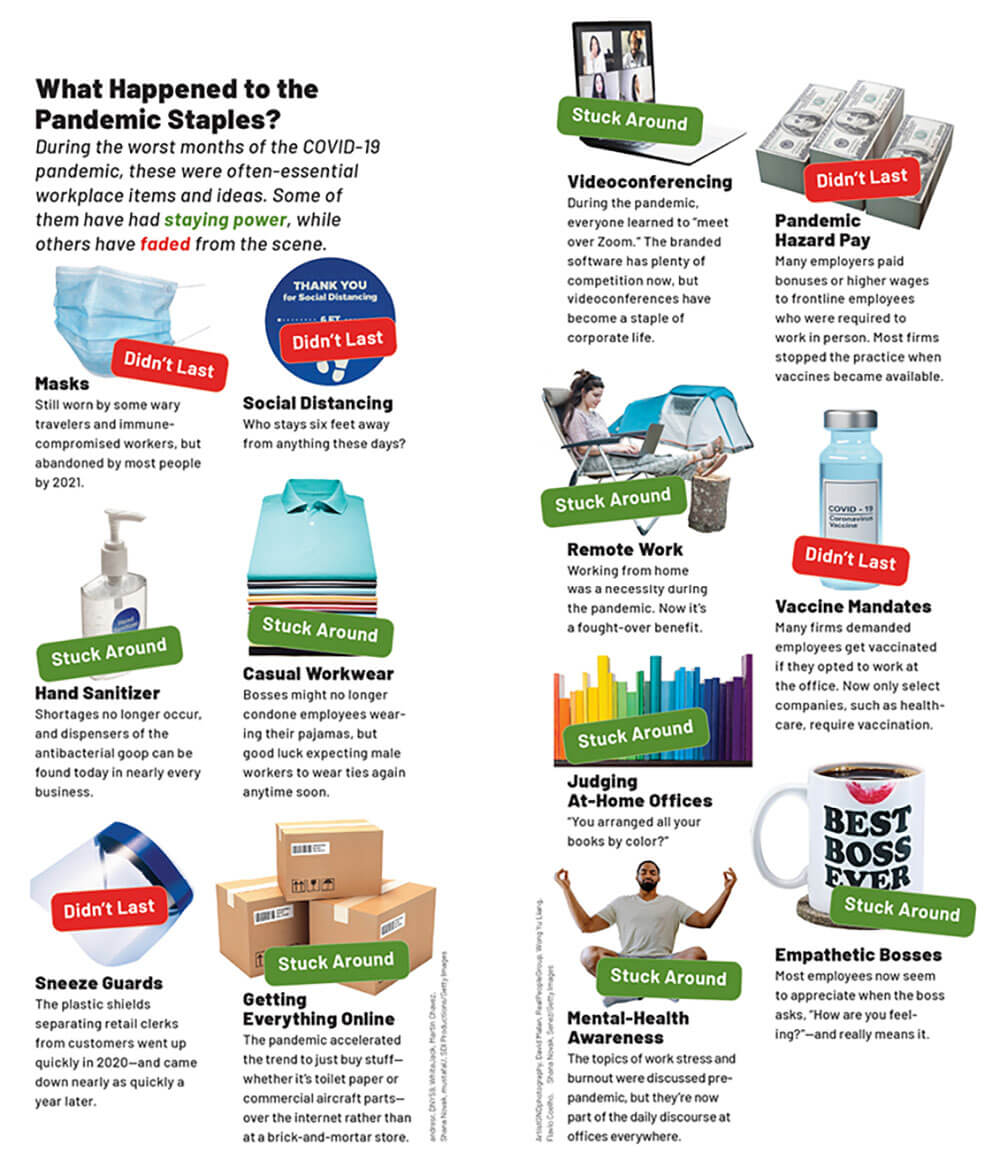
But despite that split in time, the pandemic’s changes have had some staying power—and they continue to evolve. Some are well-known, from the great return-to-office debate to the importance of leadership agility to changes in buying habits (online sales now account for about 15 percent of retail sales, up from 10 percent before COVID). More subtly, economists are noticing that we’re spending far more on services, like travel and entertainment, than we are on durable goods, like cars and appliances. More women have entered the workforce than ever before. Plus, the pandemic spurred a surge in entrepreneurship, with applications for new businesses now soaring to over 400,000 monthly, as well as a potential push for more no-touch, autonomous technology. “The pandemic caused an overnight shift that might have otherwise taken years to happen,” says Serguei Netessine, senior vice dean for innovation and global initiatives at the University of Pennsylvania’s Wharton School of Business.
But dramatic change can cause collateral damage, such as debt jumps for both governments and companies worldwide. Leaders and employees are still fighting over how much work should be done at the office, and workplace culture is in shambles. What’s more, the pandemic forced firms to focus exclusively on the short term, which may explain why revenue growth in subsequent years has shrunk sharply.


Changes for Leaders
At the beginning of the crisis, when many believed COVID-19 was an existential threat, leaders across organizations and countries engaged in what management experts call “directive leadership”—the top-down, old-school approach in which the boss, without seeking to build consensus, makes all the big decisions. Indeed, the more COVID-19 deaths a country experienced, the stronger its increase was in the top-down leadership style, according to a study of leaders in 48 countries across 32 sectors conducted by professors at the University of Groningen in the Netherlands. It made sense, experts say: Employees needed clear direction on how to stay safe, and leaders needed to act fast.
“With leadership styles, more is now better.”
That style has gradually morphed into several variations. According to the Groningen study, leaders who had adopted the directive style became far more willing, as the pandemic stretched on, to solicit ideas from colleagues, make decisions through consensus, and even let their teams make more decisions for themselves. These leaders also became more cognizant of how their teams’ general mood was impacting performance.
Fast-forward to today, and some leaders feel top-down may be right for certain moments, while collaborative is better for others. “With leadership styles, more is better,” says Sarah Hezlett, a vice president of assessment science for North America at theKorn Ferry Institute.
Elika Dadsetan-Foley has experienced this transformation since assuming the role of executive director of the consulting firm Visions in March of 2020. At the outset, she found herself ordering teams out of her office and setting up new policies to keep work going. “I was telling them, ‘I need you all to trust me, even though you don’t know me,’” she says. But within a few weeks, Dadsetan-Foley began having deep conversations with her team about how they were feeling. Today, she knows that different leadership styles fit different periods. “It’s a balance between being present and getting stuff done,” she says.
Ultimately, the biggest legacy of COVID-19 for leaders may have less to do with managing employees and more to do with managing themselves. Indeed, experts say, being the boss in the post-pandemic era has become harder than ever. A record number of CEOs departed in 2024—more than 2,200 in the US alone—breaking a record set in the previous year. Many leaders feel cornered by a host of growing pressures, from an unprecedented volume of activist campaigns focused on short-term results to an employee base that feels empowered to criticize their bosses openly. Experts say that bosses should get used to the fact that it’s never going to get easier.
Changes for Employees
It might be hard to remember, but back in 2019, even employees who could work remotely came into the office every day. At the time, fewer than one-third reported following a structured hybrid schedule. Today, nearly 65 percent of employees say they have some form of hybrid schedule in which they work at least a half day per week outside the office.
The amount of leverage employees have has been on a roller coaster.
Employees’ leverage has been on a roller coaster over the past five years. During the Great Resignation era, empowered employees could play one potential employer off another for massive pay packages, but much of that leverage has dissipated as the job market has softened. What has been a constant since the pandemic, however, is a desire for flexibility, experts say. When Korn Ferry surveyed workers around the world in 2024, they said that the number-one benefit a new employer could offer them wasn’t generous compensation, but flexible working hours. Indeed, flexibility today is a selling point even for otherwise undesirable jobs: Sixty percent of workers said they would stay in a job they hated if they had flexible working hours. “Flexibility and hybrid structures have now become standard features of modern businesses,” says Brian Lim, CEO of clothing retailer iHeartRaves.
To be sure, there are plenty of leaders who feel that a hybrid or full-time remote-work setup hurts productivity or damages the career trajectories of workers, particularly younger ones. But in numerous organizations, it’s leaders who have made the adjustment. Bladen, the Kadence CEO, hopes—but doesn’t require—that his colleagues work out of their respective offices only once a week. In return, he expects that everyone will make themselves available to connect on every workday, no matter where they are based, during the 2.5-hour overlap of mornings in the US and mid-afternoons in Europe. “We are not waiting for asynchronous communication,” he says.
Another lasting change, experts say, is the kind of clarity employees want from their bosses. In January 2020, shortly before the lockdowns began, 56 percent of workers felt they knew what was expected of them at work, according to a poll by Gallup. By the end of last year, that figure had declined to 45 percent. If the boss makes a decision, employees want to know why. If they see that the decision is based on data or sound thinking, they’ll go along with it—even embrace it—whether they agree with it or not.


Changes for Work
“Practice social distancing.”
Remember that phrase? Signs were everywhere in 2020 urging employees to stay six feet apart to slow the spread of COVID-19. The signs are gone, as are many rules requiring masks to be worn or employees to be vaccinated. But what has lingered is a sense at many organizations of needing to keep tabs on employees’ health, both physical and mental. It’s not uncommon to find hand-sanitizer stations in every workplace now, and employers have spent millions redoing air-filter systems to improve air quality. There’s also been a massive increase in mental-health awareness within organizations. In one 2024 survey, 88 percent of firms said they were prioritizing the well-being of their workers and executives.
Firms want a better sense of what could happen; there’s a new commitment to scenario planning.
As he was coming up in the business, admits David Naylor, CEO of Rayburn Electric Cooperative, his attitude was just to plow through whatever was in front of him. But today, as the boss, he sees that struggling employees—whether physically ailing or stressed-out—often can’t do their best work. Indeed, many leaders are hoping that if their employees feel healthier, they’ll be less likely to be absent and more likely to be engaged in their work. The new building Rayburn is constructing this year will include a fitness room indoors and walking paths outdoors. He’s encouraging his colleagues to consider walking to meetings. “We don’t want to be chained to a desk,” he says.
That attitude of preparedness extends beyond the issue of health. Companies today are far more likely to diversify vendors and suppliers, a step that may prove crucial in the tariff era. Factories and warehouses are a little more crowded these days, because firms are more willing to hold surplus components, parts, and even finished goods. Carrying excess inventory increases costs, but many leaders in the post-pandemic period think these costs will be far lower than those associated with being caught short of critical supplies.
Firms also want a better sense of what could happen. There’s a new commitment to scenario planning. Naylor actually had a pandemic playbook before 2020, but he suspected that it was created as little more than a check-the-box exercise. When the lockdowns happened, the firm took the actions they needed to keep the electricity flowing; only then did they look at the plan—and it “made no sense,” Naylor says. After the pandemic, he and his colleagues revised it, and revisited a host of other contingency scenarios. “The biggest change,” he says, “is that we’re far more deliberate with them.”
Image credits: Iryna Veklich, Iuliia Bessonova/Getty Images; Senez/Getty Images; Iuliia Bessonova/Getty Images; andresr, DNY59, WhiteJack, Martin Chavez, Shana Novak, mustafaU, SDI Productions/Getty Images ArtistGNDphotography, David Malan, RealPeopleGroup, Wong Yu Liang, Flavio Coelho, Shana Novak, Senez/Getty Images
