
The 3:30 AM Club
Fifteen percent of the population does their best work in the wee hours. Can the corporate world find a way to adjust to their schedule?


July 31, 2025
One time, Liviu Tanase tried to work from 9 AM to 5 PM. “I even tried waking up at 8 AM,” he says, despite being a night owl since childhood. As the CEO of ZeroBounce, an email-verification company, he was surrounded by early-rising entrepreneurs—who was he to do it differently?
THE PROBLEM The professional world is scheduled around the daytime, but certain workers perform best late at night.
WHY IT MATTERS Some of these people are wildly talented and can help the firm succeed.
THE SOLUTION Leaders need to create serial schedules to adjust workers' peak hours.
After all, 8 AM is practically midday by the standards of avowed early risers like Howard Schultz, Richard Branson, Indra Nooyi, and Bill Gates. Tanase’s experiment failed spectacularly. “I was tired and hungry and moody all day. It was killing my productivity.” At night, he repeatedly stayed up too late, leaving him hugging the pillow and hitting snooze at 8 AM. He abandoned the effort, and reverted to the schedule he keeps today: dinner, then family time, and a return to work around 11 PM.
Tanase is among the roughly 15 percent of workers whose circadian rhythms, known as chronotypes, lead them to do their best work in the wee hours. Some are extreme early risers, sometimes called “larks,” who naturally wake up at 3 AM or even earlier, while others are still awake from the previous evening, not hitting the hay until 4 AM or 5 AM. These larks and owls speak rapturously about the calm of night, when there are no ringing phones or crying kids or pressing errands and they are able to do their best work. “At night everyone’s in bed and I can come alive,” says London Wolfe, a business alignment strategist.
Yet despite constituting more than one in 10 workers, it’s a lifestyle at odds with corporate norms. It flies in the face of the best practices spouted by everyone from executives to doctors: Take good care of yourself by going to bed in the later evening. Don’t ever send emails at 3 AM, or coworkers will think you’re unhinged. “Leaders prefer morning workers, and society has a general bias toward morning people,” says Cristiano Guarana, professor at Indiana University’s Kelley School of Business, who studies sleep in organizations.
“Society has a general bias toward morning people.”
Like early birds, night owls typically go through a phase of enduring the corporate world’s schedule, only to find their health and spirits broken. Following a lot of late night “what am I doing with my life?” anxiety, owls eventually break free and accept their true selves. Staying up late becomes an identity. “The reality is, it’s exactly who I am,” says Tanase. And so it’s wildly crushing when corporate managers announce that the job starts at 9 AM. As they face all that, not to mention colleagues offended by late-night or predawn emails, you can hear their cries: Is there a better way to manage employees who sleep to the beat of their own drum?


Blame Our Tribal Times
You could say that Tanase is a night owl because tens of thousands of years ago, someone in the tribe had to stay awake to scare away the lions on the savannah. Humans would not be as successful a species if all people conked out after sundown. Instead, some people protected the clan at night, while others were up hunting before the heat; they kept an eye on the young children overnight as well. Before the widespread use of fire, hunter-gatherers likely slept based not on the time of day, but on their surroundings: If the environment was safe, they could sleep. Without any source of artificial light, they probably slept mostly at night when safe, but also napped during the day. “They were flexible with sleep,” says Kevin Koronowski, who runs a circadian-clock-research lab at the University of Texas Health Science Center at San Antonio.
The adoption of fire shifted those patterns, allowing hunter-gatherers to stay up a bit later—but also creating the permanent need for someone to remain awake to keep the fire going. Then came agriculture. Farming schedules require people to do the same tasks at predictable times of day, leading to regimented sleeping patterns—which can be pleasant for extreme larks, and a nightmare for owls. Some respite arrived with the spread of indoor light, whether from candles or light bulbs, which returned populations to the wildly varying sleep schedules of yore. “With artificial light came infinite possibilities,” says Koronowski.
Sleep Success
Experts say some key habits can boost rest and productivity on every sleep schedule.

Eat Strategically
“Eating patterns positively reinforce your circadian rhythm,” says Koronowski. The key is to eat breakfast, lunch, and dinner over a 12-or-so-hour period, and not eat within three hours of bedtime.

Keep the Same Routine
Stay on your schedule, even if it’s weird. “What’s important is regularity,” says Guarana. By waking and going to sleep at roughly the same time, you can limit negative impacts on health and work performance.

Don't Do Important Work Last
Cognitive abilities mildly decline through waking hours, and really plummet toward sleep time. “You might be error prone when it’s late,” says Koronowski. Instead, do busywork last.

Wear Blue-Light Glasses
Pop them on two hours before bedtime to filter out the blue light that prevents the body from releasing the sleep hormone melatonin. “This is even more important for owls—it helps them fall asleep faster,” says Guarana.

Educate Coworkers About Core Hours
The best time for collaboration is early afternoon. “That’s when everyone is both most alert and most awake,” says Guarana. Coworkers often don’t know this, and will set meetings for, say, 9 AM or 4 PM.
These days, humans’ waking and sleeping patterns fall on a spectrum, with approximately 85 percent of the population landing in the middle of the spectrum: wake up sometime between 5 AM and 8:30 AM, and go to sleep sometime between 10 PM and 12:30 AM. Some extreme larks and owls have mutations to the genes that drive circadian rhythm, known as clock genes. Two groups of these genes, known as the PER and CRY families, shift what time the pineal gland releases melatonin, a hormone that primes the body for sleep: Larks have an earlier melatonin release, and owls a later release.
In the morning, early birds often have a more robust spike of cortisol, a hormone associated with wakefulness. “It’s less pronounced in night owls,” says Koronowski. Critically, most employees’ peak work hours typically appear roughly three hours after waking—though some night owls say theirs come later. Most corporate firms fumble these peak performance hours with commutes or mandatory meetings, which waste top performance hours and torture night owls.

Rearranging Schedules
Not surprisingly, many extreme larks and owls gravitate to roles that accommodate their off-hours habits. Asia Solnyshkina, CEO of software-development firm ProSense, has tailored her all-night hours to work closely with European clients just after her family goes to sleep in Mexico City. She then moves on to Saudi Arabia, and when morning breaks, she meets with local clients. “I’m doing negotiations, Zoom calls, pitching, everything,” she says. She sleeps from 8 PM to 2 AM, and works from 2 AM to noon, a schedule that also allows her to spend time with her young children during the day, and be present for both their bedtimes and wakeups.
“There’s a mind after midnight, and it can do some things really well.”
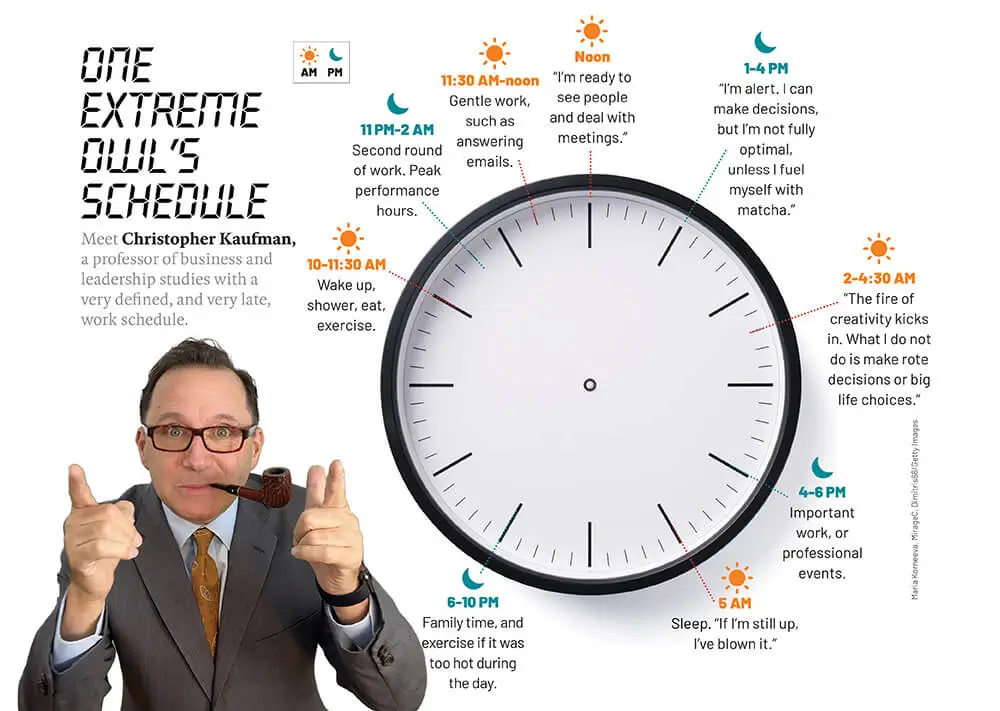
For many, shifting work hours is just the tip of the iceberg. The real challenge is knowing how to harness off-hours habits for high-quality output. “It’s a neurochemical-vampire tightrope,” says Christopher Kaufman, professor of business and leadership studies at Westcliff University. “There’s a mind after midnight, and it can do some things really well, and not others.” At 11 PM, he can be found in business attire, at a standing desk, with three glowing screens in a state he calls night-owl mode. He does his best work until 2 AM, and then enjoys a creativity boost, as the rationality of the prefrontal cortex fades and ideas emerge freely. “That means more creative and more intense flow states,” he says. But by 4 AM he’s flagging, meaning that those ideas can’t be immediately harnessed into anything due the next morning. Rather, he returns to the ideas at midday, in a different state of mind. It took him years of trying to draft and edit between 4 AM and 5 AM to learn that producing and turning in assignments the same morning doesn’t work. “That’s the problem with night owls: We’re seen by peers as sloppy,” he says.
Extreme larks and owls readily admit to two other major downsides of wee-hours work. First, with fewer people around, fewer resources are available. This is best illustrated by hospitals, where doctors commonly struggle to get tests like MRIs and ultrasounds done during the night. “It’s just easier to get things done in-house during the day, and that’s probably a true statement for everywhere,” says Larry Edelman, a physician at University of Maryland Upper Chesapeake Health, who has happily worked the overnight shift in the emergency room for 14 years. During the day, lots of extra hands are available, such as physician executives who can come down to help. “At night you might be calling someone for 30 minutes before they answer the phone.”
Edelman is quick to note that this cuts both ways. The environment is more relaxed at night, largely because staffers are calmer. “There’s a lot more anxiety during the day,” he says. “People are worried because the boss is around. At night, the nurses are a lot cooler.”
The second downside is not enough sleep. The extreme owls interviewed for this story said they sleep five to six hours per night, which is two to three hours short of typical adult-sleep needs. Guarana, the professor who studies sleep in organizations, co-led a research project looking at the sleep deprivation of leaders, and found that although tired leaders believe their relationships with their teams are fine, the workers classified their relationships with their sleep-deprived leaders as not good. “It’s similar to asking a drunk person whether they’re drunk. Sleep-deprived people engage in self-deception,” says Guarana. “Regardless of your chronotype, sleep should be nonnegotiable.”


3 AM Leadership
Tanase’s own experience has informed his leadership style. He focuses on employee output, and doesn’t care what time his employees start their days. Unlike many firms, his avoids “core hours,” the required times when everyone is available, and instead allows teams to hold mandatory meetings as needed.
Experts say that awareness is half the game when managing early birds and owls. Studies show that neurodivergent people are much more likely to be night owls, particularly those with ADHD. For these populations, working at 3 AM is not about just circadian rhythms, but also the ability to curate one’s own environment. “During the day, you can’t always find the quiet pockets you need. It’s overstimulation,” says Wolfe, the business alignment strategist, who finds it much easier to hyperfocus when she’s chosen the music and lighting, and isn’t distracted by nearby construction.
Just as important as understanding chronotypes is not taking advantage of them. “Keep in mind that some started their day at 3 AM,” says Guarana. In practice, leaders often give both larks and owls more work, such as handing off a project when leaving the office to an employee working late hours. He suggests acknowledging that everyone has a set amount of time and cognitive resources for work.
In the end, experts say savvy leaders can balance varying chronotypes into successful serial work. It looks like this: The night owl pecks away at night, and hands over the reins to the lark, who hands them off to the daytime worker. But this only works when employees don’t feel compelled to answer calls and emails during their sleep hours. Guarana says that sleep modeling is perhaps the most critical modeling a leader can do. “Protect your followers’ sleep time.”
Image credits: Thex / 500px/Getty Images; Tetra Images/Getty Images; Maria Korneeva, MirageC, Dimitris66/Getty Images; Jordan Lye/Getty Images; Yotin Kamnont, Photoplotnikov, -VICTOR-, Dimitris66, BojanMirkovic/Getty Images
