
Is Virtual Grass Greener?
Indoor golf simulators are changing the game—and executives.


November 24, 2025
Chrysonthia Horne had renounced golf. The 32-year-old’s dad taught her to swing when she was younger, but living in New York City and working a demanding job at an investment firm meant she didn’t get to play very often. After one particularly disastrous session at the driving range, she swore off the game entirely. “I’d step up to the ball and my brain would get scrambled,” she says. “It turned every experience into such a slog.”
Then indoor golf simulators, known as sims, started to pop up in the city, and she’d go hang out with her husband as he hit balls. One day, at minute 45 of an hourlong session, she casually picked up a club. Boom. “Golf sim unlocked my swing,” says Horne, who has since returned to hitting the links outdoors as well.
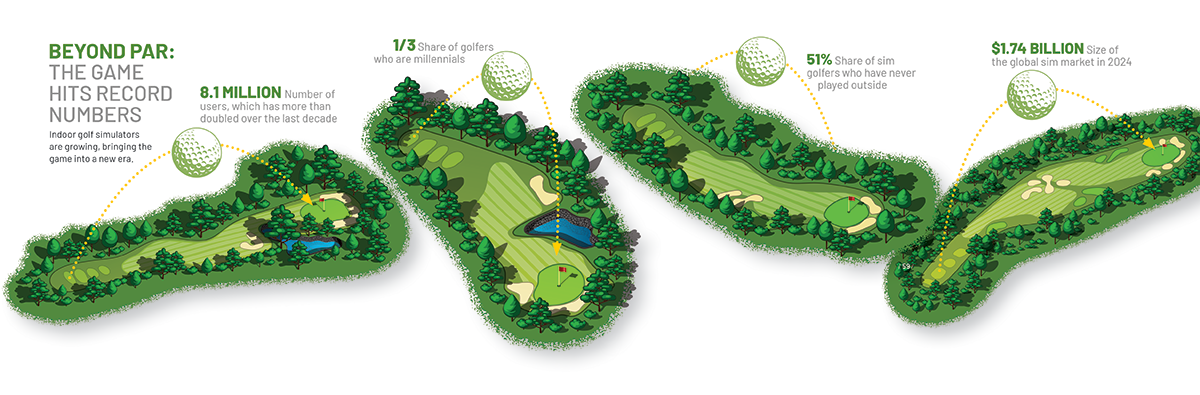
Traditionally known as a sport only available to those with access to wide-open spaces and lots of free time, screen golf is rapidly bringing the game into a new era. Sim users grew from 3.8 million in 2015 to 8.1 million last year, with more than half never having played on a course. One third of today’s golfers are millennials. The green is a primary way executives network, and, in this way, golf sim is leveling the playing field and attracting players who otherwise might not have joined the foursome.
"Indoor sim, even more than outdoor golf, strips the game of any influence beyond the mind.
Today’s golf-simulator setups are more technical than those of entertainment venues like TopGolf, but often still have a social atmosphere. Users book a bay and hit real balls at a large impact screen, which is able to register the trajectory of the ball with increasing precision. Meanwhile, cameras capture every angle of the swing for review. Users can play the world’s top courses or fun challenges. The spots are packed after work hours, with dedicated golfers practicing their swings, colleagues blowing off steam, and leaders looking for insight into how they’re executing.
The golf great Arnold Palmer famously remarked that "golf is a game of inches. The most important are the six inches between your ears." Indoor sim, even more than outdoor golf, strips the game of any influence beyond the mind. Paul Miles, founder of leadership-development program In The Swing Leadership, helps executives work out their kinks in the C-suite through swinging the club. Miles lives in the United Kingdom where, during the long winters, he relies on sims. There is no wind or rain to affect his swing, so in just a few minutes he can gain clarity on his inner weather report. If he’s forcing life, he comes through his swing too soon, creating slice. If he’s holding back and not committing to tough decisions, he tops the ball. “Once I understand what I’m doing, I can get to a place of neutral and inner calm very quickly,” Miles says, comparing hitting balls to a form of hypnotherapy. He then carries that calm into work, and coaches his clients in doing the same.
Miles says Horne’s fears are universal. Everyone is worried about looking bad on the first tee, he says. When competition and fear are taken out of the equation, it changes the dynamic. People open up. And all of a sudden the game becomes a means of connection, insight, and calibration. “The practice gives you immediate feedback around failure,” Horne says. “You’re able to diagnose what happened, then let that failure go as you set up to hit the next ball, and when it clicks it’s so beautiful.
Photo credits: Pete/Adobe Stock; Courtesy of Chrysonthia, Carly Bedwell; Peter Hoey
