Full Report: TA Trends 2026
Human-AI Power Couple
Human-AI partnership will rewire the talent landscape—but it's not the only shift. Discover six talent acquisition trends you can't afford to miss.


The talent acquisition (TA) space looks nothing like it did even a couple of years ago.
AI is the big story—84% of talent leaders plan to use it next year—but that’s just one piece of the 2026 TA puzzle.
The other challenges facing TA leaders are just as important. Leadership pipelines are fragile, skills priorities need realigning, and workplace policies are creating friction.
It's a lot to navigate. And while everyone's focused on which AI tools to buy, the more interesting question is how to make all these pieces fit together.
Take AI agents, for example. Companies are rushing to add them to teams, but most leaders have no idea how to manage mixed human-AI workforces. How could they? It’s uncharted territory.
TA Trends 2026
And consider skills. CEOs are hard focused on AI tech expertise, but talent leaders know critical thinking is what’s needed to deliver successful change.
TA sits at the center of all these shifts. And talent leaders who see the bigger picture are becoming indispensable to their organizations.
What follows are the six TA trends driving talent acquisition in 2026.
“We need to embrace AI but not lose sight of the bigger picture. Talent acquisition is about people—and human intelligence will always be the differentiator.”
Jeanne MacDonald, Korn Ferry’s CEO of Recruitment Process Outsourcing (RPO)


Trend 1: Your Next Hire Might Not Be Human
The dawn of hybrid people + agentic AI teams
“This isn't some distant future scenario. The infrastructure for human-AI teams is being built right now.”
Bryan Ackermann, Korn Ferry's Head of AI Strategy and Transformation
In 2026, you'll be sourcing talent that never sleeps, never takes vacation—but will sometimes frustratingly refuse to work properly. (Tech bugs and glitches are still a thing.)
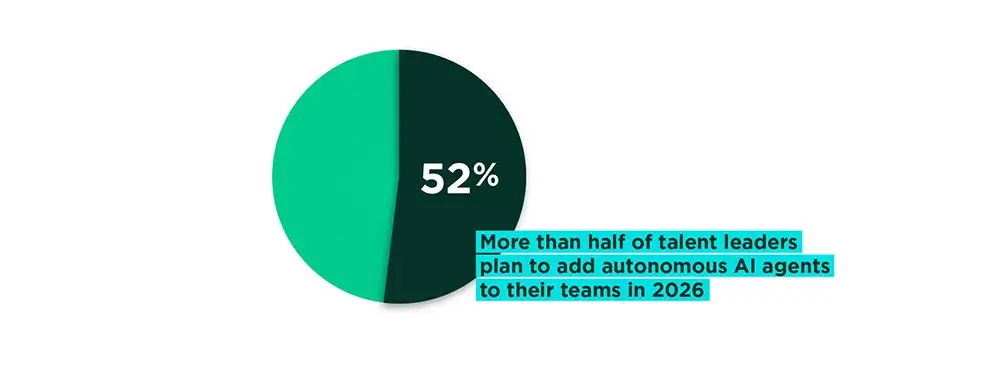
Unlike the AI tools we’re all familiar with, these “AI agents” act pretty much autonomously, performing tasks and functions without the need for constant prompts. And 52% of talent leaders are planning to add them to their teams in 2026.
AI agents are evolving beyond being helpful assistants.
They're becoming real teammates with their own identities, access permissions, and responsibilities.
Teams of the future will soon include both humans and AI agents working side by side.
“This isn't some distant future scenario,” says Korn Ferry’s Bryan Ackermann. “HR vendors are already creating employee records for AI agents. Microsoft is issuing them security IDs. The infrastructure for human-AI teams is being built right now.”
What This Means for Talent Leaders
Your job just got much more complicated.
Hiring isn’t just about humans with heartbeats anymore. You also need to match AI agents to work, onboard them, and track their performance alongside people.
Yes, it’s about benchmarking cost and capability—$100K human employee vs. $20,000 AI agent—but the real challenge isn’t technical. It’s cultural.
How do you help managers lead mixed teams? How do you redesign workflows where humans and AI work side by side? Those are the questions talent leaders need to answer in 2026.
Your Action Plan
- Start experimenting now:
“Put the tools in the hands of the users. Just do it,” advises David Ellis, Senior VP of Talent Transformation at Korn Ferry.
Don't wait for perfect AI agents. Give your people AI tools with agentic abilities today and let them experiment, within the governance frameworks you’ve provided. They'll surprise you with what they come up with.
- Train managers for mixed teams:
Your future leaders need to learn how to manage both people and AI agents working together.
How do they coordinate tasks between humans and machines? When do they override AI decisions? How do they handle conflicts between team members?
It's a completely new management skill set, which is why developing AI-ready leaders has become critical.
- Redesign workflows with handoffs in mind
Map out where humans add irreplaceable value versus where AI agents can take over. Focus on moments when work passes from human to agent—that's where things break down.
- Know when to bring in the human touch
As MacDonald notes, bringing in AI agents doesn't mean abandoning human connection in talent acquisition. Candidates still want to feel heard and valued by a human throughout the recruitment process.


Trend 2: Think First, ChatGPT Later
Most people can learn AI in less than a month. Developing critical thinking? That takes years.
“Critical thinking skills are vital to work with AI successfully. I can't see somebody being great at AI without having exceptional critical thinking skills.”
Scott Erker, Korn Ferry’s Senior Client Partner and Skills Expert
CEOs and board directors are laser-focused on AI. They’re demanding AI skills, AI certifications, AI proficiency, AI everything.
Conversely, 73% of TA leaders say the skill they actually need the most in 2026 is...critical thinking and problem-solving. What about AI skills? That ranks fifth.
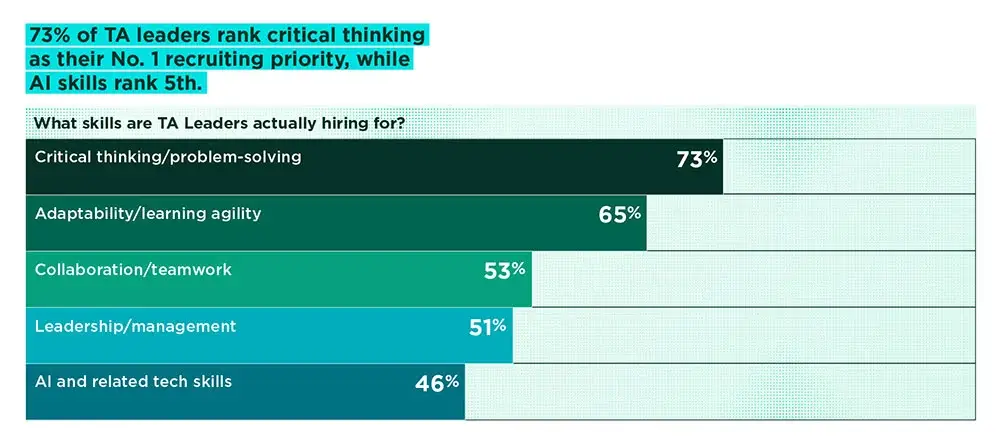
So who's right? Both, actually.
TA leaders bring a different perspective. Being closer to the ground, they understand that to deploy AI effectively, you need the ability to think critically about what it produces and how best to deliver it.
“Critical thinking skills are vital to work with AI successfully,” explains Korn Ferry’s Scott Erker. “I can't see somebody being great at AI without having exceptional critical thinking skills. You need critical thinking to understand what's a hallucination versus real data.”
What This Means for Talent Leaders
Everyone seems desperate to hire whoever knows the latest AI tech.
But the smart money is on hiring the talent who know how to assess AI’s output, spot its flaws, and know when to trust the results and when to override them.
These are the people who'll adapt to whatever AI tool comes next, not just the one they learned last month. They’ll use their unbeatable human brains to figure out the best way to use AI to solve your real business problems and fast-track growth.
Your Action Plan
- Assess for critical thinking skills, not just AI fluency
Use assessments to evaluate how candidates think, not just what they know. Ask candidates to walk through complex problems. How do they break down ambiguous situations? How do they validate information from multiple sources?
- Look for adaptability and a learning mindset
The AI tools your company uses today won't be the same ones you use next year. Hire people who can adapt to new systems and processes quickly, but who are also motivated to keep learning and developing new skills as the landscape evolves.
- Make critical thinking your competitive edge
While your competitors hire for today's technology, you're building teams that can think their way through whatever comes next.


Trend 3: Entry Level Cuts Today = Pipeline Crisis Tomorrow
Your board loves the cost savings today. They'll hate the leadership crisis it brings on its tail.
It's the easiest sell in the boardroom.
Replace entry-level roles with AI, cut payroll by millions, boost efficiency overnight.
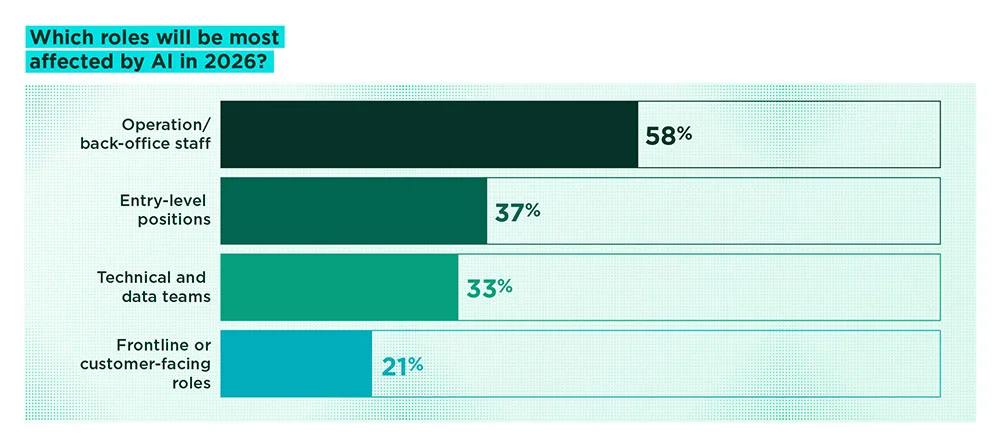
Those entry-level and operation/back-office roles you’re eliminating? That’s where your future managers and leaders come from.
The beginner analyst who spends two years learning your business becomes a junior manager. The coordinator who understands every process becomes your team leader. The mid-level manager who develops strategies while developing people steps up to VP.
Cut those roles, and your big win today is a big problem tomorrow.
“It would be a mistake to stop hiring young, entry-level people. These are the fastest adopters of new technology.”
David Ellis, Korn Ferry
What This Means for Talent Leaders
The savings look great on your 2026–2027 budget.
But what happens in 2029 when you need a new team lead, and your most experienced employee is a bot?
Entry-level and back-office positions aren't just about getting routine work done. They're where people learn your culture, understand your processes, and develop the institutional knowledge that makes them valuable leaders later.
Without them, you'll be hiring leaders from the outside who have to learn the organization from scratch.
There's another angle to consider. You're cutting entry-level roles because of AI, but these might be exactly the people who can help you use AI better.
“It would be a mistake to stop hiring young, entry-level people,” argues Ellis. “These are the fastest adopters of new technology. If you don't have these people, but your competitors do, then your rivals are going to be faster, more agile, and more ready to take on new opportunities.”
Your Action Plan
- Redesign roles, don't eliminate them
Instead of cutting entry-level roles entirely, reimagine them. Let AI handle the routine tasks while humans focus on exercising judgment, relationship-building, and strategic thinking.
- Accelerate development pathways
Career paths aren't always vertical anymore. Identify transferable skills and create new routes to leadership that don't rely on traditional ladder-climbing.
- Invest in early-career talent
Entry-level employees are cheaper, more adaptable, and better at adopting new technology. They might be exactly what you need in an AI-driven world.
- Partner with universities to prepare graduates
Rather than eliminating early-career roles, work with universities to update curriculums. Equipping graduates with the right skills builds a stronger talent pipeline and preserves entry-level opportunities.
- Plan succession with AI in mind
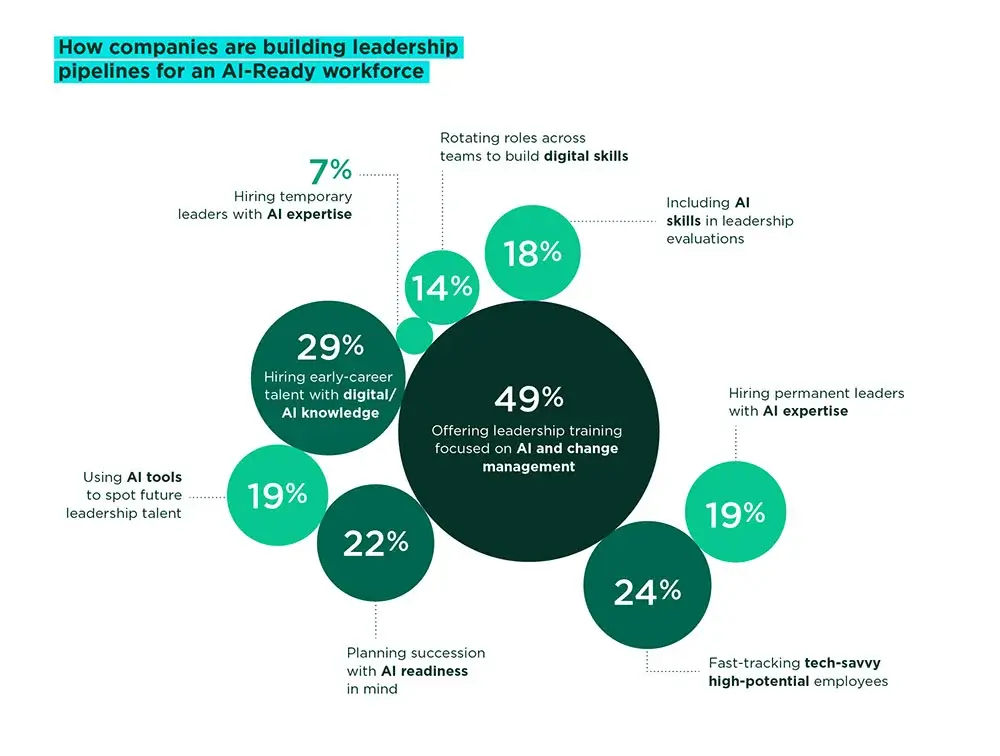
Only 22% of companies are planning leadership succession with AI readiness in mind. Identify high-potential talent and fast-track their development.


Trend 4: Buying Without Getting Buy-In
Turns out, splashing cash on AI technology was the easy part.
CEOs and boards are pouring billions into AI. The ROI is unclear, the timeline ambitious, but they're spending fast because the alternative—being left behind—feels worse.
While leadership is uncertain about financial returns, TA leaders are just as skeptical about their C-suite’s readiness to lead through this dramatic change.
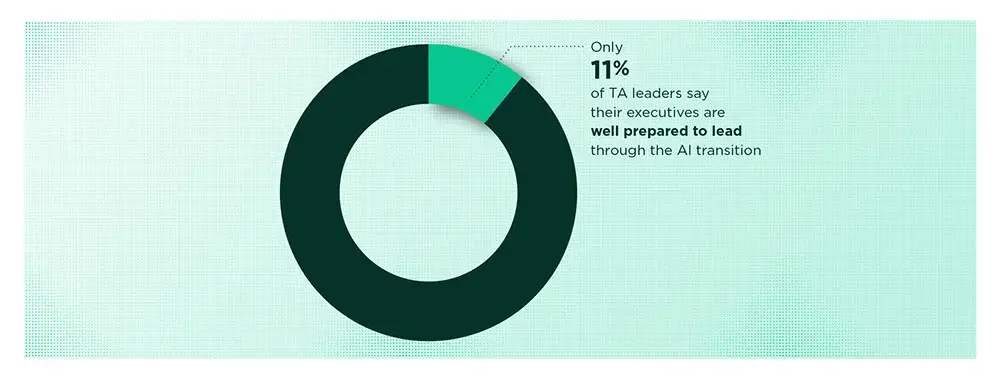
The technology is here. The tools are deployed. But your people? They’re confused.
It turns out that 2026 demands a new approach—an AI-ready leader.
Organizations need someone who can lead through this dramatic shift. They need leaders who can strategize the best approach, develop a road map, and bring their people with them on the journey.
The tech might have appeared only yesterday, but leading through change isn’t a capability you develop overnight.
Only 22% of respondents to our TA Trends survey believe their leaders can effectively manage teams that combine humans and AI agents. Yet that's exactly what many organizations need to succeed in 2026.
It's not just about technical literacy. The bigger challenge is communicating authentically about changes that even leaders don't fully understand.
“Remember what we went through in 2020? During the early days of Covid, great leaders went to their employees and asked them very simple, but important, questions,” says Ackermann.
“They asked, are you okay? Are you safe? Are you healthy? It was a level of transparent authenticity we hadn't seen in a while. And then we lost it again.”
Today with AI, that authentic communication has disappeared. Instead of honest conversations about uncertainty and change, employees are left to piece together their company's AI strategy.
“We’ve seen that a large percentage of people don't understand their company's stance on AI,” Ackermann adds. "That information is mostly hidden in an AI security policy on page 62, paragraph 4b—and they know very little until the CEO announces layoffs.”
What This Means for Talent Leaders
TA leaders are caught in a difficult position. Your executives are betting billions on AI transformation, but they’re not ready to lead people through it.
Meanwhile, you're expected to implement AI strategies with teams that don't understand what their company actually thinks about AI.
Without clear direction from the top, every AI initiative becomes a struggle.
- Employees resist changes they don't understand.
- Managers can't support tools they've never been trained on.
- Projects stall because nobody knows what success looks like.
The key is understanding how to bridge the gap between C-suite’s AI ambitions and the leadership skills needed to make them work.
Your Action Plan
- Advocate for leadership development
Push your executives to invest in AI-ready leadership training focused on change management and communication, not just technical skills.
- Partner with L&D on leader readiness
Work with Learning & Development to identify and develop leaders who can actually manage human-AI teams before you need them.
- Document the leadership impact
Track how leadership gaps affect your AI initiatives. When projects fail due to poor leadership support, make sure executives understand the real cost.
- Bridge the communication gap
Proactively explain your company's AI stance to hiring managers and candidates when organizational messaging isn't clear enough.


Trend 5: It's Time TA Got a Bigger Seat at the Table
TA has moved beyond operational—and deserves real strategic power.
The good news—most talent leaders now have more influence with the company’s leadership.
The bad news? While it’s true that 83% say they have some pull with the C-suite, 59% still feel shut out of the strategic business decisions.
TA is stuck in this weird middle ground. They’re more influential than before, but still treated like the people who just fill jobs.
Surprisingly, AI might help make the difference.
In the C-suite and boardroom, the spotlight is on AI. This is an area that TA has already been leading in, adopting it earlier than almost any other part of HR. And now, the pace is snowballing.
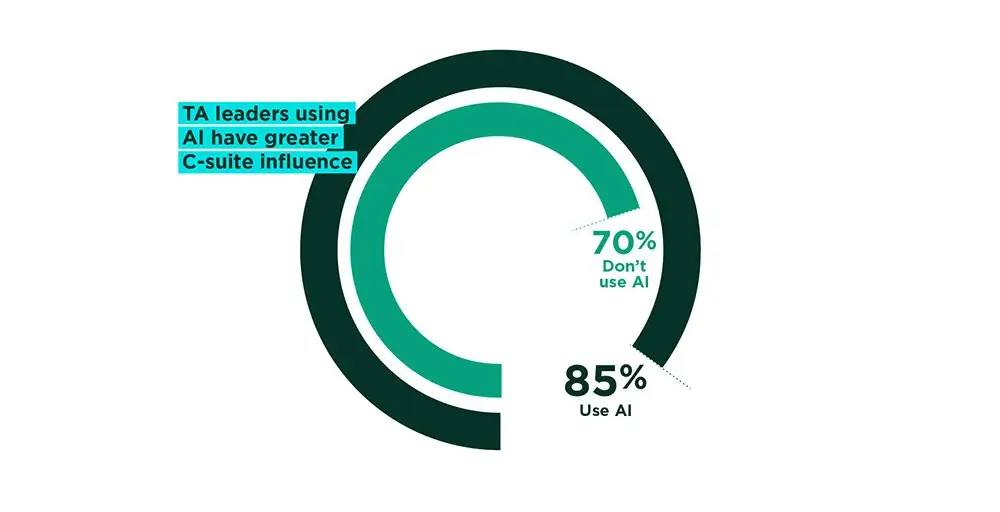
Here’s what’s interesting. TA leaders using AI are more likely to have C-suite influence (85%) than those who aren't (70%).
It makes sense when you think about it. As organizations bet billions on AI transformation, they need advisors who actually understand what works for their people and what doesn't—and that's exactly what TA leaders will become.
TA's AI experience and ability to successfully blend AI and human might be the bridge from influence to strategic input they've been looking for.
What This Means for Talent Leaders
You're not just the recruitment function anymore—you're becoming the strategic advisor on workforce transformation.
"The opportunity that TA's AI leadership has created is for the TA leader to be to the CHRO what the CHRO is to the CEO—a strategic advisor, a leader of transformation," says Ellis. "TA is the gateway for new talent entering the organization. You hold those keys, and your boss needs to advise the CEO on workforce transformation."
The traditional TA career path—moving up through recruiting operations—won't prepare you for what's coming. Future TA leaders will need critical thinking, strategy development, collaboration, and influencing skills more than technical recruiting expertise.
This AI experience you've built positions you perfectly for that transition, if you're ready to make it.
Your Action Plan
- Be the AI advisor your business needs
Use your hands-on experience to guide broader AI strategy discussions. When executives need practical insights about what works, you have the data they need.
- Develop strategic skills beyond recruiting
Focus on strategy development, collaboration, and influencing capabilities. The technical recruiting expertise that got you here won't be enough for what's coming.
- Make the business case with clear ROI
Show how your AI initiatives drive business outcomes like faster time-to-hire and competitive hiring advantage. “TA leaders need to be ready to articulate and demonstrate the benefit they're bringing, not just to HR, but to the business," advises MacDonald.
- Build your advisory relationship with the CHRO
Position yourself as their go-to resource for workforce transformation insights, the same way CHROs advise CEOs on talent strategy.


Trend 6: Office Mandates = Major TA Headache
Your best candidates want to choose where to work. Your policy demands office attendance. Guess who wins? Your flexible competitors.
The battle lines are drawn. Companies are pushing people back to the office—20% now require full-time attendance.
But workers are pushing back. Nearly three-quarters of employees want a hybrid or remote work option, according to Korn Ferry’s Workforce 2025 survey. And many won’t budge.
The disconnect is massive, leaving TA leaders stuck between a rock and a hard place.
Those recruiting for companies who insist on full-time in-office are struggling to find the right hires. The flipside? Companies offering fully remote get their pick of the crop.
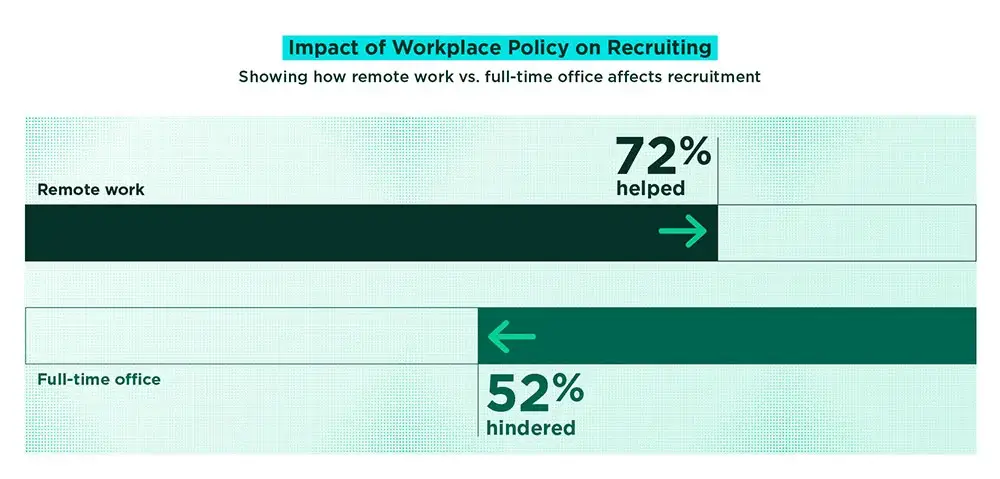
Companies demanding full in-office attendance are essentially choosing to shrink their options. Maybe the lure of working for a major brand name or the offer of a more enticing rewards package can tip the scales. But for the most part, the best people are going where the flexibility is.
“If your employee value proposition (EVP) is strong enough, if you're the biggest name brand company, for example, then you might be able to impose your workplace demands,” says Ellis. “But for most organizations, you need to match your office policies with what the talent you want expects.”
What This Means for Talent Leaders
You're caught between company policy and candidate expectations. When leadership insists on full-time office work, you're the one who has to explain to great candidates why they can't have the flexibility they’re seeking.
If your EVP isn't strong enough to overcome the office requirement, you'll end up paying premium salaries to attract people who would otherwise work elsewhere, or accepting candidates who are less desirable, but more willing to sit at a downtown desk.
Your Action Plan
- Segment roles by necessity and talent experience
Work with leadership to identify which positions truly require office presence versus those that could be hybrid or remote. Not every role needs the same workplace policy.
- Make the business case for flexibility
Track and present the real costs of office mandates—longer time-to-hire, higher salary requirements, losing great candidates to competitors. Show leadership exactly what flexibility restrictions are costing the organization.
- Strengthen other EVP elements
If office requirements are non-negotiable, ensure other aspects of your EVP—compensation, benefits, growth opportunities—are compelling enough to offset the flexibility disadvantage.


Next Steps for TA Leaders
TA leaders have never been more needed or better positioned for strategic influence.
You've been quietly implementing AI while your executives were still getting to grips with it. You know which skills actually matter. You see workforce challenges before they hit the boardroom.
Stop waiting for someone to invite you to strategic conversations. Start them yourself.
Show leadership what's really happening with talent. Make the case for policies that actually work. Use your experience to guide decisions that shape organizational success.
This moment won't last forever. The TA leaders who seize these recruitment trends will succeed where rivals fail.
Watch Our TA Trends 2026 Webinar
Find out how getting ahead of these trends can give you the edge with talent and business in 2026.