What’s Your Team’s Emotional Intelligence?
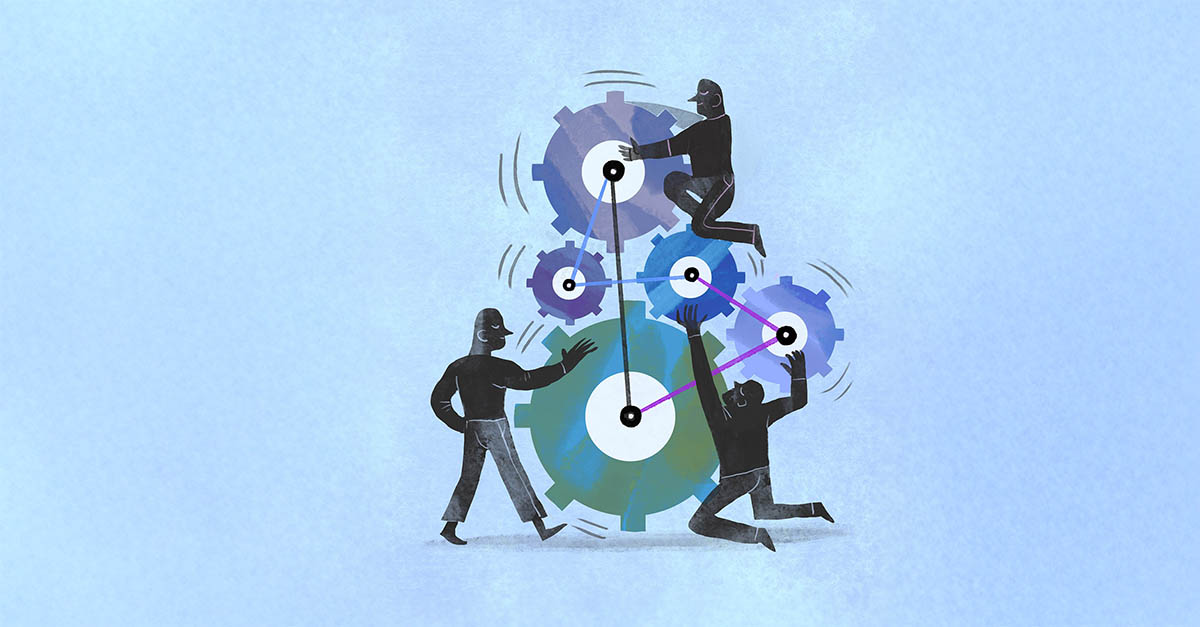
Best-selling author Dan Goleman says that even a group of self-aware, organizationally attuned colleagues can make a poor team.
Daniel Goleman is author of the international best-seller Emotional Intelligence and Optimal: How to Sustain Personal and Organizational Excellence Every Day. He is a regular contributor to Korn Ferry.
Let’s start with the obvious: the ability to collaborate is crucial to team performance. In today’s high-stakes, high-change, distributed environments, this couldn’t be more true. However, a team’s intellectual and technical intelligence are only as good as a group’s ability to put them to use. Team performance will depend on how teams listen; respond; manage their collective and individual emotions; and set and adhere to shared norms.
This insight is at the heart of Team Emotional Intelligence, or TeamEI, a framework developed by Vanessa Druskat, professor at the University of New Hampshire. In her new book, The Emotionally Intelligent Team, Druskat draws on three decades of research to reveal the behavioral norms that enable teams to be both emotionally attuned and strategically effective. The broad conclusion: emotionally intelligent teams are better at collaborating, and therefore better at performing.
This doesn’t mean just collecting a group of emotionally intelligent people and putting them together in service of a shared goal. In fact, you can have a team full of self-aware, empathic, and organizationally attuned individuals and still have poor team dynamics. This is because TeamEI is less about individual personalities than it is about shared habits: how people treat one another, how they communicate, and how they manage tension and feedback. These behaviors—what Druskat calls "norms"—make up the informal rules that govern a team's culture. TeamEI transcends any given member’s competence.
Think of it like an espresso machine: the grinder, the beans, the water, the milk – these all need to be high quality. But unless the machine is operating with clean tubes, good valves, the right pressure and a proper amount of steam, you’ll never get a top-of-line beverage.
In Druskat’s model, there are nine TeamEI norms in total, all observable and measurable. They span everything from how psychological safety is maintained to how team members hold each other accountable. One powerful norm is what Druskat calls “Address Unacceptable Behavior” – a skill that sounds simple but actually requires a good amount of courage, clarity, and emotional agility. This norm is about how teams create explicit agreements around what behaviors undermine their collective work. For example, how do teams address interrupting, arriving late, dominating airtime, or checking phones during meetings? Do they let it slide and erode collaboration? Do they have a way of routinely calling these behaviors out?
Without these kinds of explicit norms, dysfunction tends to go unspoken and unaddressed. In a hybrid work world, that silence can be deadly. Some teams even make the calling out process playful. At one company, interrupting warrants a toss of a stuffed animal across the table – an easy and effective way to recalibrate the team around their shared commitments.
To assess TeamEI, Druskat has developed a research-based diagnostic that helps teams assess themselves across the nine core norms. This tool helps the team spot areas of misalignment, surface hidden tensions, and clarify what’s working and what needs to improve. This process doesn’t necessarily require an outside consultant. Instead, it depends on the willingness of team members to take an honest look at their own dynamics and take ownership for change. Interventions are tailored and suggested for each team’s unique profile. Then, ideally, everyone participates in making them real.
Collaboration isn’t a personality trait, but a discipline. It takes intention, reflection, and a shared commitment to showing up with clear and open communication.
This discipline is critical right now. Research shows that emotionally intelligent teams are not only more cohesive, but more productive, more innovative, and more resilient. They’re better equipped to handle change, less prone to burnout and show greater adaptability during organizational transitions.
For organizations this means two things. One, you first need to get the right people in the room. Two, you then need to help them develop the structures and norms to actually work well together.
Co-written by Elizabeth Solomon
Click here to learn more about Daniel Goleman's Building Blocks of Emotional Intelligence.