What Are Skills?

Defining skills is not as easy as it sounds. Learn what they are, how they’re developed & why companies must consider the whole person to maximize skill impact.
Key takeaways
- Why skills for work are much more than someone’s technical abilities
- Why two people may have identical skills on paper, but perform very differently
- The pros and cons of using ‘skills-tech’ to quantify organizational skills
How would you reply if someone asked, “What makes you great at your job?”
You might talk about your ability to communicate clearly and empathize with others. Perhaps you’d point to your adaptability and critical thinking—no matter the circumstances, you can find a solution. Maybe you’d mention how collaboration comes as second nature and you love bringing people together. Or maybe you’re a whiz at coding, an exceptional writer, or the best on your team at crunching numbers.
The consistent thread in these responses is the emphasis on skills.
Why are skills top of mind for everyone? From generative AI to automation, the rapid pace of change has altered the skill sets required for jobs by 25% since 2015. And this rate is expected to double by 2027. In addition, 40% of leaders say their employees’ core skills will change in the next five years. Now, more than ever, there’s a rush to ‘future-proof’ organizations by finding and developing talent with the right skills for work. But for organizations to succeed at skills-based hiring, a clear understanding of what skills are and how they are developed is essential.
What are skills?
The term "skills" covers a lot of ground, but at its core, it combines technical abilities, behavioral competencies and personal identity.
Skills are learned or developed over the course of a person’s career through the roles they hold, challenges they face, success and achievements, mistakes made, and lessons learned. Some skills may be acquired through education, on-the-job training, formal mentoring, new experiences and changing roles. Others are more innate aspects of a person’s self, closely tied to their behavior and identity.
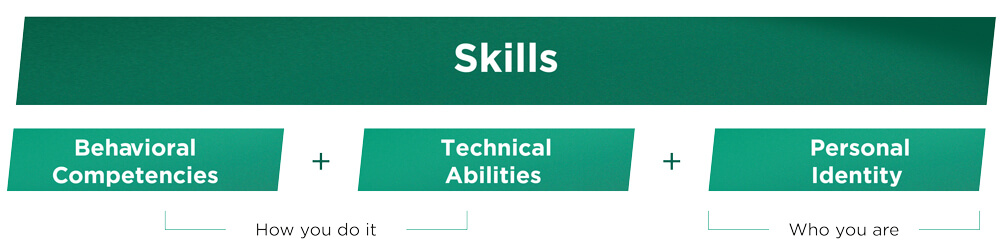
Technical abilities, behavioral competencies and personal identity: what’s the difference?
- Technical abilities, also known as technical or hard skills, is the knowledge used to do practical and applied tasks. These skills tend to involve tools, technology, practices and methods. Technical skills can be trained.
- Behavioral competencies are the observable skills and behaviors required for success. These are sometimes referred to as “soft skills.” Compared with technical abilities, they are more difficult to quantify and develop, but they are just as critical.
- Personal identity is who you are and why you do what you do. It is what drives and motivates you, what personal characteristics you have, and the attitude with which you live your values. This impacts what energizes you. Thus, it’s not just what someone’s skills are, it’s how they use their skills and in what context. Someone’s personal identity is the most difficult to change since this is more the essence of who you are. Therefore the development is in acknowledging, being aware and creating the best context to make the best fit.

“Someone may see themselves as a hard worker or an underachiever, a ‘cog in the machine’ or an enterprise leader, a team player or a lone wolf,” says Karin Visser, Vice President, Org, Work & Reward IP Development, Korn Ferry Institute. “Personal identity impacts how technical abilities and behavioral competencies are brought forth. It’s not just what my skills are, it’s how I use my skills and what energizes me or makes me tick.”
People can enhance skills for work performance through consistent practice, on-the-job training, or continuing education. Our research finds that behavioral competencies and especially personal identity are more ingrained and harder to develop than technical abilities, but they are also more important factors for future success.
Examples of technical abilities and behavioral competencies

Developing skills in the workplace: 4 key benefits
- Better agility and adaptability: Organizations focused on skills are 57% more likely to anticipate and effectively respond to changes.
- Talent retention and attraction: Skills-based organizations are 107% more likely to place talent effectively and 98% more likely to retain high performers.
- Innovation and problem-solving: Collaboration among people with diverse skill sets offers fresh perspectives, unique thinking, and more inventive solutions.
- Future-proofing: Organizations with a comprehensive understanding of their teams’ current skills and competencies are better able to identify and close skill gaps.
Capabilities: A combination of skills and experiences
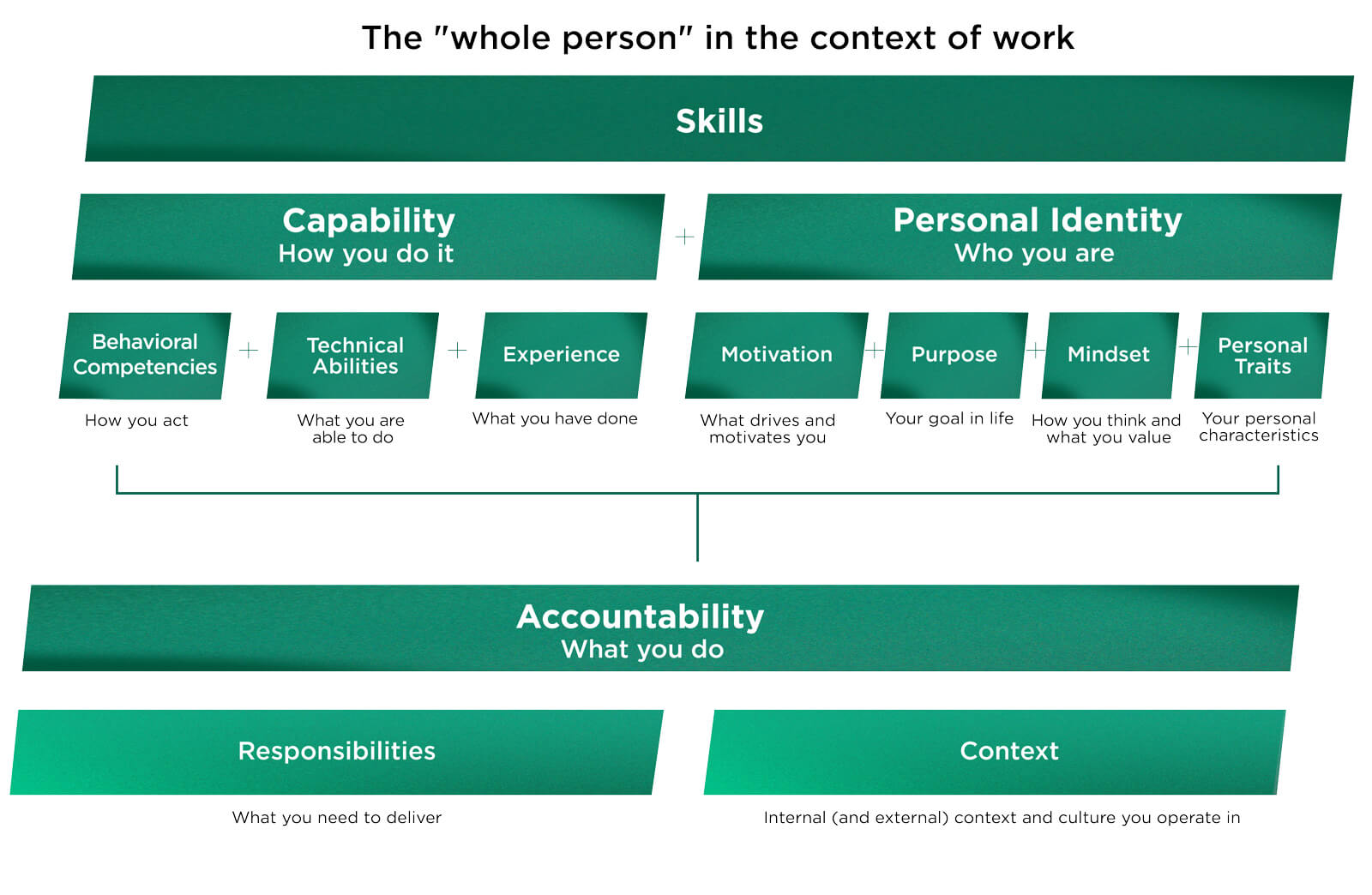
A person’s capabilities are all their technical abilities, behavioral competencies, personal identity and experiences combined—a collection of their talents and how they can use them.
Since skills are ever evolving, keeping a hub or database of capabilities in the organization helps identify where people excel and where there’s room to grow. Individual teams and employees can do this, too, which is beneficial during reviews and one-on-one meetings. If someone doesn’t have the capability to accomplish something right now, that doesn’t mean they won’t ever be able to. They may simply need to hone a technical ability or add experience in a new area. The key is to look at the whole person to assess their potential, rather than the presence or lack of a specific skill.

Skills and the whole person
Skills do not exist in isolation. They mix with identity and mindset when they’re applied in the context of the work that we do. A whole-person assessment recognizes that organizational culture and structure impact how skills come to life. On paper, two people may have identical technical skills, but one individual could be a much better fit and have greater growth potential at your company.
Consider the task of risk assessment for an organization. Two people could have the same technical ability and be equally adept at using the same technology and methods to build risk models. But they could have a very different mindset towards risk, depending on their personal identity.
“Someone who is risk averse is naturally more cautious, versus someone who might be more open to experimentation and risk taking, illustrating the importance of looking at the whole person versus an individual technical ability,” says Serena Jones, Senior Client Partner.
Jones has worked with organizations that fall across the risk continuum, ranging from risk-averse to high risk tolerance. The right fit between the organization and the whole person (technical abilities, behavioral competencies, and personal identity) positively impacts engagement and performance. In this case, an individual who is more cautious will be a much better fit in a risk-averse culture while someone open to experimentation is more likely to thrive in an organization with a higher risk tolerance.
The rise of “skills-tech” to assess and identify skills gaps
Recognizing skills as an essential driver for business success is not a new idea. What is new are the technological advancements (skills-tech) that make it easier for organizations to document and evaluate current skills, identify skill gaps, and take steps to close these gaps. But these tech platforms can also give a false sense of security.
“Cataloging hundreds or even thousands of skills feels impressive, but the number doesn’t tell us if these are the right skills to achieve business goals,” says Tracy Bosch, Senior Client Partner. “Most organizations don’t know if their people have these skills or if they have the experience to apply them in context. Organizations that are serious about transforming for growth look at their internal skill counts in the context of the future work that needs to be done. They’re combining skills analysis with business strategy to predict and prepare for the future.”
Whether work is bundled into jobs, roles, projects, or gigs, think about skills for work as an enabler and a catalyst, versus an endgame. This mindset can help avoid the pitfall of focusing on skill quantity over quality, and instead focus on individual potential and organizational fit.
Becoming a skills-based organization: the next step
A skills-based organization recognizes that people have a wide range of unique skills, capabilities and personal identity that combine to be successful in a variety of roles or jobs, building through a combination of responsibilities. In doing so, people can help foster an environment of diversity, equity and inclusion by opening opportunities for employment, development and promotion based on skills rather than solely relying on education or experience. These organizations are striving to be more agile by evolving their thinking about work—from static jobs to dynamic work where skills are learned and applied in a more fluid way.
A skills-based organization recognizes that people have a wide range of skills that can be utilized to be successful in various roles. They consider the individual as a whole person and how their capabilities fit with the work that needs to be done today and tomorrow within their organization.
Having the right people with the right technical abilities is important, but it’s just one part of a comprehensive approach to building a skills-based organization. Organizations that truly want to transform for growth know the best ways to assess and unleash a person’s potential.
Take the next step: change your organization’s skills mindset and transform how you work.
