A Talent Development Framework for Tech’s Future

Six critical steps to creating a tech talent roadmap that helps your business and people grow.
Key takeaways
- Why traditional training models are failing fast in tech
- The six-step strategy for building a future-ready tech workforce
- How development frameworks impact innovation and retention
Tackling Tech Workforce Skills Gaps
Technology companies are facing an urgent question: Do we have the right people with the right skills to deliver what’s next?
As AI reshapes roles and product cycles accelerate, companies are struggling to keep capabilities current. Traditional training can’t keep up, and static development models often leave high-potential talent behind.
People with up-to-date skills are what differentiate successful tech companies from those that stumble. That’s why organizations need more than just training programs. They need a future-ready, AI-powered talent development strategy built around how engineers, designers, and product teams actually work, learn, and grow.
Here's a six-step talent development framework for the tech industry.
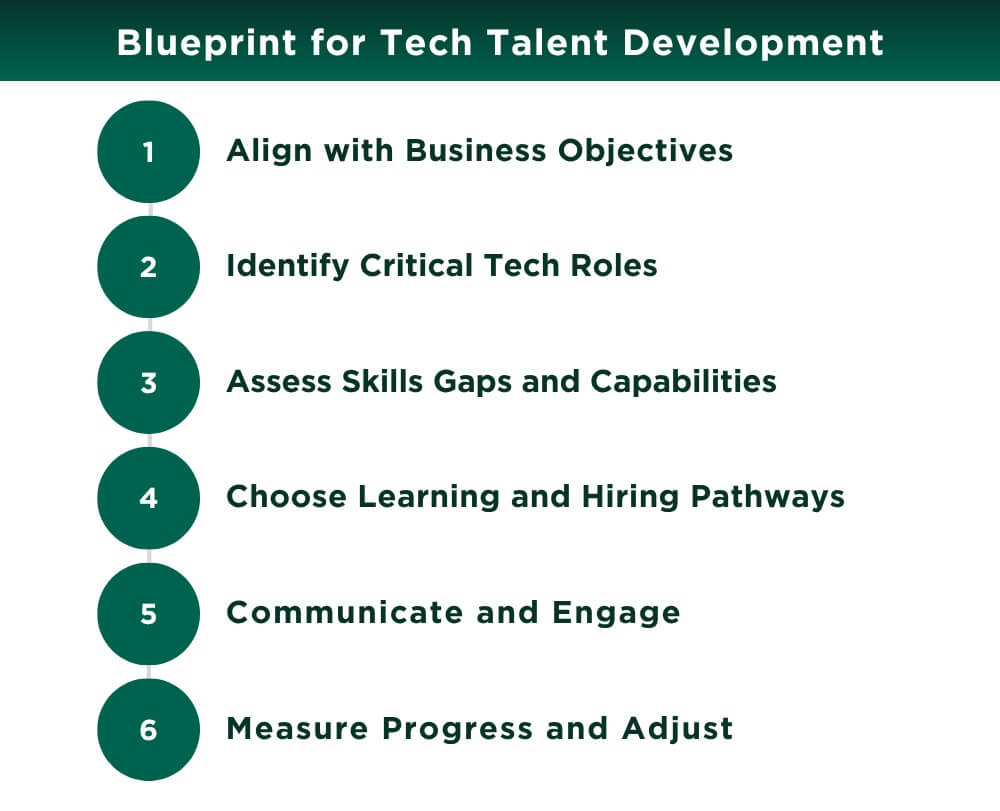
Step 1: Align with Business Objectives
Before you dive into courses or hiring plans, pause and ask, “What are we trying to achieve as a tech organization?”
“Understanding the business goals and how the people strategy embeds into that will inform the talent strategy,” says Jerry Collier of Korn Ferry. “We always start with the business strategy first.”
Talent strategy must connect directly to the engineering and product roadmap. Whether you’re aiming to reduce latency by 20%, launch an AI-powered feature, or scale from 100 to 1 million users, your people plans need to align with those deliverables.
For example, a company scaling its cloud platform might need more talent in site reliability engineering. A startup developing edge AI products will prioritize expertise in ML Ops and embedded systems. The strategy only works when it mirrors real business goals, not generic capability models.
Step 2: Identify Critical Tech Roles
Not every role has the same impact on innovation. The key is to zero in on those that improve how quickly a product goes from concept to market and enhances customer outcomes.
These roles might include:
- Platform engineers building scalable backend infrastructure
- AI and machine-learning leads adding intelligence into products
- Site reliability engineers maintaining uptime and performance
- Product designers ensuring usability meets utility
These are the people building the systems and experiences that give your tech company its edge. When you create intentional development pathways tailored to how engineers and product teams actually work, you build a culture they want to be part of.
Investing in the growth of people in these critical roles helps your organization stay competitive, keep up with the pace of change, and attract and retain talent.
Step 3: Assess Skill Gaps and Capabilities
You can’t improve what you don’t understand. “You must have some form of discovery to baseline the talent you have in the organization,” says Collier. “This will allow you to prioritize your development action.”
It starts with assessing your current talent landscape in terms of real capabilities. Go deeper than job descriptions or course completions—look at how people actually work and solve problems.
Use a combination of:
- Technical skills audits
- Self-assessments
- Manager feedback and code reviews
This data gives you a realistic picture of where your workforce is now and what your organization will need to thrive next.
Step 4: Choose Learning and Hiring Pathways
Now comes the decision point. Should you build or buy talent? In tech, the answer is often both.
Upskilling from within nurtures culture and keeps institutional knowledge in play. Hiring externally brings fresh perspectives and capabilities you may not be able to develop fast enough.
Internal learning opportunities might include:
- Bootcamps focused on building needed technical skills
- Hackathons to solve live engineering challenges
- Peer learning, mentoring, and pair-programming sessions
- AI-powered learning platforms that personalize content to each engineer’s path
But upskilling isn’t always fast enough, especially when the business is pushing into new frontiers. In areas like LLM fine-tuning or real-time infrastructure scaling, the depth of knowledge required and speed at which things are moving may demand external hiring to quickly plug capability gaps.
Smart organizations plan for both. They build what they can, buy when they must, and create blended talent strategies where people grow, teams stretch, and culture keeps evolving.
Step 5: Communicate and Engage
The best frameworks fall flat without buy-in, and in tech, engineers especially need to see the “why” behind their learning pathways. Be transparent. Involve teams early. Invite feedback.
“You need to convey that their development matters to you and that you believe in the benefits of this growth path for them,” says Collier. “Your teams will also want to know that they’ll be supported.”
Communication is also critical during hiring and team growth. When companies are opening new teams or bringing in specialized talent, existing employees need clarity: What’s changing? Why now? How will this impact their roles and future?
Here’s what meaningful engagement looks like in action:
- Engineering town halls that connect learning and team development initiatives to product milestones.
- Open demos that showcase internal tools or skill-building programs.
- Leadership visibility, such as CTOs and VPs sharing their own growth stories or explaining the strategic rationale of hiring.
- Onboarding transparency, where new hires are introduced with purpose.
Learning and scaling shouldn’t feel like an HR project. It should feel like a shared mission to grow together.
Step 6: Measure Progress and Adjust
Just as agile teams sprint, test, and iterate, your talent framework should do the same.
Progress means moving the needle on real business and people outcomes. “Is your talent development action working, and how might you improve it?” asks Collier. “Are you seeing the business results you were hoping for? Are your people responding favorably to the learning and development?”
Meaningful metrics might include:
- Deployment frequency and incident resolution rates
- Retention of high-potential engineers
- Completion of technical certifications (cloud, security, AI)
- Internal mobility and peer recognition
- Pulse surveys measuring learning culture and career growth
The key is to close the loop. Learn what’s working. Change what’s not. Repeat.

Leadership & Professional Assessments
Assess the talent you have to find the talent you need
Building a Tech-Ready Talent Engine
Tech leaders know code is only part of the equation. People power progress.
This blueprint is your starting point. It’s a way to match skills with strategy and learning with outcomes. It's time to build better teams and a resilient, future-ready culture.
Ready to activate this framework in your tech organization? Contact Korn Ferry’s technology experts. Let’s engineer your people strategy for tomorrow’s innovation.
