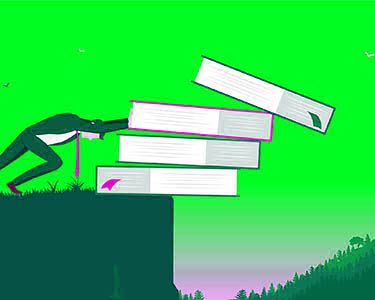
When Burnout Wears a Smile

Many employees might be silently breaking down while grinding away. Why “quiet cracking” can hurt workers and firms alike.
The employee dragged himself to work on Monday morning, feeling drained despite a three-day weekend. He’d been feeling burned-out for months. He didn’t like his job, but in this market, he knew that staying put was the best move. So he greeted his boss in the only way he knew—with a smile.
Pretending to be fine despite significant exhaustion or inner turmoil may be becoming a norm in the office: 45% of US employees say they’re “emotionally drained” from their work, and 51% say they feel “used up” at day’s end, according to data from the Society for Human Resource Management. And it’s a risk to firms. “It’s costly,” says Marnix Boorsma, senior client partner in the CFO and Global Energy practices at Korn Ferry, adding that workers in this state are unlikely to be very productive or innovative. “Quiet cracking blunts creativity, erodes connection and slowly depletes collective energy,” he says.
To be sure, overworked employees who pretend to be fine have been a longstanding issue, but in this economy—where people are incentivized to keep their heads down and slog through to maintain employment—it’s becoming an enormous challenge. “People are afraid of looking weak when so many firms are reshuffling,” says Moses Zonana, senior client partner in the Technology practice at Korn Ferry. The term “quiet cracking” was coined this past summer, after data emerged suggesting that 20% of employees are consistently “unraveling behind their computer screens,” with a third admitting to doing so recently. Much like its cousin, quiet quitting, the term has been shaped by particular job-market dynamics: namely, low hiring prospects that are leading employees to stay in jobs that are poor fits.
Surprisingly, those most prone to quiet cracking tend to have the best coping and multitasking skills. “It’s usually some of your best people,” says JP Sniffen, practice leader in Korn Ferry’s Military Center of Expertise. “They don’t want to disappoint, and never ask for help.” These workers trudge on, displaying what some management and psychoanalytic pros have dubbed “neurotic resilience”: the ability to push through pain—to simply take on more assignments—without acknowledging it.
Ideally, quiet crackers would be able to admit to bosses that they’re feeling overwhelmed. Barring that, organizations could offer a space staffed with coaches or counselors in which people would feel safe to admit that they’re stretched thin. But in an increasingly competitive world, “that’s just not very easy,” says Boorsma.
Experts agree that some employees who are quietly cracking will successfully hide their inner turmoil. For this reason, maintaining one-on-ones during the busy upcoming holiday months is essential, as is using these conversations as an opportunity to deeply listen to subordinates. “When it’s too much, you can hear it in someone’s voice,” says Cheryl D’Cruz-Young, senior client partner in the Sustainability and Global Energy practice at Korn Ferry. For example, an employee might accept a new assignment with a flutter in their voice. A good manager might ask about priorities and help the employee spread out their work assignments. “Then you start to problem-solve,” says D’Cruz-Young.
Learn more about Korn Ferry’s Total Rewards capabilities.